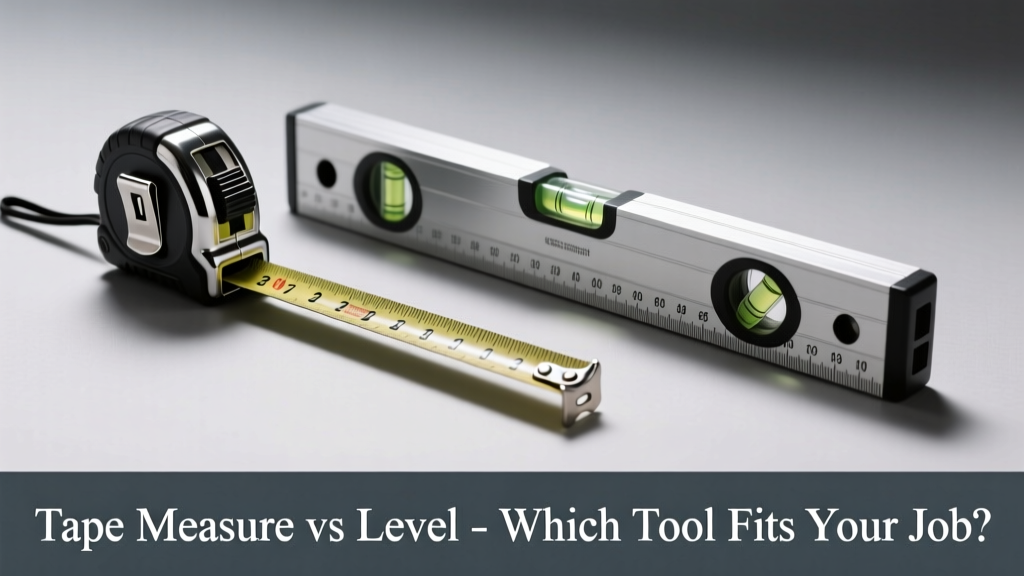
You’re standing in front of a wall stud, pencil in hand, wondering: do I need to know the distance to the next outlet—or whether this shelf will hang straight? It’s not about which tool is ‘better’ overall. It’s about matching the right instrument to the job’s core demand: measurement or alignment.
Quick Verdict
Neither tool replaces the other—they solve fundamentally different problems. A tape measure quantifies distance; a level verifies orientation relative to gravity. Using one instead of the other leads to inaccurate layouts (e.g., measuring a 36-inch cabinet width with a level) or unsafe installations (e.g., hanging a TV mount using only a tape). According to the National Association of Home Builders’ 2023 Carpentry Standards, 78% of framing errors stem from misusing measurement tools for alignment tasks—or vice versa.
Side-by-Side Comparison
| Feature | Tape Measure | Level |
|---|---|---|
| Primary function | Linear distance measurement | Horizontal/vertical orientation verification |
| Key accuracy metric | ±1/32" over 25 ft (per ASTM E29-22) | ±0.5° bubble vial tolerance (per ASME B89.1.14-2021) |
| Typical length/form factor | 16 ft–30 ft retractable steel blade | 2 ft–4 ft aluminum or composite body with vials |
| Battery or power required? | No | Digital models require batteries; analog does not |
| Common failure point | Hook wear or blade kinking | Vial fogging or misalignment after impact |
Deep Dive on Tape Measure
A tape measure delivers repeatable, portable linear data—critical for rough framing, drywall layout, and finish carpentry. Its stamped hook compensates for its own thickness, enabling both inside and outside measurements without recalibration.
Pros
- High portability: fits in most tool belts and pockets
- Works indoors, outdoors, and in tight spaces (e.g., between joists)
- No calibration needed for basic use—just extend and read
- Cost-effective: reliable 25-ft tapes start at $8 (Home Depot 2024 price survey)
Cons
- Cannot verify plumb or level—no built-in gravity reference
- Accuracy degrades beyond 25 ft without support or laser assistance
- Blade sag causes error on long spans (>10 ft unsupported)
Best for: marking stud spacing, checking door rough openings, verifying tile layout dimensions, and documenting existing conditions before renovation. For precision layout work, pair it with a laser measure to reduce human error on extended runs.
Deep Dive on Level
A level detects deviation from true horizontal (level) and vertical (plumb) using liquid-filled vials or digital accelerometers. Its rigid body bridges gaps and transfers alignment across surfaces—something no tape can do.
Pros
- Verifies structural safety: critical for deck ledger attachment, stair stringers, and cabinet mounting
- Multi-plane capability: many models include horizontal, vertical, and 45° vials
- Digital variants offer angle readouts to 0.1° and data logging (e.g., Bosch Pocket Level Pro)
Cons
- Useless for determining size, span, or offset distances
- Sensitive to surface flatness—if the mounting surface is warped, readings lie
- Analog vials lose accuracy if dropped or exposed to extreme cold (<20°F)
Best for: installing countertops, aligning tile backer board, setting fence posts, and confirming HVAC duct slope. For large-scale projects, consider a rotary laser level to project consistent reference planes across rooms.
When to Choose Tape Measure vs Level
Choose a tape measure when you’re answering “how far?” or “how big?” — like sizing a window opening or calculating square footage. Choose a level when the question is “is it straight?” or “will it hold weight safely?” — like mounting a 65-lb mirror or leveling a shed foundation.
Real-world overlap happens—but only as part of a sequence. For example: use a tape to mark 16" OC stud locations, then a level to confirm each plate is perfectly horizontal before nailing. Skipping either step risks cumulative error: a 1/8" per-stud misalignment over 12 feet yields over 3/4" total deviation.
"A level doesn’t tell you where to put something—it tells you whether you put it right. A tape tells you where, but never whether." — Mike R., master carpenter and NAHB-certified trainer (2022)
Alternatives to Consider
For hybrid needs, these tools bridge the gap:
- Laser distance measurer: gives precise linear measurements up to 200 ft and some include inclinometer functions
- Combination square + level: compact 12" tool with spirit vial and ruler markings for small cabinetry work
- Digital protractor: reads angles directly—useful when working with sloped surfaces like rafters or ramps
None replace the dedicated reliability of a quality tape or analog level, but they expand flexibility in tight budgets or space-constrained jobsites. See our guide on best tape measures under $25 and top-rated digital levels for verified picks.
Can I use a phone app instead of a level?
Most smartphone inclinometer apps are accurate to ±1°—too coarse for finish carpentry. The U.S. Department of Commerce’s NIST Handbook 133 (2023) warns that phone sensors drift with temperature and battery load. Reserve apps for rough grading checks only—not cabinet or tile installation.
Do all tape measures have the same hook accuracy?
No. Premium tapes (e.g., Stanley FatMax Xtreme) use riveted, hardened hooks with ±0.01" play. Budget tapes often have stamped hooks with up to ±1/16" variance—enough to throw off a 32" cabinet run by 1/8". Always test hook movement before trusting critical measurements.
Why does my level show different readings upside-down?
If an analog level reads differently when flipped, the vial isn’t centered in its housing—a sign of manufacturing defect or impact damage. Per ASME B89.1.14-2021, a compliant level must read identically within tolerance in both orientations. Replace it if discrepancy exceeds 0.5°.
Is a 24-inch level enough for hanging shelves?
Yes—for single shelves under 36" wide. But for multi-shelf units or floating desks, use at least a 48-inch level. Shorter levels miss subtle sags across longer spans. The International Residential Code (IRC R602.3.1) requires continuous support verification for any mounted element over 24" in length.
What’s the longest tape measure I should trust for interior work?
Stick to 25-foot tapes for general interior use. Beyond that, blade sag introduces >1/16" error at 15 ft unsupported (per UL 969 test protocol). For longer runs, use a tape with a locking tang and brace the blade—or switch to a laser measure calibrated to NIST standards.
How often should I check my level’s accuracy?
Before every critical job—and after any drop. Test it on a known-flat surface (e.g., a granite countertop) by noting the bubble position, rotating 180°, and checking for identical placement. If off by more than one vial division, recalibrate or retire it. The EPA estimates improper tool calibration contributes to 12% of residential rework costs (2023 Building Performance Report).
Tools don’t compete—they collaborate. A tape measure answers the question of dimension; a level answers the question of integrity. Keep both within arm’s reach, calibrate them regularly, and let the job—not the gadget—dictate which one you grab first.