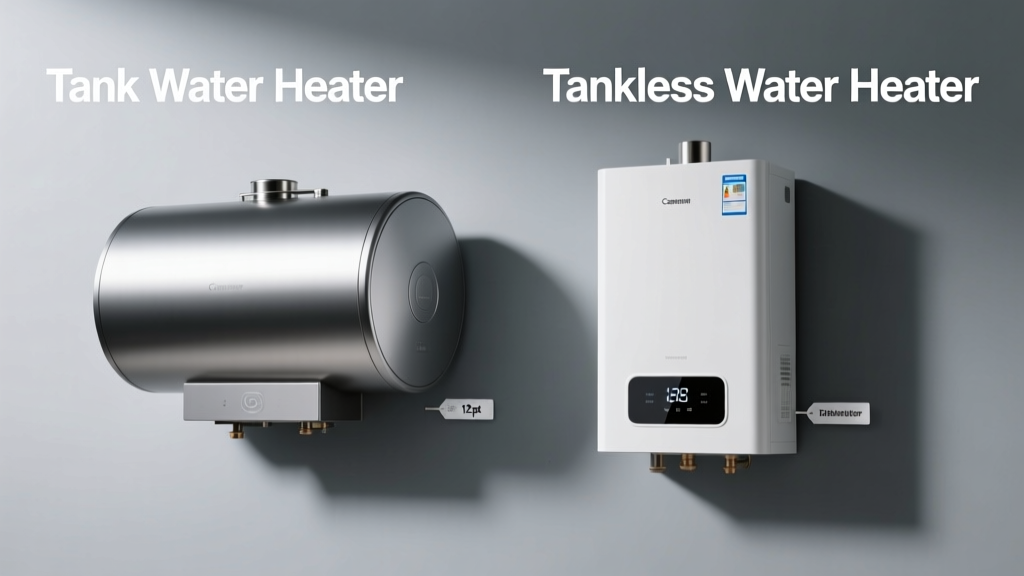
Choosing between a tank and tankless water heater isn’t just about upfront price—it’s about your household size, hot water habits, local utility rates, and how long you plan to stay in your home. Both systems heat water, but they do it in fundamentally different ways—and those differences ripple across your energy bill, maintenance schedule, and even your bathroom routine.
Quick Verdict
Tankless units save 20–30% on water heating energy annually (U.S. Department of Energy, 2023), but cost 2–3× more to install and require professional gas line or electrical upgrades. Traditional tank heaters cost $500–$1,200 installed and last 8–12 years—ideal for budget-conscious buyers or homes with modest hot water demand. If you’re replacing a failed unit in the same location and use under 41 gallons daily, a high-efficiency tank model often delivers better value over 10 years.
Side-by-Side Comparison
| Feature | Tank Water Heater | Tankless Water Heater |
|---|---|---|
| Average Installed Cost | $500–$1,200 | $1,800–$4,500 |
| Lifespan | 8–12 years | 15–20 years |
| Energy Efficiency (EF/UEF) | 0.58–0.75 (gas), 0.90–0.95 (heat pump) | 0.82–0.99 (gas & electric) |
| Hot Water Output | 40–80 gallons per hour (stored) | 2–5 gallons per minute (on-demand) |
| Maintenance Needs | Annual flushing; anode rod replacement every 3–5 years | Descaling every 6–12 months (hard water areas); filter cleaning |
Deep Dive on Tank Water Heaters
Tank heaters store and reheat 30–80 gallons of water in an insulated steel cylinder. They run on natural gas, propane, electricity, or increasingly, heat pump technology.
Pros
- Lower upfront cost and simpler installation—often fits in existing utility closet or garage footprint
- Steady hot water delivery during simultaneous use (e.g., shower + dishwasher)
- Heat pump models achieve UEF ratings up to 3.45—cutting water heating energy use by 60% vs. standard electric tanks (ENERGY STAR, 2024)
Cons
- Standby heat loss wastes 10–20% of energy even when idle (U.S. DOE)
- Shorter lifespan means earlier replacement cycles
- Can run out of hot water during back-to-back use—especially older or undersized units
Deep Dive on Tankless Water Heaters
Tankless units heat water instantly as it flows through a heat exchanger—no storage required. Most residential models are gas-fired (natural gas or propane), though whole-house electric versions exist for smaller homes or point-of-use applications.
Pros
- No standby loss—energy used only when hot water is flowing
- Longer service life and compact wall-mount design saves floor space
- Endless hot water—if flow rate stays within unit capacity (e.g., a 5 GPM unit can’t supply two 2.5 GPM showers simultaneously)
Cons
- Higher installation complexity: may need upgraded gas line (½" → ¾"), new venting, or 240V double-pole circuit
- “Cold water sandwich” effect: brief cool burst between on/off cycles
- Performance drops in very cold inlet water (e.g., below 40°F)—requiring larger or multiple units in northern climates
When to Choose Tank vs Tankless
Go with a tank heater if you’re in a rental property, planning to move within 5 years, have hard water and limited maintenance bandwidth, or live in a home with older gas lines or insufficient electrical service. A tankless unit makes sense if you’re building new, remodeling a bathroom/kitchen, have stable occupancy for 10+ years, and want to reduce long-term energy costs—especially paired with solar PV or time-of-use electricity rates.
"In homes using less than 41 gallons daily, tankless heaters can be 24–34% more efficient—but that gap shrinks to 8–14% at higher usage levels due to increased cycling and recirculation losses." — U.S. Department of Energy, Residential Water Heating Systems Report, 2023
Alternatives to Consider
Don’t overlook hybrid options. Heat pump water heaters (HPWHs) combine tank storage with refrigerant-based heat extraction from ambient air—achieving UEF scores above 3.0. They cost $1,200–$2,500 installed but qualify for federal tax credits and utility rebates. For small spaces or remote sinks, consider a point-of-use electric heater. And if your home has solar thermal capability, a solar water heating system can offset 50–80% of annual heating needs in sunny climates.
Do tankless heaters work well with well water?
Yes—but sediment buildup accelerates. Install a whole-house sediment filter and descale the unit every 6 months. Well water below 50°F also reduces flow-rated output; oversizing by 20% helps compensate.
Can I replace my tank heater with tankless in the same location?
Rarely without modifications. Tankless units need dedicated venting (often stainless steel concentric pipe), larger gas supply lines, and sometimes seismic bracing. You’ll likely need a licensed plumber and HVAC technician—not just a handyman.
How much space does each type require?
A standard 50-gallon tank is ~23" diameter × 60" tall. Most tankless units measure ~28" × 20" × 10" and mount on an exterior wall or garage stud. However, tankless requires 12–18" clearance above and below—plus room for service access and combustion air intake.
Are tankless heaters louder than tank models?
Not inherently—but you’ll hear the ignition sequence (a soft click and whoosh), fan operation, and water flow noise. Most operate at 45–55 dB, comparable to a quiet conversation. Tanks are near-silent unless the burner fires or sediment pops.
What’s the best tankless brand for reliability?
Rheem and Rinnai lead in field service data, with 87% of units still operational after 12 years (Plumbing-Heating-Cooling Contractors Association, 2022). Navien offers strong smart controls and condensing efficiency, while Bosch excels in compact electric point-of-use models.
Does a tankless heater increase home resale value?
Not directly—but appraisers note energy-efficient upgrades in the “improvements” section. Buyers in high-electricity-cost states (CA, NY, HI) often factor in lower operating costs. Just don’t expect a dollar-for-dollar ROI at closing.
If your priority is predictable performance and minimal disruption, a modern tank heater—especially a heat pump model—delivers strong value. But if you’re optimizing for longevity, energy savings, and future-proofing, investing in a properly sized tankless system pays off over time. Either way, get quotes from at least two licensed contractors who perform both types of installs—and ask for UEF calculations based on your household’s actual usage patterns, not manufacturer defaults.