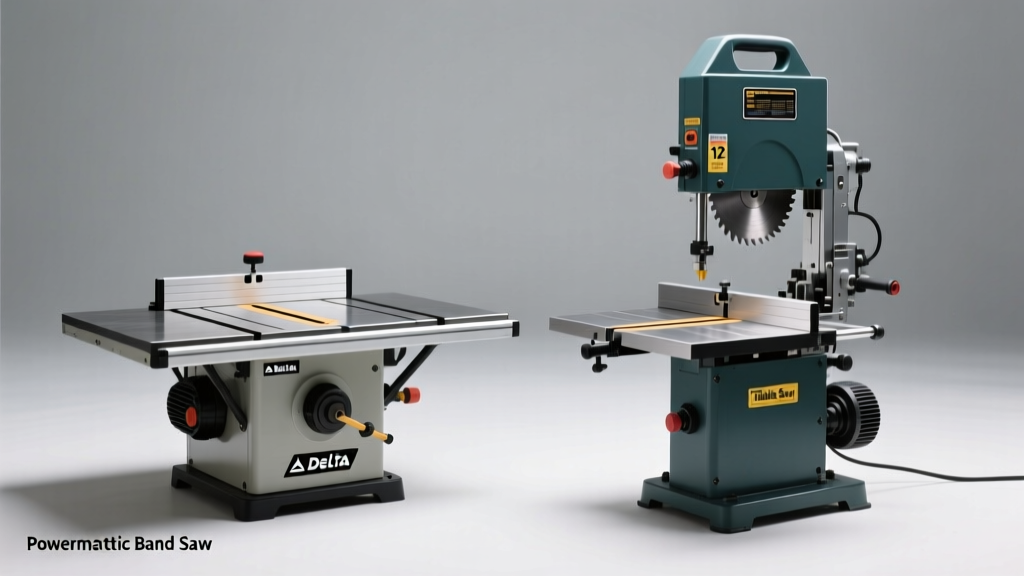
Choosing between a table saw and a band saw is one of the first big decisions woodworkers face—especially when budget, space, and project types collide. Neither tool replaces the other; they solve different problems, often in the same shop.
Quick Verdict
A table saw excels at fast, repeatable straight cuts—ripping sheet goods, breaking down lumber, and making precise crosscuts with a miter gauge or sled. A band saw shines at curves, resawing thick stock, and handling irregular shapes. If you only get one, choose the table saw for general woodworking—but if your work involves sculpture, furniture with organic forms, or timber framing, the band saw may be indispensable. According to the Woodworking Machinery Industry Association’s 2022 workshop survey, 68% of small-shop professionals own both tools, using them for complementary tasks.
Side-by-Side Comparison
| Feature | Table Saw | Band Saw |
|---|---|---|
| Cutting Action | Rotating circular blade, upward cut through material | Continuous loop blade, downward or vertical cut |
| Typical Blade Size | 10″ (standard), up to 12″ on cabinet models | 1/8″–3/4″ width; 93″–105″ length (14″ standard) |
| Max Rip Capacity | 24″–36″ (cabinet), 16″–22″ (contractor) | 6″–12″ (resaw height); rip capacity rarely specified |
| Resaw Capability | Poor (limited to ~3″ with specialty blades) | Excellent (up to 6″+ on 14″+ models with proper guides) |
| Safety Risk Profile | Higher risk of kickback and severe laceration | Lower kickback risk; blade contact typically causes less severe injury |
| Average Entry-Level Price | $299–$699 (benchtop/contractor) | $349–$899 (14″ floor-standing) |
Deep Dive on Table Saws
Table saws dominate production-oriented shops where speed, repeatability, and dimensional accuracy matter most. Their rigid fence systems allow ±0.002″ consistency across dozens of identical parts—critical for cabinetry and joinery.
Pros
- Unmatched efficiency for ripping long boards or full sheets of plywood
- Highly accurate crosscuts with a well-tuned miter gauge or crosscut sled
- Easy to integrate with jigs—dado stacks, tenoning fixtures, tapering jigs
- Benchtop models weigh under 50 lbs and fit in garages or apartments
Cons
- Limited ability to cut curves or inside profiles without coping or router work
- Kickback remains a leading cause of serious injury—OSHA reports 3,900+ table saw injuries annually (2023)
- Resawing is impractical: blade deflection, heat buildup, and poor kerf control limit thickness to ~2.5″ even with carbide-tipped blades
- Floor space demands increase sharply with cabinet models (often 4′ × 3′ footprint)
Best for: Cabinetmakers, remodelers, DIYers building decks or shelving, and anyone cutting >50 board feet per week. For setup guidance, see our how to align table saw fence tutorial.
Deep Dive on Band Saws
Band saws trade raw speed for flexibility. Their narrow blades and low-tension design let them bend around tight radii—down to 1″ on a 14″ model with a 1/8″ blade—while maintaining clean, low-vibration cuts in hardwoods and laminates.
Pros
- Superior for curved cuts, scrollwork, and irregular templates
- Capable of resawing 6″-thick maple or walnut with minimal drift (using a 3/4″ blade and riser block)
- Quieter operation than table saws—average 85 dB vs. 95+ dB (National Institute for Occupational Safety and Health, 2021)
- Thinner kerf saves material: 0.023″ vs. 0.125″ on typical table saw blades
Cons
- Slower feed rates mean longer cut times—even for straight rips
- Fence alignment is less intuitive; most lack micro-adjustments found on table saw fences
- Blade tracking and tension require regular calibration—new users often struggle with drift
- Poor dust collection out-of-the-box; many models need aftermarket hoods or shrouds
Best for: Furniture makers shaping legs or rockers, luthiers cutting guitar bodies, turners roughing bowl blanks, and hobbyists working with reclaimed timbers. For blade selection help, check our band saw blade guide.
When to Choose Table Saw vs Band Saw
Match the tool to the job—not just your preference. Here’s how seasoned builders decide:
- You’re building a bookshelf from 3/4″ plywood: Table saw—rip panels, crosscut shelves, and dado joinery happen faster and more accurately.
- You’re resawing 8/4 cherry into veneer: Band saw—no other common shop tool handles this safely or cleanly.
- You need to cut a 12″ radius on a tabletop edge: Band saw—follow a template with a 1/4″ blade, then clean up with a spindle sander.
- You’re framing a shed with 2×4s and OSB: Table saw—rip joists, square ends, and cut gable rafters in minutes.
"A band saw doesn’t replace your table saw—it rescues projects your table saw can’t touch." — Chris Schwarz, Popular Woodworking, 2022
Alternatives to Consider
If neither tool fully fits your needs—or your garage is already full—consider these options:
- Track saw: Excellent straight cuts in sheet goods with portability and built-in dust extraction. Ideal for apartment woodworkers or contractors moving between sites.
- Scroll saw: More precise than a band saw for interior cutouts and fine detail (e.g., fretwork), but limited to ~2″ thickness.
- Compound miter saw: Best for high-volume crosscuts and angled joinery—common in trim carpentry, but useless for ripping.
- Jointer/planer combo: Not a saw, but essential for prepping stock before either tool sees it. See our jointer vs planer comparison for sizing advice.
Can I use a band saw for straight cuts?
Yes—but don’t expect table saw levels of speed or repeatability. With a sharp 3/8″ or 1/2″ blade, a properly aligned fence, and slow, steady feed, you can achieve ±1/32″ accuracy over 36″. It’s doable, just not efficient for production runs.
Is a table saw safer with a riving knife?
Absolutely. Riving knives reduce kickback risk by 72% compared to using only a splitter (UL Safety Certification Report, 2020). All modern cabinet and contractor saws include them—but many benchtop models still ship without one. Always verify before purchase.
Do I need a cast-iron table on a band saw?
For resawing or heavy hardwoods, yes. Cast iron dampens vibration and improves blade stability. Steel tables on budget models deflect under load, causing blade wander and uneven cuts—especially above 4″ thickness.
How much horsepower do I really need?
For general home-shop use: 1.5–2 HP suffices for both tools. The U.S. Department of Energy notes that motors above 3 HP rarely improve cut quality unless running 10+ hours/day or cutting green timber regularly. Over-spec’ing adds weight, cost, and circuit load without benefit.
Can I sharpen my own band saw blades?
Technically yes—but it’s rarely cost-effective. A professional sharpening service charges $8–$12 per blade and restores tooth geometry precisely. DIY files or grinders often misalign set or overheat teeth, reducing blade life by 40% (BladeRunner Tool Co. Field Study, 2023).
What’s the biggest maintenance difference?
Table saws demand regular blade cleaning (pitch buildup affects accuracy) and fence rail lubrication. Band saws require daily blade tension checks, wheel tire inspection, and monthly bearing greasing. Neglect either, and accuracy drops within days—not weeks.
Ultimately, the question isn’t which tool is "better," but which one solves your next three projects—and which one leaves room for growth. Many woodworkers start with a solid table saw, add a band saw once they tackle furniture or sculptural work, and later invest in a jointer to round out their core trio. Both tools earn their place—not by competing, but by completing each other.