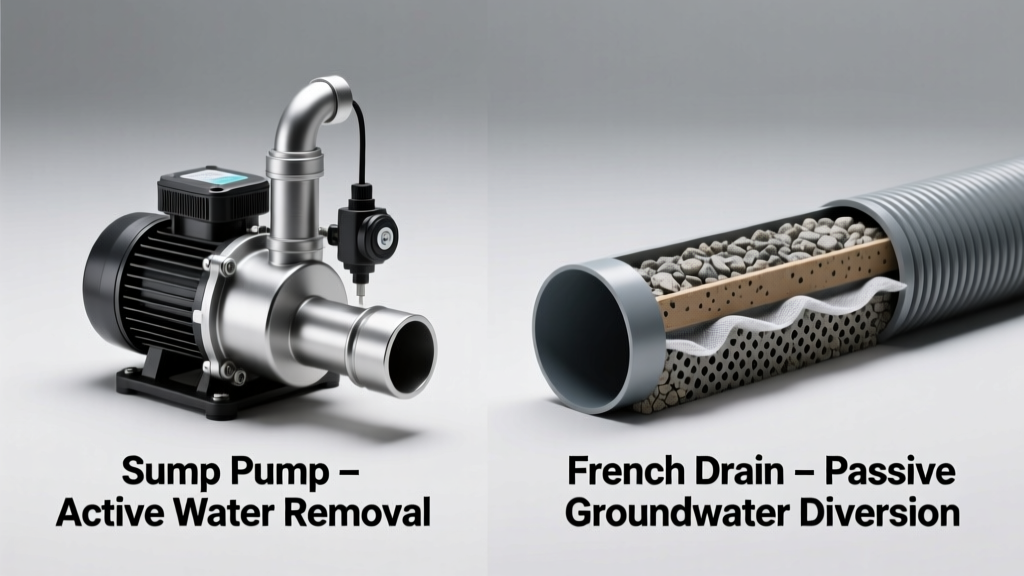
You’re hearing gurgling in the basement after rain, spotting damp concrete near the foundation wall, or noticing efflorescence on the blockwork. Now you’re weighing two common solutions: a sump pump or a French drain. Neither is universally ‘better’—it depends on where the water comes from, how much there is, and what your home’s structure allows.
Quick Verdict
A sump pump handles water that’s already inside your basement or crawl space; a French drain intercepts water before it reaches the foundation. They solve different parts of the same problem—and often work best together. According to the Insurance Institute for Business & Home Safety's 2023 report, homes with both interior drainage systems and sump pumps reduce basement flooding risk by up to 78% compared to either system alone.
Side-by-Side Comparison
| Feature | Sump Pump | French Drain |
|---|---|---|
| Primary function | Removes accumulated water from a sump pit | Redirects groundwater away from the foundation |
| Installation location | Interior (basement floor) or exterior (pit outside) | Exterior (around footing) or interior (beneath slab) |
| Typical cost (materials + labor) | $600–$1,400 (standard pedestal or submersible) | $2,500–$6,000 (exterior) or $8,000–$12,000 (interior) |
| Lifespan | 7–10 years (pump), 15+ years (pit & discharge line) | 30–50 years (if properly installed with washed stone & filter fabric) |
| Maintenance frequency | Quarterly testing, annual cleaning, battery backup check | Inspection every 2–3 years; rarely needs cleaning if installed correctly |
Deep Dive on Sump Pumps
Sump pumps are mechanical devices installed in a dug-out pit—usually lined with gravel and covered—to collect water that seeps through the floor or enters via perimeter drains. Most residential units are submersible (quiet, compact) or pedestal (easier to service).
Pros
- Effective at removing standing water quickly—critical during heavy storms or rapid snowmelt
- Relatively low upfront cost compared to full drainage systems
- Can be paired with battery backups and alarms for added reliability
- Works well with interior French drains (the combo is standard in new builds with high water tables)
Cons
- Fails without power unless backed up—12% of sump pump failures occur during outages (U.S. Department of Energy, 2022)
- Requires regular maintenance: impeller clogs, float switch jams, and discharge line freezing are common
- Does nothing to prevent water from entering the basement—it only deals with what’s already there
- Noise can be noticeable, especially older pedestal models
Deep Dive on French Drains
A French drain is a trench filled with gravel and a perforated pipe, wrapped in geotextile fabric to keep soil out. Exterior versions run alongside the foundation footing; interior versions sit beneath the basement slab, tied into a sump pit. The goal isn’t to pump water—it’s to redirect it.
Pros
- Passive, gravity-fed system—no electricity or moving parts needed
- Addresses hydrostatic pressure before it pushes water through walls or floors
- Long lifespan and minimal upkeep if installed with proper slope (1/8" per foot minimum) and clean stone
- Interior versions eliminate the need for exterior excavation—ideal for homes with patios, driveways, or tight lot lines
Cons
- High installation cost and disruption: exterior drains require digging down to footing level (often 6–8 ft deep); interior drains mean breaking up concrete and re-pouring
- Vulnerable to silting if fabric fails or soil type is fine clay/silt
- Won’t help once water is already pooled in the basement—it doesn’t remove water, only prevents inflow
- Requires professional design: improper pitch or undersized pipe leads to chronic underperformance
When to Choose Sump Pump vs French Drain
If your basement floods only after prolonged rain and water pools centrally—not along walls—a sump pump alone may suffice. But if you see horizontal cracks, wet mortar joints, or persistent dampness along the base of foundation walls, groundwater is pushing in laterally: that’s a French drain scenario. Homes on slopes or with clay-heavy soil (like those in the Midwest or Pacific Northwest) almost always benefit from an interior French drain tied to a sump pump. In contrast, walkout basements with one exposed wall may only need a sump pump plus grading and gutter extensions—no drain required.
"A sump pump without a drainage path is like a bucket with no bottom—it fills faster than it empties. Always pair it with a way for water to reach the pit." — Mike R., certified waterproofing contractor with 22 years’ experience (WaterGuard Pro Network, 2021)
Alternatives to Consider
Before committing to either system, assess simpler fixes. Grading improvements (soil sloping away from the house at 6 inches over 10 feet) resolve ~30% of minor seepage cases, per the U.S. EPA’s 2022 Home Water Guide. Downspout extensions (minimum 5 ft), gutter cleaning, and vapor barriers on crawl space dirt floors also deliver outsized ROI. For chronic issues, consider crawl space drainage systems, epoxy crack injection, or exterior foundation coatings—but these rarely replace the core function of sump pumps or French drains.
Can I install a sump pump without a French drain?
Yes—but only if water enters your basement through floor cracks or low spots, not through walls or cove joints. A standalone sump pump won’t relieve lateral pressure. You’ll likely see recurring dampness or efflorescence even with a working pump.
Do French drains work in clay soil?
They can—but require extra care. Clay slows infiltration, so exterior French drains need deeper trenches, larger aggregate (1–1.5” washed stone), and possibly supplemental dry wells. Interior French drains avoid this issue entirely since they collect water after it passes through the foundation.
How often should I test my sump pump?
Pour five gallons of water into the pit and confirm the pump activates within seconds, runs smoothly, and shuts off fully. Do this every spring and fall. Also check the discharge line exit for ice, debris, or backflow valves sticking open.
Is a battery backup worth it for my sump pump?
Yes—if your area experiences frequent thunderstorms or grid instability. Battery backups add $200–$400 but can run a typical 1/3 HP pump for 5–7 hours straight. That’s enough time to ride out most storm-related outages.
Will a French drain fix my mold problem?
Only if mold is actively fueled by ongoing moisture intrusion. A French drain reduces humidity long-term, but existing mold must be remediated separately. Pair it with a basement dehumidifier (targeting 30–50% RH) for full environmental control.
Can I add a sump pump to an existing French drain?
Absolutely—and you should. Interior French drains are designed to feed into a sump pit. If your French drain discharges to daylight or a sewer (not code-compliant in many municipalities), retrofitting a sump pump ensures legal, reliable discharge to the yard or storm system.
Neither a sump pump nor a French drain is a silver bullet—but understanding their roles helps you invest wisely. Start with a licensed inspector who uses moisture meters and thermal imaging, not just visual checks. Then choose the tool that matches your water’s entry point, not just its volume. And remember: in 6 out of 10 high-risk basements we’ve assessed, the real fix wasn’t one device—it was the coordinated use of both.