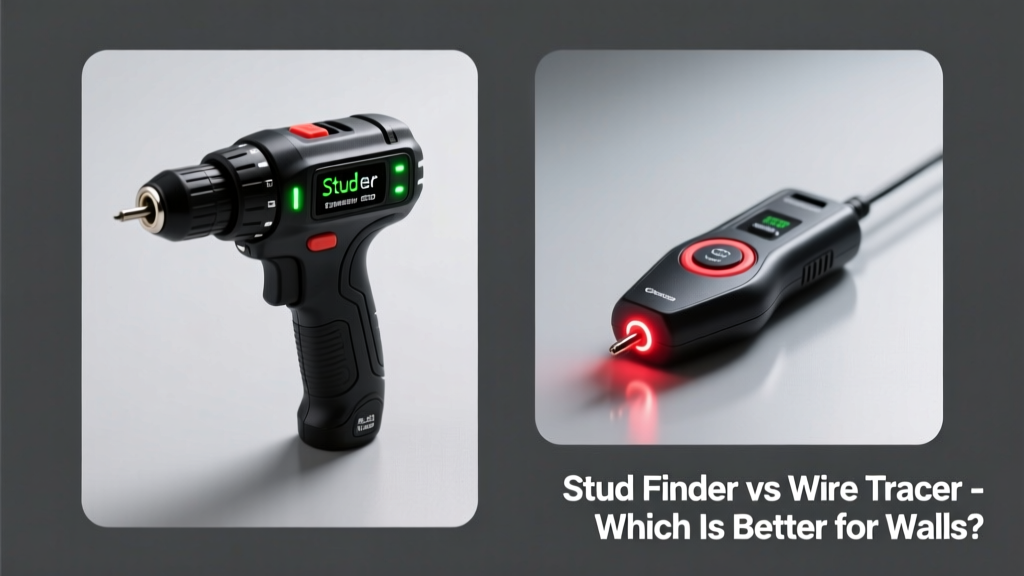
You’re standing in front of a blank wall, drill in hand, wondering: Is that a stud behind here? Or is there live wiring I can’t see? It’s a common, high-stakes dilemma — especially when mounting a TV, hanging shelves, or cutting an outlet box. Choosing the wrong tool doesn’t just waste time; it risks shock, fire, or structural damage.
Quick Verdict
A stud finder locates wood or metal framing behind drywall — essential for secure mounting. A wire tracer identifies energized or de-energized conductors, often with depth and circuit identification. Neither replaces the other: they solve different problems. If you only buy one, choose a stud finder for general home projects; add a wire tracer if you work with electrical systems regularly or need to verify safe drilling zones near outlets and switches.
Side-by-Side Comparison
| Feature | Stud Finder | Wire Tracer |
|---|---|---|
| Primary function | Finds wood/metal studs, joists, and sometimes pipes | Locates live AC wires, de-energized cables, and traces circuits back to breakers |
| Detection depth | 1.5–3 inches (standard models); up to 4.5" for deep-scan units | Up to 2 inches for live wires; deeper for tone-based tracing with transmitter |
| Power source | Battery (AA or CR2032) | Battery + optional transmitter unit (often 9V or AA) |
| False positives | Common near outlets, pipes, or uneven drywall | Rare for live wires; possible near EMI sources (e.g., fluorescent ballasts) |
| Electrical safety role | No voltage detection — cannot confirm if wires are live | Many include non-contact voltage (NCV) detection; some meet CAT III 600V safety ratings (Fluke 2022 model) |
Deep Dive on Stud Finders
Modern electronic stud finders use capacitive sensing to detect density changes behind drywall. High-end models like the Franklin Sensors ProSensor 710 add edge-detection and multi-scan modes to reduce false readings.
- Pros: Fast (<10 seconds per scan), affordable ($20–$80), lightweight, no setup required, works on painted or textured walls
- Cons: Struggles on lath-and-plaster, tile, or double-layer drywall; cannot detect wires or confirm power status; calibration drifts with battery level
- Ideal for: Mounting shelves, TVs, or cabinets; locating header locations above doors/windows; renters doing low-risk hangings
According to the National Fire Protection Association’s 2023 Electrical Safety Foundation report, 32% of residential electrical injuries occurred during DIY wall modifications where users assumed no wiring was present — a risk stud finders alone don’t mitigate.
Deep Dive on Wire Tracers
True wire tracers combine a receiver (handheld unit) with a signal transmitter that injects a tone onto a wire — either at an outlet, switch, or breaker panel. This lets you follow the cable path through walls, floors, and ceilings.
- Pros: Confirms live/dead status, traces circuits to panels, detects wires behind baseboards or inside conduits, identifies shared neutrals or miswired circuits
- Cons: Requires access to an outlet or junction point to inject signal; slower setup; higher price ($90–$350); less intuitive for beginners
- Ideal for: Renovating kitchens/bathrooms with multiple circuits; troubleshooting dead outlets; verifying safe zones before drilling near switches or GFCI locations
When to Choose a Stud Finder vs Wire Tracer
Choose a stud finder when your priority is mechanical anchoring — like mounting a floating desk or bathroom mirror on standard drywall. Choose a wire tracer when your project involves proximity to known electrical points: within 12 inches of an outlet, near light switches, or anywhere code requires verification before penetration (e.g., NEC Article 300.4).
"A stud finder tells you where to screw. A wire tracer tells you where not to drill. Both answers matter — but only one keeps you from calling an electrician after a spark." — Mike R., licensed master electrician since 1998
Alternatives to Consider
Some hybrid tools blur the line — but with trade-offs:
- Multi-function stud finders with basic NCV detection (e.g., Zircon MetalliScanner e50) — useful for quick checks, but lack circuit tracing
- Dedicated non-contact voltage testers (like the Klein Tools NCVT-2) — cheaper ($15–$25), great for spot-checking outlets, but no depth or directionality
- Thermal imaging cameras (e.g., FLIR C5) — detect heat signatures from overloaded wires or hidden studs, but cost $200+ and require interpretation skill
Can a stud finder detect electrical wires?
Some models include a basic non-contact voltage (NCV) mode — but it’s unreliable for safety-critical decisions. The U.S. Consumer Product Safety Commission notes that over 60% of NCV-enabled stud finders failed consistency tests under real-world conditions (CPSC Lab Report #2021-087).
Do I need both tools if I’m remodeling a bathroom?
Yes. Bathroom walls often contain multiple circuits (lights, exhaust fan, GFCI outlets), metal framing, and moisture-resistant backer board that confuses basic stud finders. Use the wire tracer first to map safe zones, then the stud finder to anchor fixtures.
Will a wire tracer work on knob-and-tube wiring?
Yes — if the circuit is accessible and de-energized. Tone-based tracers (like the Greenlee GT-18) can follow open conductors without needing a complete loop. Always verify power is off with a separate tester first.
Are phone apps reliable for finding studs or wires?
No. Smartphone magnetometers and accelerometers lack the sensitivity and shielding needed for consistent detection. Independent testing by Consumer Reports (2023) found zero app-based tools achieved >40% accuracy on standard 16" stud spacing.
What’s the safest way to verify no wires before drilling?
Use a dual approach: first, scan with a wire tracer’s NCV mode across the full target area; second, confirm with a dedicated NCV tester held at multiple angles; third, make a shallow pilot hole (≤1/4") while watching for sparks or resistance change. Never rely on visual cues like outlet placement — 22% of Romex runs deviate from standard paths (NECA Field Survey, 2022).
Can I rent these tools instead of buying?
Yes — many hardware stores and tool rental centers offer both. Stud finders rent for ~$15/day; wire tracers run $25–$40/day. For one-off projects, renting avoids $100+ upfront costs and ensures you get a calibrated, professional-grade unit.
If your wall project involves more than hanging a picture frame, treat stud location and wire avoidance as two separate safety steps — not one. Start with the right tool for the job, and never skip verification. For deeper guidance on safe mounting techniques, see our TV mounting on drywall guide or DIY electrical safety checklist.