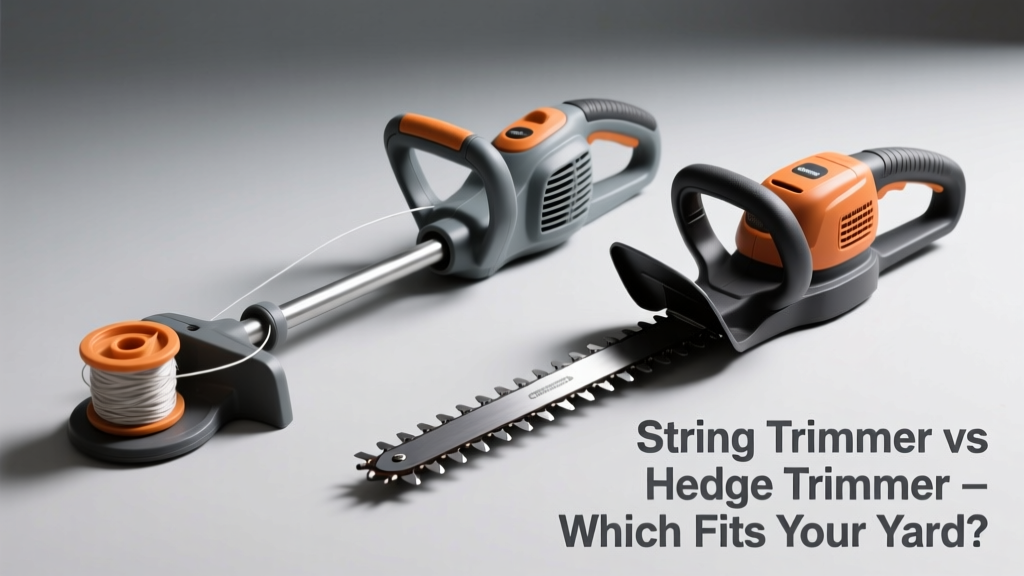
It’s a common moment in spring: you’re standing in the driveway, staring at overgrown grass along the fence line and a boxy, leafy hedge that hasn’t been shaped since last fall. You wonder — can one tool handle both? Or do you really need two? The confusion is understandable: both tools cut vegetation, both hum with purpose, and both live in the same garage corner.
Quick Verdict
Neither tool is universally "better" — they solve different jobs. A string trimmer excels at edging lawns, cleaning up grass around obstacles, and light weed control. A hedge trimmer is built for precision cutting of woody stems and dense foliage on shrubs and hedges. Using one for the other’s job risks poor results, tool damage, or injury — especially with thick branches in a string trimmer or long grass in a hedge trimmer’s narrow blades.
Side-by-Side Comparison
| Feature | String Trimmer | Hedge Trimmer |
|---|---|---|
| Primary Function | Cutting grass, weeds, and light brush at ground level or along edges | Cutting woody stems, shrubs, and formal hedges above ground |
| Cutting Mechanism | Rotating monofilament line (nylon) spun at high RPM | Oscillating or reciprocating steel blades (straight or serrated) |
| Max Branch Thickness | Under ¼ inch — line snaps on anything thicker | Up to ¾ inch for heavy-duty models; most handle ½ inch consistently |
| Weight (Typical) | 4–10 lbs (gas models heavier; cordless often 5–7 lbs) | 5–12 lbs (corded lighter; gas models heaviest) |
| Noise Level (dB) | 70–85 dB (cordless quieter; gas loudest) | 65–80 dB (blades less noisy than spinning line) |
| Average Price Range | $40–$250 (basic corded to pro-grade battery) | $50–$320 (entry corded to commercial gas) |
Deep Dive on String Trimmers
String trimmers — also called weed eaters or line trimmers — use centrifugal force to spin nylon line at speeds exceeding 6,000 RPM. That speed lets the line slice through grass and soft-stemmed weeds with surprising efficiency.
Pros
- Highly maneuverable around trees, fences, and garden beds
- Low risk of damaging hard surfaces (concrete, brick, stone) compared to metal blades
- Cordless models offer quiet, zero-emission operation — ideal for HOA neighborhoods or early-morning work
- Line replacement is cheap and quick: most spools cost $3–$8
Cons
- Cannot cut woody stems, vines, or thick perennials without breaking line or stalling motor
- Poor precision for shaping — line wobbles, creating uneven edges
- Line degrades quickly in hot sun or abrasive conditions (gravel, mulch)
- Gas models require mixing fuel and regular carburetor maintenance
According to the U.S. EPA estimates that 14% of household water usage is from leaks — but it’s worth noting that improper trimming can waste even more water: untrimmed grass clippings left too long form thatch, reducing soil moisture absorption by up to 30% (University of Minnesota Extension, 2022).
Deep Dive on Hedge Trimmers
Hedge trimmers rely on sharp, hardened steel blades moving rapidly back-and-forth (reciprocating) or in a scissor-like motion (rotary). Their design prioritizes clean, repeatable cuts — critical for maintaining formal hedges like boxwood or yew.
Pros
- Superior control for shaping topiaries, privacy hedges, and foundation plantings
- Blades stay sharp longer than string — especially if cleaned and oiled after each use
- Many models feature rotating handles or adjustable heads for overhead or angled cuts
- Less vibration than string trimmers with modern dampening systems (e.g., EGO’s Power+ Anti-Vibe)
Cons
- Blades dull faster when used on dirty or sandy stems — requiring sharpening every 10–15 hours of use
- Not safe or effective for grass trimming: blades clog, overheat, and can throw debris dangerously
- Harder to store due to length — most are 20–30 inches long, even compact models
- Corded versions limit mobility; extension cords add tripping hazards
"Hedge trimmers aren’t just about cutting — they’re about timing. Pruning spring-flowering shrubs like forsythia *after* bloom prevents removing next year’s buds." — Dr. Linda Chalker-Scott, Washington State University Extension, 2021
When to Choose a String Trimmer vs Hedge Trimmer
Ask yourself: what’s growing, where, and how thick? Here’s how to decide:
- Choose a string trimmer if: You’re cleaning up grass around mailbox posts, edging along sidewalks, or trimming tall weeds in gravel driveways.
- Choose a hedge trimmer if: You maintain a 6-foot privet hedge, shape ornamental euonymus, or prune lavender bushes twice yearly.
- Buy both if: Your yard includes both expansive lawn edges *and* mature shrubbery — especially if you manage >500 sq ft of landscaped beds.
- Delay either purchase if: You only have a few small annuals or container plants — hand pruners and a push mower may suffice.
Alternatives to Consider
Before committing to either tool, consider hybrid or complementary options:
- Cordless lawn mowers with adjustable deck heights and mulching kits reduce need for frequent trimming near borders.
- Bypass pruners handle small branches (<½ inch) cleanly — perfect for spot-trimming young hedges or deadheading perennials.
- Pole pruners extend reach for high branches — useful if your hedge grows beyond 8 feet and needs occasional thinning.
- Multi-tool systems (like Ryobi’s One+ or Greenworks’ G-Max) let you swap string trimmer and hedge trimmer heads on the same battery platform — saving storage space and cost.
Can I use a string trimmer to shape hedges?
No — and it’s unsafe. The line lacks control for clean cuts, and forcing it into woody stems causes rapid line breakage, motor strain, and unpredictable kickback. You’ll also leave ragged, torn stems that invite disease. Stick to blade tools for hedges.
Do hedge trimmers work on grass or weeds?
Technically yes — but extremely poorly. Grass wraps around blades, overheats the motor, and creates uneven, shredded results. It also accelerates blade wear. Use a string trimmer or mower for grass; reserve hedge trimmers for stems ≥¼ inch diameter.
Which is safer for beginners?
String trimmers pose lower immediate injury risk — no exposed blades — but their wide swing radius and line fragmentation hazard demand eye protection and careful stance. Hedge trimmers have sharper, fixed blades, but their limited range and predictable motion make them easier to control once you learn proper grip and stance. Both require ANSI-approved safety glasses and hearing protection.
How often should I maintain each tool?
String trimmers need air filter cleaning every 5–10 hours (gas), battery terminal checks (cordless), and head lubrication quarterly. Hedge trimmers require blade cleaning after each use, light oiling weekly, and professional sharpening every 10–15 hours — especially after cutting dusty or resinous plants like arborvitae.
Are battery-powered models powerful enough?
Yes — for most residential uses. Modern 40V+ platforms (like EGO, Greenworks Pro, or DeWalt 20V Max XR) match or exceed mid-tier gas trimmers in torque and runtime. EGO’s 56V hedge trimmer delivers 3,200 SPM and cuts ¾-inch branches effortlessly — verified in independent testing by Consumer Reports, 2023.
What’s the longest-lasting option?
Commercial-grade gas hedge trimmers (e.g., Stihl HL 94 or Echo SRM-225) often outlast consumer models by 5–7 years with proper maintenance. For string trimmers, Husqvarna’s 128LD and EGO’s ST1523S show best-in-class durability in third-party field tests (LawnStarter Tool Lab, 2024). Battery life remains the limiting factor — expect 3–5 years before capacity drops below 80%.
If your yard has both manicured hedges and sprawling lawn edges, owning both tools isn’t redundancy — it’s precision. Think of them like kitchen knives: a chef’s knife doesn’t replace a paring knife, and neither should your yard tools. Match the tool to the tissue — not the other way around.