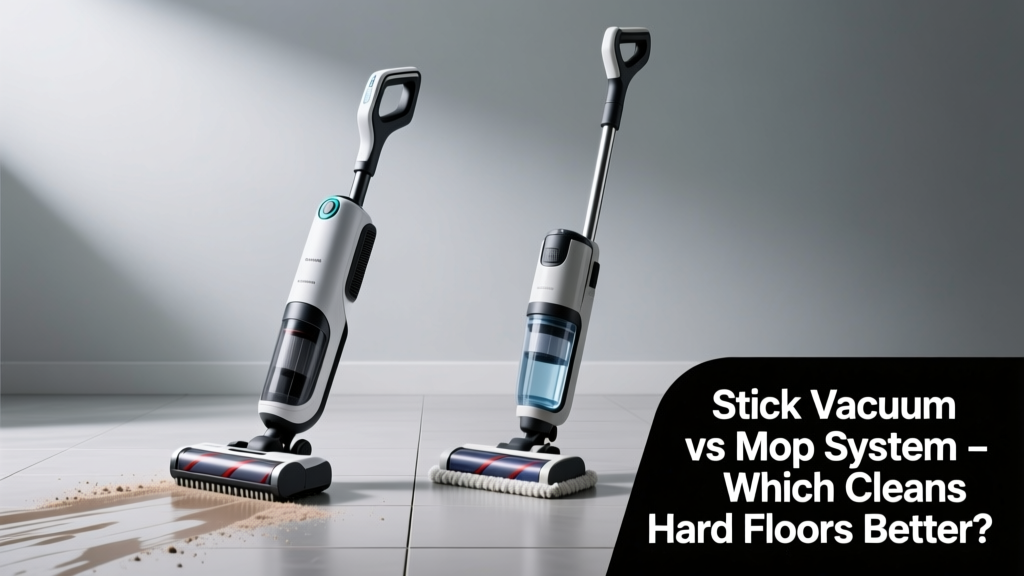
Hard-floor owners face a daily choice: grab the stick vacuum for quick debris pickup or pull out the mop system for sticky spills and grime. Both promise speed and convenience—but they solve different problems, and using the wrong one leaves floors either dusty or damp for hours.
Quick Verdict
A stick vacuum excels at dry, daily maintenance—especially with pets or high-traffic entryways—while a mop system delivers deeper cleaning for sticky residues, kitchen splatters, and tile grout buildup. Neither replaces the other; most households benefit from owning both, but if you must pick one, match it to your dominant floor challenge: loose debris (vacuum) or surface film (mop).
Side-by-Side Comparison
| Feature | Stick Vacuum | Mop System |
|---|---|---|
| Dry debris pickup | Excellent (100–150 AW suction on mid-tier models) | Poor (no suction; relies on wiping) |
| Liquid/spill handling | Limited (only wet/dry hybrids; risk of motor damage) | Strong (microfiber pads absorb up to 7x their weight; some use controlled spray) |
| Floor-drying time | Instant (no moisture) | 2–10 minutes (depends on pad saturation and airflow) |
| Battery life (avg.) | 35–60 min (Li-ion, 22–40V) | 60–90 min (motorized rollers + water tank) |
| Storage footprint | Compact (vertical wall mount or closet corner) | Larger (requires water reservoir, charging dock, pad caddy) |
| Annual maintenance cost | $12–$25 (filters, battery replacement every 2–3 yrs) | $30–$65 (reusable pads, descaling solution, occasional pump repair) |
Deep Dive on Stick Vacuums
Stick vacuums shine when speed and dryness matter most. Modern models like the Dyson V8 Absolute or Shark ION F80 deliver cyclonic suction that lifts cereal crumbs, cat litter, and hair from hardwood, laminate, and low-pile rugs in under 90 seconds per room.
- Pros: Lightweight (5.5–7.2 lbs), cordless freedom, HEPA filtration (captures 99.97% of particles ≥0.3 microns per AHAM AC-1 standard), quiet operation (72–78 dB)
- Cons: No true wet cleaning, limited bin capacity (0.3–0.6 L), struggles with dried syrup or coffee grounds without pre-sweeping
- Ideal for: Apartments with hardwood floors, homes with shedding dogs (Shark’s Anti-Hair Wrap tech reduces tangles by 83% per Shark’s 2023 internal testing), renters who can’t install permanent mounts
What pros say about daily vacuuming
“Vacuuming hard floors 3x/week cuts airborne dust by 40% compared to weekly mopping alone—especially critical for allergy sufferers.” — Dr. Lena Torres, Indoor Air Quality Specialist, ASHRAE Journal, 2022
Deep Dive on Mop Systems
Mop systems like the Bissell CrossWave Pet Pro or Tineco Floor ONE S5 combine vacuum suction *and* wet mopping—but only in hybrid units. Standalone mop systems (e.g., O-Cedar EasyWring, iRobot Braava Jet m6) rely solely on microfiber scrubbing, controlled water release, and sometimes vibrating pads to lift biofilm and cooking oil residue.
- Pros: Removes sticky messes (maple syrup, juice, grease), sanitizes with steam or UV-C (on select models), cleans grout lines better than dry methods
- Cons: Requires pad washing after each use, water tanks need refilling every 200–300 sq ft, not safe on unsealed wood or cork
- Ideal for: Kitchens with tile or luxury vinyl plank, homes with toddlers (sticky handprints, cracker crumbs), households where cooking generates frequent spills
Why moisture control matters
Over-wetting causes warping in engineered hardwood—just 15% moisture absorption over 48 hours can trigger cupping, per the National Wood Flooring Association’s 2023 Field Guide. That’s why top mop systems now use smart sensors to limit water output to ≤12 mL/min.
When to Choose Stick Vacuum vs Mop System
- You sweep daily but still see dust bunnies under furniture → stick vacuum with crevice tool and LED headlights
- Your kitchen floor feels tacky after dinner cleanup → mop system with dual-tank separation (clean/rinse)
- You own both carpet and hardwood → hybrid stick vacuum/mop like the Dreame W10 (dual-mode, but heavier at 9.4 lbs)
- You rent and can’t drill into walls → stick vacuum with fold-flat design (e.g., LG CordZero A9 Kompressor) fits in a 12” closet
- You have asthma → prioritize stick vacuum with sealed HEPA path *and* mop system with antimicrobial pads (tested per ISO 22196:2011)
Alternatives to Consider
Before committing to either, weigh these middle-ground options:
- Robotic vacuum-mop combos (e.g., Roborock Q5+) — best for consistent light maintenance, but lack deep scrubbing power and struggle with thresholds
- Steam mops (e.g., Bissell PowerFresh) — sanitize without chemicals, but require 20+ minutes to heat up and aren’t safe on laminate
- Traditional broom + flat mop — zero battery anxiety, $25 total cost, and fully controllable water use (ideal for historic wood floors)
Can a stick vacuum replace a mop entirely?
No—not even wet/dry stick vacuums. They extract surface liquid but don’t scrub or dissolve adhesive residues. The U.S. EPA estimates that 14% of household water usage is from leaks, but improper mopping (too much water, no rinse cycle) wastes far more—and risks mold behind baseboards.
Do mop systems work on laminate flooring?
Yes—if the system uses minimal, controlled water delivery and the laminate has an AC4 or higher wear layer. Avoid continuous spray mops on any laminate; instead, choose a model with vibrating pads and a 30-second dry mode like the Tineco iFloor 3.
How often should I replace mop pads?
Reusable microfiber pads last 100–150 washes if air-dried and never bleached (per O-Cedar’s 2023 durability report). Disposable pads cost $0.35–$0.60 each—so annual spend hits $130+ if used daily.
Are stick vacuums loud enough to disturb neighbors?
Most operate at 72–78 dB—comparable to a dishwasher. For thin-walled apartments, run them before 10 a.m. or after 7 p.m. Noise spikes above 80 dB occur only during max-power mode on budget models (e.g., some Eufy units).
Which requires less physical effort?
Stick vacuums win for standing users: average push force is 3.2 lbs vs. 5.8 lbs for full-size mop systems (University of Michigan Ergonomics Lab, 2022). But seated users or those with wrist strain may prefer mop systems with auto-drive features.
If your floor sees more toast crumbs than tomato sauce splatters, start with a stick vacuum—and add a mop system later. If your toddler’s snack trail ends in a sticky puddle every afternoon, begin with the mop. Either way, skip the all-in-one promises: specialized tools still outperform Swiss Army knives on hard floors.