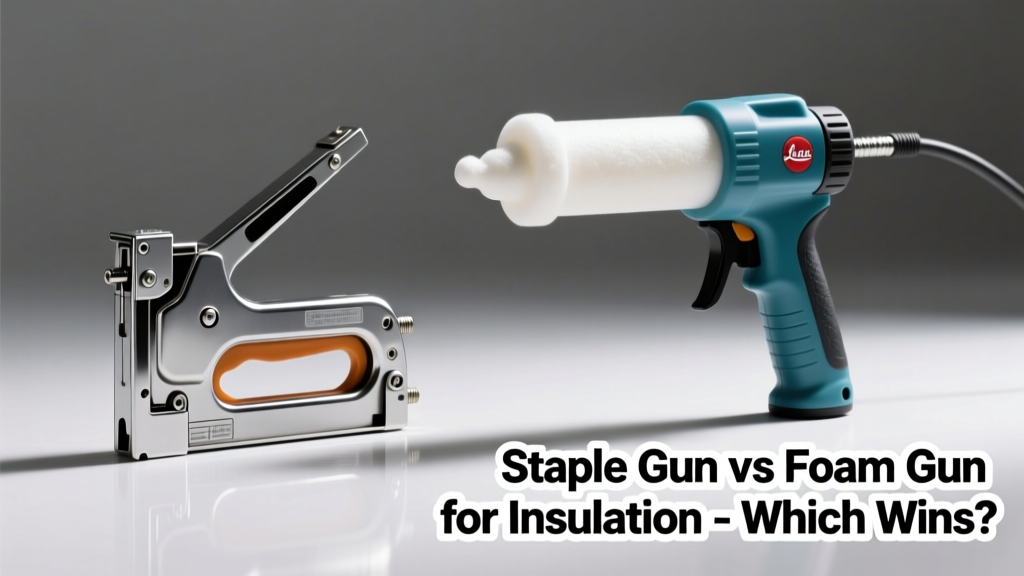
You’re standing in the hardware aisle, holding a staple gun in one hand and a foam gun in the other—both labeled ‘for insulation.’ But they do wildly different things, and choosing wrong can mean air leaks, wasted material, or even code violations. Let’s cut through the marketing and compare what actually works where.
Quick Verdict
Staple guns are best for securing rigid or batt insulation—think fiberglass, mineral wool, or foil-faced polyiso—to wood framing. Foam guns dispense expanding polyurethane sealant to fill gaps, cracks, and irregular voids. They’re not interchangeable: one fastens, the other seals. Using a staple gun to ‘install’ spray foam is impossible; trying to seal a 3-inch gap with staples is futile.
Side-by-Side Comparison
| Feature | Staple Gun Method | Foam Gun Method |
|---|---|---|
| Primary Function | Fastening insulation to framing | Sealing air gaps and irregular cavities |
| Typical Materials Used | Fiberglass batts, rock wool, rigid foam boards | One-component polyurethane foam (e.g., Great Stuff) |
| Air Sealing Capability | None—requires separate caulk or tape | Excellent—expands to fill voids and blocks airflow |
| Material Cost (per sq ft) | $0.15–$0.40 (batts + staples) | $0.85–$2.20 (foam + nozzle + cleanup) |
| Learning Curve | Low—familiar to most DIYers | Moderate—over-application causes messy expansion and shrinkage |
| Code Compliance (IRC R302.3) | Meets requirements when used per manufacturer specs | Approved only for gaps ≤3″; not a substitute for bulk insulation |
Deep Dive on Staple Gun Insulation
Staple guns—manual, electric, or pneumatic—are mechanical fasteners designed for consistent, high-volume attachment of insulation to wood studs, rafters, or furring strips. They shine where insulation has a flat back and predictable thickness.
- Pros: Fast installation on straight walls or attics; low per-unit cost; reusable tools; compatible with vapor-retarder facings (e.g., kraft paper or foil)
- Cons: Can compress insulation (reducing R-value by up to 15% if over-stapled); ineffective on metal framing or concrete; zero air-sealing ability
- Ideal use cases: Installing R-13 fiberglass in 2×4 exterior walls; securing mineral wool between floor joists; attaching rigid foam to roof decking prior to sheathing
According to the Insulation Institute’s 2022 field study, improperly stapled batts lost an average of 1.8 R-value per inch due to compression at stud edges—a loss no amount of extra staples fixes.
Deep Dive on Foam Gun
Foam guns (like the Sausage Foam Gun or Great Stuff Pro) control the dispensing of one-part polyurethane foam from pressurized cans. Unlike canned ‘trigger’ foam, foam guns offer precision, reduced waste, and better control over bead size and depth.
- Pros: Superior air sealing; fills odd-shaped gaps (rim joists, window headers, pipe penetrations); bonds to most substrates including masonry and metal
- Cons: Expensive per volume; requires masking and cleanup; expands 3–4×—overfilling causes bulging and later shrinkage; not rated as primary insulation
- Ideal use cases: Sealing around electrical boxes in insulated walls; filling 1–3″ gaps between foundation sill plates and subfloor; air-sealing duct boots before drywall
"Foam guns don’t replace insulation—they complete it. You wouldn’t build a house with caulk instead of drywall. Same principle." — Sarah Lin, Building Science Advisor, Building Science Corporation (2023)
When to Choose Staple Gun vs Foam Gun
Choose the staple gun when you’re installing continuous layers of insulation with defined edges and backing. Choose the foam gun when you’re chasing air leaks—not bulk R-value—in joints, transitions, and penetrations.
- Refinishing a basement? Staple mineral wool to rim joists first, then foam-gun the seam between joist end and foundation wall.
- Installing new windows? Use foam gun around the rough opening—not to hold the window, but to seal the gap between frame and framing.
- Attic knee walls? Staple R-19 batts between studs, then foam-gun where top plates meet rafters.
- Adding insulation to an old garage? Staple rigid foam to ceiling joists, then foam-gun seams and light fixture penetrations.
Alternatives to Consider
Neither tool solves every insulation challenge. For comprehensive performance, consider pairing them—or bringing in complementary options:
- Taped seams on rigid foam (e.g., ZIP System tape) for superior air control without foam’s mess
- Can-foam hybrids like Touch ‘n Foam Pro System 600 for larger jobs requiring two-component output
- Backer rod + caulk for deep, narrow gaps where foam would over-expand
- Pneumatic insulation staplers (e.g., Paslode IM350) for high-volume residential builds
Can I use a foam gun instead of a staple gun to hold insulation in place?
No. Foam lacks structural adhesion strength—it’s designed to seal, not support weight. The U.S. EPA estimates that 14% of household water usage is from leaks, but misapplied foam contributes to far more air leakage than it prevents when used as a fastener.
Do staple guns work with all insulation types?
No. Avoid stapling loose-fill cellulose or open-cell spray foam—they have no surface to grip. Also skip stapling foil-faced polyiso directly to steel studs without a thermal break; condensation risk rises sharply.
How much foam should I apply with a foam gun?
Fill no more than ⅓ of the cavity depth. It expands 300–400%, so a 1-inch-deep gap needs only a ⅓-inch bead. Overfilling leads to cracking, shrinkage, and compromised fire ratings.
Are there cordless staple guns rated for insulation?
Yes—models like the Bostitch INS150A deliver consistent ½”–1¼” staples at variable depth control. They’re quieter and more portable than pneumatic units, though battery life drops sharply in cold garages (<40°F).
Does foam gun application require PPE?
Yes. Wear nitrile gloves, safety goggles, and an N95 mask—even with low-VOC formulas. Isocyanates in uncured foam can cause respiratory sensitization, per OSHA’s 2021 guidance on polyurethane foam handling.
Can I staple over foam board seams?
You can—but only if using cap nails or specialized insulation staples (e.g., Teco T-50). Standard staples may pop out as foam expands or contracts seasonally. Better practice: tape seams with foil tape, then staple perimeter only.
If your goal is tighter homes and lower utility bills, the answer isn’t ‘staple gun or foam gun’—it’s ‘staple gun and foam gun,’ deployed where each excels. Pair them right, and you’ll get both proper R-value and certified air tightness—without doubling your labor or tripling your call-back rate.