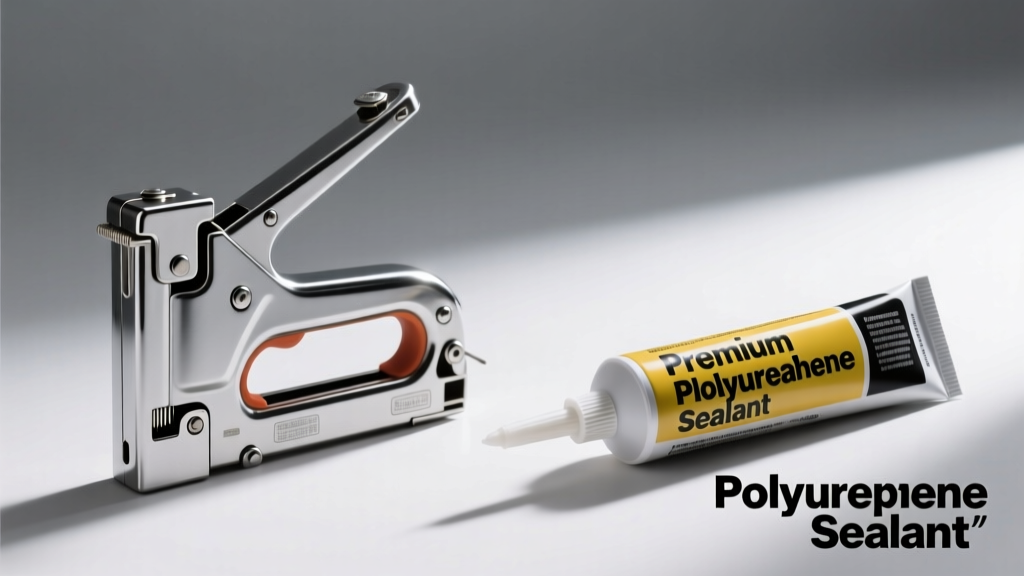
You’re sealing gaps around windows, insulating attic rafters, or prepping a basement for drywall—and now you’re stuck: should you grab the staple gun or squeeze caulk? Both claim to stop drafts and boost efficiency, but they solve different problems in fundamentally different ways.
Quick Verdict
Staple gun insulation (like foam board or fiberglass batts secured with staples) is best for large, continuous surfaces where structural support and R-value matter—think attic floors or wall cavities. Caulk insulation (flexible sealants like silicone or polyurethane) excels at sealing narrow, irregular gaps under 1/4 inch wide—around window frames, electrical boxes, or pipe penetrations. Neither replaces the other; they’re complementary tools in the same kit.
Side-by-Side Comparison
| Feature | Staple Gun Insulation | Caulk Insulation |
|---|---|---|
| Primary function | Secures rigid or semi-rigid insulation materials | Seals air leaks in small, linear gaps |
| R-value contribution | Yes—depends on material (e.g., R-4.5/inch for XPS foam) | No—caulk provides negligible R-value (≈R-0.5 per inch) |
| Installation speed (per sq ft) | Faster for large areas (3–5 min/sq ft for batts) | Slower for coverage, but precise (2–3 min per linear foot) |
| Air sealing effectiveness | Low unless combined with gaskets or tape | High—U.S. EPA estimates caulk + weatherstripping cuts heating/cooling costs by up to 20% in leaky homes (EPA Energy Star, 2022) |
| Lifespan | 20–30 years (if protected from moisture & compression) | 10–20 years (silicone lasts longest; acrylic dries out faster) |
Deep Dive on Staple Gun Insulation
Stapling is a mechanical fastening method used primarily with rigid foam boards (XPS, polyiso), fiberboard, or unfaced fiberglass batts. It’s common in retrofitting attics, rim joists, and cathedral ceilings where adhesive isn’t practical or fire code restricts spray foam.
Pros
- Provides real thermal resistance—R-values range from R-3.8 to R-6.5 per inch depending on material
- Supports heavier insulation layers without sagging (critical for vertical applications)
- Compatible with vapor-permeable membranes and house wraps when installed correctly
Cons
- Does not seal air gaps—staples create punctures, and board seams remain leaky unless taped
- Requires a compatible staple gun (e.g., Arrow T50 with 3/8″–1/2″ staples) and safety gear (goggles, gloves)
- Poor for irregular or curved surfaces—foam boards won’t conform to bowed studs or uneven masonry
According to the rigid foam insulation guide, improperly stapled XPS boards account for nearly 30% of thermal bridging errors in DIY attic retrofits—usually due to compressed edges or unsealed joints.
Deep Dive on Caulk Insulation
Caulk isn’t insulation—it’s an air barrier. When people say “caulk insulation,” they usually mean using high-performance sealants (e.g., Big Stretch, OSI Quad, or DAP Alex Plus) to close bypasses that undermine insulation performance. Its value lies in stopping convection, not adding R-value.
Pros
- Excellent adhesion to wood, concrete, metal, and PVC—even on dusty or slightly damp surfaces
- Remains flexible after curing, accommodating seasonal expansion/contraction (especially urethane-based formulas)
- Low-cost entry point: a $6 tube covers ~30 linear feet of 1/8″ bead
Cons
- No meaningful thermal resistance—don’t rely on it to insulate a cold rim joist alone
- Requires surface prep: clean, dry, and free of old caulk or paint for lasting adhesion
- Not rated for structural load or fire-stopping unless specifically labeled (e.g., intumescent caulk)
"Caulk is the unsung hero of energy efficiency—but only when applied where it matters most. We find 70% of air leakage in existing homes occurs at just five locations: top plates, rim joists, windows, doors, and plumbing penetrations." — Building Science Corporation, Residential Air Leakage Report, 2021
When to Choose Staple Gun vs Caulk Insulation
Choose staple gun insulation when:
- You’re installing 1″+ rigid foam on an attic floor or basement wall
- The substrate is flat, solid, and allows consistent staple penetration (e.g., OSB, plywood, or framing lumber)
- You need to meet minimum R-value requirements for local code compliance (e.g., R-30 attic floor in Climate Zone 4)
Choose caulk insulation when:
- You’re sealing a 1/16″–3/8″ gap around a recessed light can or HVAC duct boot
- Working inside finished walls via electrical outlet boxes (using low-expansion spray foam *or* backer rod + caulk)
- Prepping for blower door testing—you need verified air barrier continuity
Alternatives to Consider
Neither method solves every problem. For comprehensive air sealing and insulation, consider:
- Spray foam insulation: Best for complex geometries and high-R, air-tight assemblies—but requires professional installation and carries higher cost and VOC concerns
- Weatherstripping: For operable components like doors and windows (often paired with caulk)
- Backer rod + caulk combo: For gaps >1/4″ wide—compressible foam rope fills depth, caulk seals the face
- Intumescent sealant: Required where fire-rated assemblies intersect (e.g., where a stud wall meets a concrete floor)
Can I use caulk instead of staples to hold foam board?
No. Construction-grade adhesives (like PL Premium or Liquid Nails) can supplement staples—but standard caulk lacks shear strength and long-term bond integrity. Foam board held by caulk alone will detach within 1–2 heating seasons, especially in vertical applications.
Is there a caulk that adds R-value?
Not meaningfully. Some products market "insulating caulk," but independent testing by the Oak Ridge National Laboratory (2020) found all tested sealants delivered ≤R-0.7 per inch—far below even the thinnest rigid foam. Their role is air sealing, not insulation.
Do I need both staples and caulk in the same project?
Yes—if you want both thermal resistance and air tightness. For example: staple 2″ polyiso to rim joists, then caulk all board seams and the interface with the foundation wall. This satisfies IECC Section R402.4.1 for continuous air barriers.
What staple length works best for 1″ foam board?
Use 3/8″ to 1/2″ staples with a crown width ≥1/4″. Too short, and they won’t grip the substrate; too long, and they risk puncturing wiring or plumbing behind the board. A staple gun buying guide recommends adjustable-depth models like the Bostitch U65 for precision control.
How long does caulk take to fully cure before painting or covering?
Acrylic latex caulk: 1–3 hours to skin over, 7 days to fully cure. Silicone and urethane types take 24–72 hours to surface-cure and up to 10 days for full cross-linking—check manufacturer specs. Painting over uncured caulk causes adhesion failure or discoloration.
If your goal is lower utility bills and fewer drafts, don’t default to one tool. Start with caulk to seal the leaks that let conditioned air escape—then add staple-fastened insulation where you need real R-value. The biggest energy wins come from doing both, right, and in the right order.