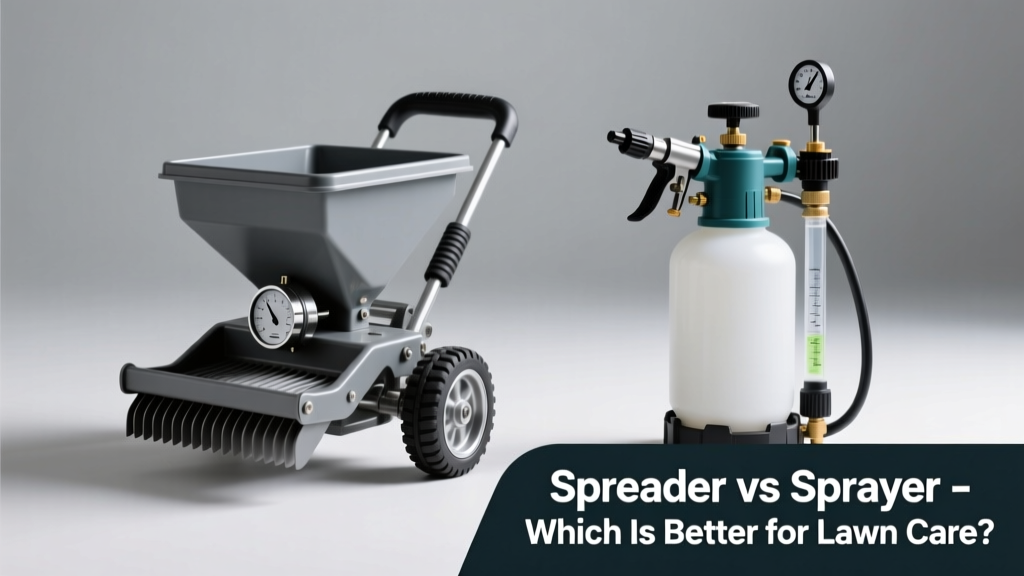
Choosing between a spreader and a sprayer feels like picking between a scalpel and a paintbrush — both get the job done, but in radically different ways. You’ve got fertilizer to apply, weed killer to deploy, or seed to distribute, and the wrong tool can mean uneven growth, chemical runoff, or wasted time.
Quick Verdict
A spreader excels at dry, granular applications like fertilizer, lime, or grass seed — especially on large, flat lawns where consistency matters more than pinpoint accuracy. A sprayer shines with liquid herbicides, insecticides, or foliar feeds where coverage uniformity and targeted delivery are critical. Neither is universally 'better'; your lawn’s size, slope, soil type, and treatment goals determine the right choice — and sometimes, you need both.
Side-by-Side Comparison
| Feature | Spreader (Broadcast or Drop) | Sprayer (Tank or Backpack) |
|---|---|---|
| Best for | Granular fertilizers, pre-emergent herbicides, grass seed, lime | Liquid herbicides, fungicides, insecticides, liquid fertilizers, iron supplements |
| Application speed (1/4 acre) | 8–12 minutes (broadcast), 15–20 min (drop) | 10–14 minutes (with proper calibration) |
| Precision control | Low to moderate; affected by wind, surface texture, and calibration | High — adjustable nozzles, pressure control, and spray pattern options |
| Calibration difficulty | Moderate — requires test runs and scale checks (e.g., 10 ft × 10 ft catch pan method) | High — demands pressure testing, nozzle flow rate measurement, and GPA calculation |
| Cost range (entry-level) | $35–$120 (push-type); $250+ (tow-behind) | $25–$90 (hand pump); $130–$350 (backpack or battery-powered) |
Deep Dive on Spreaders
Spreaders come in three main types: drop, broadcast (rotary), and tow-behind. Drop spreaders deliver material directly beneath the unit — ideal for tight spaces and avoiding overspray onto driveways or flower beds. Broadcast models cast granules in a wide arc (up to 12 ft), covering more ground faster but requiring careful overlap to prevent streaks.
Pros of Spreaders
- No mixing required — just pour and go
- Less risk of chemical drift or overspray onto non-target plants
- Longer shelf life for granular products (no clogging or tank corrosion)
- Easier to store and maintain — no seals, gaskets, or pressure systems
Cons of Spreaders
- Poor performance on slopes >15% — granules roll or wash away before settling
- Inconsistent output on uneven or wet turf (granules clump or bounce)
- Limited ability to treat spot weeds or disease patches without over-applying
- Calibration errors cause visible striping — a 5% error means ~200 sq ft per 1,000 sq ft missed or overlapped
According to the University of Minnesota Extension’s Lawn Care Equipment Guide (2022), “Broadcast spreaders achieve 85–92% uniformity on level ground when properly calibrated — but that drops to 60–70% on bumpy or sloped lawns.”
Deep Dive on Sprayers
Tank sprayers — whether handheld, backpack, or wheeled — atomize liquid solutions into fine droplets. They rely on consistent pressure, clean nozzles, and correct dilution ratios. Battery-powered models now offer variable pressure (20–60 PSI) and digital flow meters, closing the gap with professional-grade units.
Pros of Sprayers
- Superior coverage on slopes, around trees, and in irregularly shaped beds
- Faster uptake for contact herbicides and foliar nutrients (visible results in 24–72 hrs)
- Spot-treatment capability reduces chemical use by up to 40% vs. blanket application (U.S. EPA Pesticide Environmental Stewardship Program, 2021)
- Compatible with adjuvants like surfactants and stickers for better adherence
Cons of Sprayers
- Requires thorough cleaning after every use — residue can degrade seals or clog nozzles
- Vulnerable to wind drift: droplets under 200 microns travel up to 50 ft off-target (USDA ARS Wind Tunnel Study, 2020)
- Liquid concentrates have shorter shelf life and may separate or crystallize if stored improperly
- Higher learning curve: mis-calibrated sprayers waste 30% more product on average (Penn State Turfgrass Team, 2023)
When to Choose a Spreader vs Sprayer
Choose a spreader if you’re applying starter fertilizer before seeding a 5,000-sq-ft backyard, topdressing with compost in spring, or spreading crabgrass preventer across a flat, open lawn. Choose a sprayer if you’re spot-killing dandelions in a shaded patio border, treating brown patch fungus on bentgrass, or applying liquid iron to correct chlorosis on a steep hillside.
For mixed-use lawns — say, a 1/2-acre property with both open turf and ornamental beds — many professionals keep a 40-lb broadcast spreader for granular jobs and a 4-gallon backpack sprayer for targeted liquid work. Some even use a combination unit like the Chapin 20000, which accepts both granular hoppers and spray tanks — though it sacrifices specialization for versatility.
Alternatives to Consider
Before committing to one tool, consider hybrid or complementary options:
- Combo units: Models like the Scotts Turf Builder EdgeGuard MAX integrate spreader + sprayer functions in one chassis — useful for small yards but less precise than dedicated tools.
- Spot-spray attachments: Add-on nozzles (e.g., TeeJet XR8004VS) let you convert some spreaders into low-volume sprayers for liquid pre-emergents.
- Professional services: For lawns over 1 acre or complex pest issues, hiring a licensed applicator may cost $150–$300 per visit but ensures EPA-compliant calibration and recordkeeping.
Can I use a sprayer for granular fertilizer?
No — granules will clog nozzles, damage pumps, and settle in tanks. Even “soluble” granules require full dissolution and filtration before spraying, and most aren’t labeled for that use. Stick to liquids formulated for sprayers — like liquid 10-10-10 or fish emulsion.
Do spreaders work well on Bermuda grass overseeding?
Yes — but only with a drop spreader or slit seeder. Broadcast spreaders scatter seed too widely, leaving bare patches in dense Bermuda thatch. Calibrate for 5–7 lbs of seed per 1,000 sq ft and follow with light raking and irrigation.
How often should I calibrate my sprayer?
Before every use — especially when changing products, nozzles, or pressure settings. The U.S. EPA recommends checking flow rate with a graduated cylinder and stopwatch at least once per tank fill. A 5% deviation adds up fast: over 10,000 sq ft, that’s 500 sq ft under- or over-treated.
Is a battery-powered sprayer worth the extra $80?
Yes, if you treat more than 0.25 acre regularly. Cordless units eliminate pump fatigue, maintain steady PSI, and reduce operator error. In a 2023 Purdue Turf Field Trial, users achieved 22% more consistent coverage with battery sprayers vs. hand-pump models over 30-minute sessions.
What’s the biggest mistake people make with spreaders?
Skipping the calibration step and assuming the bag’s “recommended setting” matches their specific product and wheel speed. One homeowner’s error — using setting “12” for a slow-release 21-7-14 instead of the tested “8” — resulted in 3x the nitrogen rate and severe burn on Kentucky bluegrass (Michigan State Turf Newsletter, Fall 2022). Always test first on pavement or cardboard.
Can I use both tools in the same season?
Absolutely — and many do. Apply granular pre-emergent in early March with a spreader, then spot-spray post-emergent herbicide in May with a sprayer. Just wait 7–14 days between applications to avoid antagonism (e.g., glyphosate + certain fertilizers). Check label compatibility — reading labels saves time and turf.
There’s no universal winner — only the right tool for your specific job, terrain, and timeline. If your lawn is mostly flat and you’re focused on feeding and seeding, start with a quality spreader. If weeds, pests, or disease are recurring issues — or your yard has slopes, trees, and beds — invest in a calibrated sprayer first. And remember: the best equipment won’t fix poor timing, wrong rates, or skipped calibration. Tools serve strategy — not replace it.