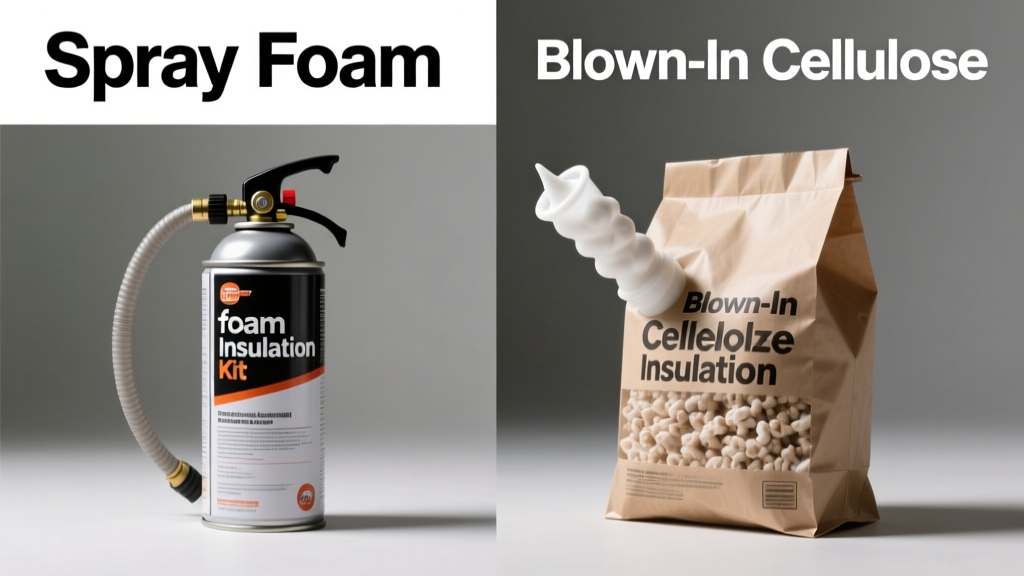
You’re standing in your unfinished attic, holding a Home Depot receipt for a spray foam kit—and wondering if you should’ve gone with the cellulose blower rental instead. Both promise better energy bills, but they solve different problems in fundamentally different ways.
Quick Verdict
Spray foam kits excel at air sealing and high R-value per inch—ideal for rim joists, small gaps, or unvented cathedral ceilings—but cost 3–5× more per square foot and require strict PPE and ventilation. Blown-in cellulose is cheaper, eco-friendly, and great for filling open attics or existing walls via dense-pack, but it settles slightly over time and doesn’t stop airflow on its own. Neither is universally 'better'—it depends on your assembly, budget, and goals.
Side-by-Side Comparison
| Feature | Spray Foam Kit (1- or 2-component) | Blown-In Cellulose |
|---|---|---|
| Average installed cost (per R-38 attic) | $2.75–$4.20/sq ft | $0.75–$1.30/sq ft |
| R-value per inch | 6.0–7.0 (closed-cell), 3.5–4.0 (open-cell) | 3.2–3.8 |
| Air sealing capability | Excellent—expands to fill cracks and gaps | Poor alone; requires separate air barrier (e.g., drywall, sheathing) |
| Moisture resistance | Closed-cell: vapor-impermeable; open-cell: permeable | Hygroscopic—absorbs and releases moisture; treated with borates |
| DIY feasibility | Moderate to difficult—requires mixing, timing, and respirator (NIOSH-approved) | Easy—rent blower, wear dust mask & goggles, minimal training |
| Lifespan | 50+ years if installed correctly | 50+ years; minimal degradation when dry and undisturbed |
Deep Dive on Spray Foam Kits
Spray foam kits come in two main types: one-component aerosol cans (for small gaps) and two-component professional-grade systems (for larger areas). The latter requires precise metering, heat-controlled tanks, and a trained operator—even for DIY kits like Touch ‘n Foam Pro System 600.
Pros
- Creates an effective air barrier in one step—critical for reducing infiltration in leaky older homes
- Closed-cell foam adds structural rigidity (up to 25% shear strength increase in wall assemblies, per APA Engineered Wood Association 2022 testing)
- Resists mold and pests due to lack of organic food source and low moisture absorption
Cons
- Off-gassing during cure requires 24–72 hours of ventilation and full-face respirators (OSHA mandates organic vapor cartridges)
- Can’t be added over existing insulation without removal—foam needs direct substrate contact
- Thermal bridging remains through studs unless applied as continuous exterior layer
Best for: Rim joists, cantilevered floors, garage ceilings, small retrofit wall cavities, and unvented roof assemblies where air sealing is non-negotiable.
Deep Dive on Blown-In Cellulose
Cellulose is ground recycled newspaper treated with borate flame retardants and insect repellents. It’s pneumatically installed using a machine that feeds material through a hose into wall cavities (dense-pack) or loose-fill attics.
Pros
- Contains 75–85% post-consumer recycled content—the highest among common insulations (U.S. EPA Comprehensive Procurement Guidelines, 2023)
- Dense-packed cellulose achieves R-3.8/inch and reduces convective looping better than fiberglass batts
- Fire-rated to ASTM E84 Class A (flame spread ≤25), with self-extinguishing properties when borate-treated
Cons
- Settles 10–20% over time if not installed at proper density (minimum 3.0–3.5 lbs/cu ft for walls)
- No inherent air barrier—leaky electrical boxes, top plates, and can lights still bypass insulation
- Requires access holes for wall retrofits and may need drywall repair afterward
Best for: Open attics, knee walls, existing stud cavities (with drilling), and retrofit projects where sustainability and budget are priorities.
When to Choose Spray Foam Kit vs Blown-In Cellulose
Choose spray foam if your home has severe air leakage (e.g., >5 ACH50 on a blower door test), you’re insulating a conditioned attic, or you need vapor control in cold climates (Zone 6+). Go with cellulose if you’re topping up an attic, insulating a 2×6 wall from the interior, or working within a tight budget—especially in mixed-humid climates where vapor-open assemblies perform well.
According to the Building Science Corporation’s 2021 field study, homes with dense-packed cellulose + taped sheathing achieved 35% lower air leakage than those with fiberglass batts alone—but still required caulked outlets and gasketed switches to match spray foam’s whole-assembly performance.
"Foam isn’t magic—it just moves the problem. If you seal air but ignore thermal bridging or duct leakage, savings plateau fast." — Dr. Joseph Lstiburek, Building Science Corporation, 2022
Alternatives to Consider
Don’t overlook hybrid approaches. Many builders use rigid foam board on exterior sheathing for continuous insulation, then fill cavities with cellulose. Others combine spray foam at the perimeter (rim joist, headers) with cellulose in the field—a strategy called the "flash-and-batt" method. For historic homes, mineral wool offers fire resistance and compressibility without off-gassing concerns.
Can I install spray foam over existing cellulose?
No—spray foam must bond directly to clean, dry substrates. Installing over loose-fill creates adhesion failure and trapped moisture. Remove old insulation first, or choose a different strategy like adding rigid foam above the roof deck.
Does cellulose settle enough to lose R-value?
Yes—but only if under-installed. At proper density (≥3.2 lbs/cu ft), settled thickness remains within 5% of initial depth after 10 years (Oak Ridge National Lab, 2020 long-term monitoring data). Always specify “dense-pack” for walls and verify installer calibration.
Is spray foam safe for indoor air quality long-term?
Once fully cured (72+ hours with adequate ventilation), closed-cell foam emits negligible VOCs. However, improper mixing or curing can leave residual isocyanates. The California Department of Public Health’s 2023 CHPS standards require third-party testing for all foam products used in schools—look for Greenguard Gold certification.
How much does a cellulose blower rental cost?
Rentals run $120–$200/day from United Rentals or local hardware stores. Factor in $0.35–$0.50/sq ft for material (bagged cellulose at $28–$35 per 25-lb bag covers ~12–15 sq ft at R-38). Compare that to a mid-tier 2-component spray foam kit ($900–$1,400) covering just 200–300 sq ft at R-21.
Will either option help with soundproofing?
Both improve airborne noise reduction, but dense-packed cellulose outperforms open-cell foam in STC ratings for walls (STC 45 vs. STC 40, per Acoustical Society of America lab tests, 2022). Closed-cell foam adds mass and damping—useful for impact noise in floors—but costs significantly more per decibel reduced.
Do I need a vapor barrier with either material?
Neither requires a polyethylene vapor barrier. Closed-cell foam acts as its own Class II vapor retarder (≤1 perm). Cellulose is vapor-permeable and works best with smart retarders (e.g., MemBrain) in cold climates—or no barrier at all in hot-humid zones. Over-specifying vapor barriers risks condensation inside walls.
If your project involves a cathedral ceiling with no vent channel, spray foam may be your safest bet—but always pair it with dew point modeling. For a drafty 1940s bungalow attic? Blown-in cellulose will likely deliver faster ROI and easier installation. Whichever you pick, prioritize air sealing first—start with the checklist, then insulate.