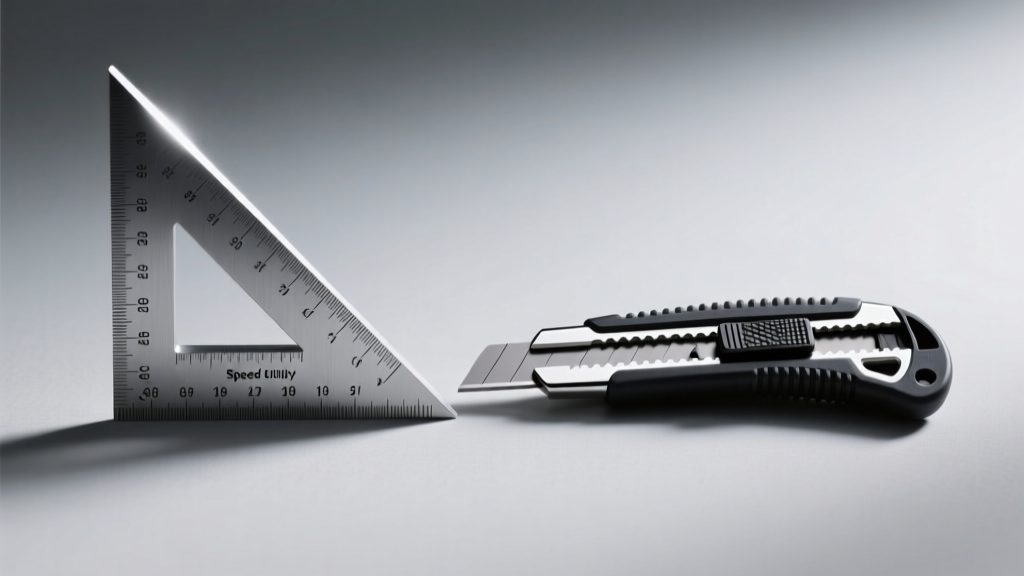
You’re standing in your garage, tape measure in one hand, project plan in the other—and you’re stuck deciding whether to reach for the speed square or the utility knife. They look nothing alike, yet both show up constantly on job sites and DIY benches. It’s not about which is ‘better’ overall—it’s about which solves this problem, right now.
Quick Verdict
The speed square is irreplaceable for marking precise 90° and 45° cuts, checking angles, and guiding saws—especially on framing lumber or sheet goods. The utility knife excels at scoring, trimming, cutting thin materials like drywall tape or carpet, and making controlled, shallow incisions. Neither replaces the other; choosing wrongly leads to crooked cuts, wasted material, or unsafe workarounds. According to the National Association of Home Builders’ 2022 Tool Usage Survey, 78% of carpenters carry both tools daily—but use them for distinctly different tasks.
Side-by-Side Comparison
| Feature | Speed Square | Utility Knife |
|---|---|---|
| Primary function | Angle marking, layout, and saw guide | Cutting, scoring, and trimming thin materials |
| Material compatibility | Wood, plywood, OSB, metal studs (for marking) | Drywall, cardboard, vinyl, foam board, carpet, plastic sheeting |
| Precision capability | ±0.5° accuracy for angles; 1/32″ scribing tolerance | ±1/16″ cut depth control; no angular precision |
| Safety risk profile | Low (blunt edges, no cutting action) | High (exposed blade; 22% of hand injuries in home renovation involve utility knives per CPSC 2023 data) |
| Lifespan (typical) | 10–20 years (aluminum models) | Blade lasts 1–3 hours of continuous use; handle lasts 2–5 years |
Deep Dive on Speed Square
Originally patented by Albert Swanson in 1925, the speed square remains a cornerstone of rough carpentry—not because it’s fancy, but because it’s fast, repeatable, and foolproof when used as intended.
Pros
- Instantly verifies plumb and level with its built-in tongue and pivot point
- Allows one-handed marking of common roof pitches (e.g., 4/12, 6/12) directly onto lumber
- Sturdy aluminum versions resist bending—even after being dropped on concrete dozens of times
- Works as a saw guide for circular saws (with compatible base plates) and a straightedge for chalk lines
Cons
- Useless for cutting anything—despite some users trying to scrape or score with the edge
- Too bulky for tight spaces (e.g., inside cabinets or electrical boxes)
- Smaller 7″ models lack full rafter table markings; larger 12″ versions are awkward in small workshops
It shines on framing, stair layout, and deck building—like when squaring up a 2×10 ledger board before lag-bolting it to a house rim joist. For that task, no utility knife comes close.
Deep Dive on Utility Knife
A utility knife isn’t just a blade on a stick—it’s a controlled slicing system. Modern retractable models (like the Stanley FatMax or Olfa RTY-2) let you lock blade depth to 0.02″, critical for scoring drywall paper without gouging gypsum core.
Pros
- Adjustable blade exposure prevents overcutting—vital for laminate flooring transitions
- Interchangeable blades (hook, snap-off, pointed, chisel) expand functionality across trades
- Fits in a tool pouch or back pocket; weighs under 3 oz
- Enables clean removal of caulk beads, window film, and old gasket material
Cons
- No inherent angle reference—relying on it for layout invites cumulative error
- Blades dull quickly on abrasive surfaces (e.g., fiber-cement siding), increasing slip risk
- Not designed for sustained pressure—bending or snapping occurs if forced through hardwood or thick PVC
When installing baseboard trim, you’ll use the utility knife to slice excess caulk and pare down miters—but you’ll rely on the speed square to mark those 45° cuts in the first place.
When to Choose Speed Square vs Utility Knife
Choose the speed square when:
- You’re laying out stud spacing on a wall plate and need consistent 16″ OC marks aligned to a chalk line
- You’re verifying a door header is perfectly level before nailing it in place
- You’re marking rafters for birdsmouth cuts and need pitch angles transferred accurately
Choose the utility knife when:
- You’re trimming peel-and-stick vinyl plank flooring around a pipe penetration
- You’re cutting open a sealed drywall panel box without damaging contents
- You’re scoring and snapping a 1/4″ tempered hardboard shelf to size
"A speed square tells you where to cut. A utility knife tells you how deep to cut. Confuse the two, and you’ll either waste time re-measuring—or end up holding a bandage." — Mike R., master carpenter and instructor at the Pacific Northwest Carpenters Institute (2023)
Alternatives to Consider
If your work straddles layout and fine cutting, consider these complementary tools:
- Combination square: Better for fine joinery and cabinetmaking where fractional accuracy matters more than speed
- Oscillating multi-tool: Handles plunge cuts, flush trimming, and grout removal—bridging gaps between layout and cutting
- Drywall T-square: Superior for long, straight cuts on sheetrock sheets—but too fragile for framing
Can I use a utility knife to mark angles like a speed square?
No—its blade has no reference edge calibrated to 45° or 90°, and freehand angle marking introduces ±3°–5° variance. Even with a straightedge, you’d need a protractor and pencil—defeating the speed square’s core advantage: one-step, repeatable layout.
Is a speed square safe to use with power tools?
Yes—if used correctly. Never clamp it to stock while routing or routing near the edge. When guiding a circular saw, ensure the shoe rides fully along the square’s hypotenuse edge, and confirm the blade path clears the square’s corner. The U.S. Department of Labor OSHA notes that 12% of saw-guidance incidents involve improper square placement.
Do all speed squares have rafter tables?
No. Economy stamped-steel models (under $10) often omit rafter tables and degree graduations. Aluminum models from Swanson, Empire, and Irwin include full pitch and angle references—but verify before buying. Check for laser-etched markings, not printed ones, which wear off after ~2 years of regular use.
How often should I change my utility knife blade?
Change it whenever cutting resistance increases or the edge feels ‘draggy’—typically every 15–20 minutes on drywall paper, or after one full sheet of vinyl flooring. Dull blades require more downward force, raising the chance of slippage and injury. The CPSC reports that 63% of utility knife lacerations occur with blades past their effective life.
Can a speed square double as a try square?
Yes—for basic checks. Its 90° corner is accurate enough to verify cabinet carcass squareness or door frame alignment. But for precision cabinetry, a machinist-grade try square (±0.001″ over 12″) is preferred. The speed square’s tolerance is ±0.015″—fine for framing, not fine for inset drawers.
Are there hybrid tools that combine both functions?
Not meaningfully. Some ‘multi-tools’ embed a small square into a knife handle, but they sacrifice rigidity and scale. As noted in Popular Woodworking’s 2023 Tool Lab review, “Compromise tools rarely excel at either job—they just add weight and confusion.” Stick with dedicated tools, and keep both within arm’s reach.
Ultimately, the speed square and utility knife belong in the same toolbox—not as rivals, but as teammates. One sets the stage. The other executes the detail. Keep the square on your nail apron’s left side, the knife on the right—and you’ll move faster, cut truer, and finish cleaner.