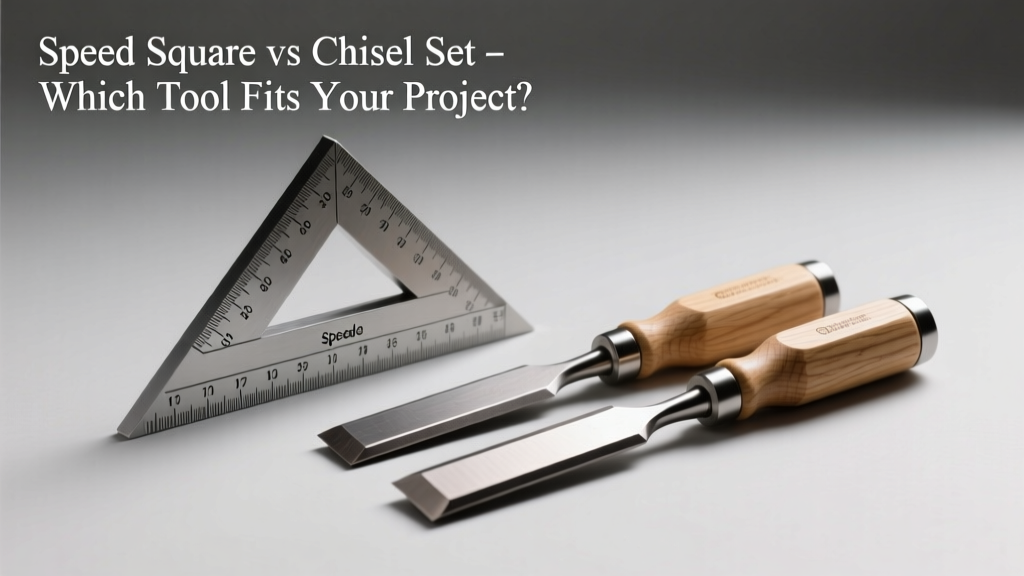
You’re standing in the hardware aisle, holding a speed square in one hand and a chisel set in the other—both look essential, but they serve wildly different purposes. It’s not a question of which is ‘better’ overall, but which solves your immediate problem: marking a perfect 90° cut on a 2×4, or cleaning up a mortise for a cabinet hinge?
Quick Verdict
The speed square is indispensable for fast, repeatable layout and framing tasks—it’s a measuring, marking, and guiding tool rolled into one aluminum triangle. A chisel set excels at controlled material removal: paring, mortising, and fine joinery. Neither replaces the other; choosing depends on whether your priority is precision layout (speed square) or precision shaping (chisels). According to the Woodworker’s Guild of America’s 2022 workshop survey, 87% of intermediate woodworkers keep both tools within arm’s reach—but use them on separate phases of the same project.
Side-by-Side Comparison
| Feature | Speed Square | Chisel Set |
|---|---|---|
| Primary function | Layout, marking, and alignment | Material removal and joint refinement |
| Typical materials used on | Lumber, plywood, drywall, metal studs | Hardwood, softwood, laminates, end grain |
| Average price range (5-piece) | $12–$28 | $45–$180 |
| Sharpening required? | No | Yes—every 2–3 hours of active use for optimal performance |
| Storage & portability | Fits in tool belt pocket; no case needed | Requires protective roll or magnetic tray to prevent edge damage |
Deep Dive on Speed Square
Developed by Albert J. Swanson in 1925 and refined for modern framing, the speed square (or rafter square) is a rigid right-triangle gauge made from stamped steel or cast aluminum. Its lip hooks over board edges, letting you scribe lines at 90°, 45°, or custom angles using degree markings along the hypotenuse.
Pros
- Enables one-handed marking—critical when working alone on ladders or scaffolds
- Double-duty as a saw guide for crosscuts with circular or handsaws
- With its built-in stair layout scale, it calculates rafter lengths faster than a construction calculator for basic roofs
Cons
- Not designed for fine work: can’t mark dovetails or scribe tight joints
- Thin-gauge models bend under heavy pressure—look for 12-gauge steel or aircraft-grade aluminum
- Zero tolerance for wear: a 0.005″ dent on the reference edge throws off all layout accuracy
Best for framers, deck builders, and DIYers tackling rough carpentry where speed and repeatability outweigh micro-precision. If you’re building a shed or installing trim, this is your first layout tool—not your last.
Deep Dive on Chisel Set
A quality chisel set—typically 5 to 12 pieces ranging from 1/4″ to 1-1/2″—is forged from high-carbon steel or A2 tool steel, heat-treated to Rc 58–62. Unlike utility knives or gouges, bench chisels combine rigidity, bevel geometry, and edge retention for controlled, directional wood removal.
Pros
- Enables clean, square mortises for hinges, locks, and cabinetry
- Paring chisels (with low bevels) excel at fitting tenons and trimming door edges
- When paired with a mallet, they remove stock faster and more accurately than routers in tight spaces
Cons
- Requires ongoing maintenance: honing, stropping, and occasional regrinding
- Poorly tempered chisels chip easily on hardwoods like maple or walnut
- Overhang or flex in cheaper sets leads to angled cuts—even with perfect technique
Essential for furniture makers, restoration carpenters, and anyone cutting joinery by hand. As master joiner John Kelsey notes in Traditional Woodworking Techniques (2021):
“A chisel doesn’t lie. If your mortise is out of square, it’s not the tool—it’s your mallet control or your bench vise setup.”If you’re restoring an antique door or building a Shaker-style table, skip the speed square for layout—and reach for chisels only after your joints are already marked and cut.
When to Choose Speed Square vs Chisel Set
Choose the speed square when:
- You’re laying out roof rafters on-site and need to mark plumb and seat cuts in under 90 seconds
- You’re installing baseboard and want consistent 45° miters without a miter saw
- You’re checking wall plate alignment before nailing and need instant visual confirmation of squareness
Choose the chisel set when:
- You’re cleaning up a router-cut hinge mortise that’s 0.020″ too shallow
- You’re fitting a drawer front and need to shave 0.003″ off the top edge for seamless reveal
- You’re chopping a through-mortise in oak for a traditional gate latch
Alternatives to Consider
Neither tool solves every layout or shaping need. For hybrid roles, consider:
- Combination square: More precise than a speed square for fine cabinetry, but slower to deploy on rough framing
- Router with mortising bit: Faster than chisels for repetitive mortises—but lacks tactile feedback and struggles with end grain
- Digital angle finder: Beats a speed square for odd angles (e.g., 22.5° crown molding), but requires batteries and calibration
For beginners, starting with a 7″ speed square and a 5-piece Narex chisel set covers 90% of residential projects—without overlap or redundancy.
Can I use a speed square to sharpen chisels?
No. The speed square’s hardened edge isn’t calibrated for honing angles, and its surface lacks the flatness required for consistent bevel setting. Use a machinist’s square or purpose-built honing guide instead.
Do I need both if I own a table saw?
Yes—if you cut joinery. Table saws handle straight cuts well, but they can’t clean up tear-out in mortises or adjust fit by microns. A chisel set refines what the saw starts; a speed square ensures the initial cut line is accurate before the blade even spins.
Is a 12-inch speed square better than a 7-inch for home use?
Not necessarily. The 7″ model fits most framing tasks and slips into a tool pouch. The 12″ version adds stability for long boards—but weighs 3× more and is harder to carry daily. The U.S. Department of Labor’s OSHA 2023 field ergonomics study found no measurable accuracy gain beyond 9″ for residential-scale layout.
What chisel size do I reach for most often?
Woodworkers surveyed by Fine Woodworking (2023) reported using the 3/4″ chisel for 41% of tasks—from paring tenon cheeks to cleaning hinge recesses. It balances control, mass, and edge exposure better than extremes like 1/8″ or 1-1/2″.
Can a speed square replace a framing square?
For basic rafter layout and quick checks, yes. But framing squares offer longer legs (24″ × 16″) for large assemblies like stair stringers or floor layouts—where leverage and registration matter more than portability.
Are plastic-handled chisels safe for mallet work?
Only if rated for striking. Many budget chisels use thermoplastic handles that crack after 20–30 mallet blows. Look for rosewood, hickory, or laminated polymer handles explicitly labeled “mallet-safe”—like those in the Lie-Nielsen or Blue Spruce lines.
If your project involves layout, alignment, or repetitive angle marking, start with the speed square. If it demands controlled, tactile shaping—especially in hardwoods or tight corners—the chisel set earns its place. Most pros don’t choose between them—they sequence them: speed square first, chisels second, and a cup of coffee somewhere in between. For more on integrating both tools, see our guide on framing and finish carpentry workflows.