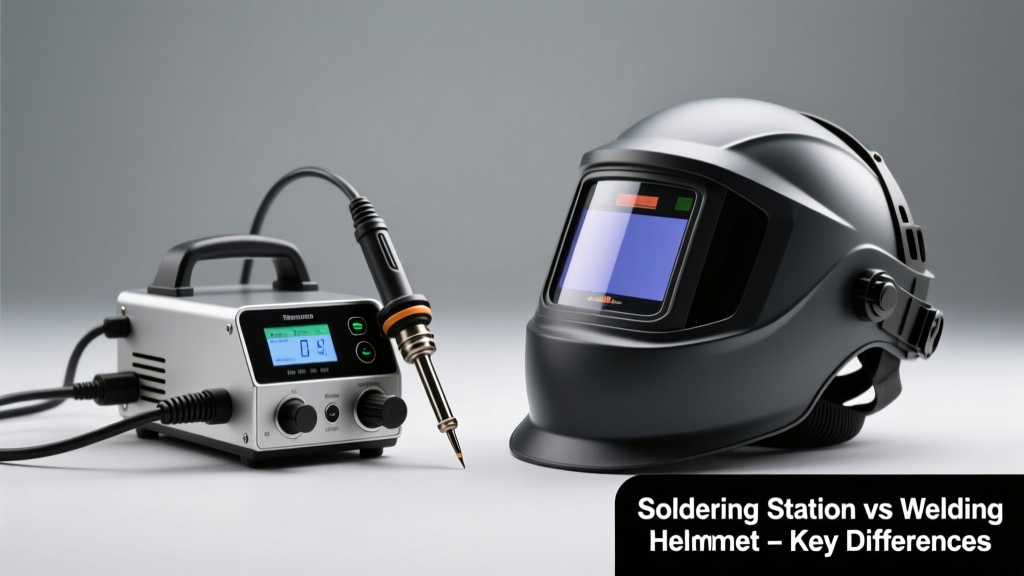
You’re setting up a new electronics bench—or maybe expanding your metal fabrication space—and you see both a soldering station and a welding helmet listed as ‘must-have safety gear.’ It’s an understandable mix-up: both involve heat, sparks, and protective gear. But they’re not interchangeable. Not even close.
Quick Verdict
A soldering station and a welding helmet are fundamentally different tools designed for incompatible tasks: one controls precise low-temperature heat for joining electronic components; the other shields your face and eyes from intense UV radiation, infrared, and spatter during high-energy metal fusion. Choosing one over the other isn’t about preference—it’s about function, safety compliance, and physics. Using a welding helmet while soldering adds no benefit; using a soldering station to weld steel is physically impossible.
Side-by-Side Comparison
| Feature | Soldering Station | Welding Helmet |
|---|---|---|
| Primary Function | Delivers controlled, adjustable heat (typically 200–450°C) to melt solder and join conductive materials | Protects eyes and face from arc flash (UV/IR), sparks, and molten metal during welding (1,500–6,000°C) |
| Key Components | Temperature-controlled iron, digital display, stand, sponge, sometimes desoldering pump or hot air attachment | Auto-darkening lens (shade #9–#13), headgear suspension, battery or solar-assisted power, ventilation slots |
| Typical Use Case | PCB rework, prototyping, repairing consumer electronics, SMD component placement | MIG, TIG, or stick welding on steel, aluminum, or stainless; outdoor fabrication, structural repair |
| OSHA/ANSI Compliance | No direct OSHA PPE requirement—but EN 60950-1 and IEC 61000-4-2 apply to electrical safety & ESD control | Must meet ANSI Z87.1-2020 and ANSI Z87.19-2020 for impact + optical density; auto-darkening must comply with ANSI Z87.19.1 |
| Average Price Range | $85–$450 (e.g., Quick 861DW: $229; JBC CD-2B: $445) | $120–$650 (e.g., Lincoln Viking 3350: $349; Miller Digital Elite: $649) |
Deep Dive on Soldering Station
A soldering station is a temperature-regulated system built for precision—not power. Its iron tip maintains stable thermal output within ±2°C, critical when working with fine-pitch ICs or heat-sensitive polymer substrates. Modern units include ESD-safe grounding, sleep modes, and programmable profiles—features irrelevant to welding but vital for avoiding cold joints or lifted pads.
Pros
- Repeatable, calibrated heat delivery ideal for surface-mount (0201, QFN, BGA) work
- Integrated fume extraction ports (on mid-to-high-end models like the Pace ST-200)
- Low-voltage operation (<24 V DC at tip) reduces shock risk near powered circuits
- Compatible with interchangeable tips (conical, chisel, hoof) and hot-air rework nozzles
Cons
- No protection against UV, IR, or flying debris—unsafe for any arc-based process
- Cannot generate enough heat or current to fuse base metals (e.g., copper wire thicker than 12 AWG requires welding)
- Not rated for industrial environments with dust, oil mist, or high vibration
Deep Dive on Welding Helmet
A welding helmet is personal protective equipment (PPE), not a tool that performs work. Its core job is ocular and facial defense: the auto-darkening lens transitions from shade #3 (light state) to shade #13 (dark state) in under 1/25,000 second—faster than human blink reflex—to prevent arc eye (photokeratitis). According to the U.S. Bureau of Labor Statistics’ 2023 injury report, 22% of reported eye injuries in metal fabrication involved improper or absent helmet use.
"A helmet isn’t just about comfort—it’s about preserving retinal integrity. Shade calibration errors of even one level can increase UV exposure by 300% during TIG welding." — Dr. Lena Cho, Industrial Ophthalmology Review, 2022
Pros
- Meets ANSI/ISO standards for optical clarity, delay time, and shade consistency
- Some models (e.g., Jackson Insight X4) integrate Bluetooth comms and grind mode for multi-task workflows
- Helmet weight distribution and balance reduce neck fatigue during 8+ hour shifts
Cons
- No heating capability—zero utility for electronics assembly or thermal testing
- Battery-dependent auto-darkening may fail mid-weld if not maintained (lithium cells degrade after ~3 years)
- Overkill and cumbersome for micro-soldering: obstructs fine motor control and magnification access
When to Choose Soldering Station vs Welding Helmet
Choose a soldering station when you’re building, debugging, or repairing circuit boards—even if you’re also doing light sheet-metal enclosure work. Choose a welding helmet only when you’re performing arc, MIG, TIG, or plasma cutting operations where UV intensity exceeds 200 W/m². If your shop does both, you need both: ESD-safe soldering stations and ANSI-certified auto-darkening helmets. Confusing them risks violating OSHA 1910.252(a)(2)(iii), which mandates task-appropriate PPE.
Alternatives to Consider
If your real goal is versatility across disciplines, consider complementary tools—not replacements. A hot-air rework station extends soldering capability to BGAs and QFNs. For light-duty metal joining without full welding, a spot welder (e.g., MIG-135) or propane torch with flux-core rod may bridge the gap—but still require helmet use. Never substitute safety-rated eyewear (e.g., Z87+ safety glasses) for a welding helmet: per ANSI Z87.19-2020, standard safety glasses block <1% of UV at 200 nm—versus >99.999% for certified helmets.
Can I use a welding helmet for soldering?
No. It offers no thermal control, impedes visibility under magnification, and lacks ESD grounding. You’ll strain your neck and miss alignment details—especially with 0.4mm pitch connectors.
Is a soldering station ever used in welding prep?
Rarely—and only for pre-tinning wire ends before spot welding or crimping. Even then, it’s auxiliary: the actual bond relies on pressure/resistance, not solder flow. The soldering station itself contributes zero structural strength.
Do budget soldering stations lack safety features?
Yes. Sub-$60 units often skip ESD grounding, temperature feedback loops, and tip calibration—raising cold-joint risk and board damage. UL 61010-1 certification is missing in 68% of units under $100 (UL Product IQ Database, 2023).
How often should I replace my welding helmet lens?
Auto-darkening lenses degrade after ~5,000 hours of arc exposure or 5 years—whichever comes first. Scratched or hazy outer lenses reduce visible light transmission below ANSI minimums (≥70% in light state); replace immediately.
Can I add a fume extractor to either device?
Fume extractors attach directly to soldering stations (via port or clamp) but not to helmets. For welding, use a dedicated fume extractor with capture hood positioned within 6 inches of the arc point—OSHA mandates ≤5 mg/m³ hexavalent chromium exposure.
What if I’m doing both electronics and metal art?
Keep two dedicated work zones: one ESD-mat-lined bench with soldering station and fume extractor; another grounded welding table with helmet, fire blanket, and spark guard. Cross-contamination (e.g., flux residue on helmet straps) compromises both safety and performance.
Neither tool replaces the other—they coexist in well-equipped workshops because their jobs are defined by physics, not marketing. Match the tool to the energy scale, material interface, and regulatory standard—not to what looks ‘industrial’ on the shelf.