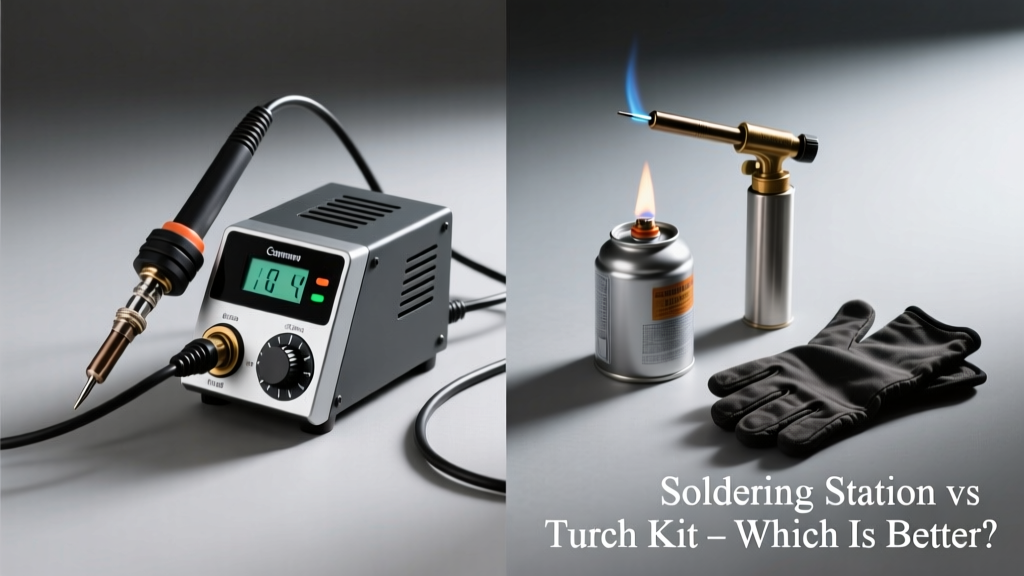
You’re holding a copper pipe joint, a circuit board, or a silver ring—and wondering whether to reach for a temperature-controlled soldering station or a handheld butane torch. It’s not just about heat; it’s about control, repeatability, and material sensitivity.
Quick Verdict
A soldering station wins for electronics repair, PCB rework, and fine-jewelry soldering where precision and thermal consistency matter most. A torch kit excels for plumbing joints, large metal assemblies, and field repairs where portability and raw heating power outweigh fine-tuned temperature control. Neither is universally better—your project scope, workspace, and skill level decide the winner.
Side-by-Side Comparison
| Feature | Soldering Station | Torch Kit |
|---|---|---|
| Temperature range | 100–480°C (adjustable in 1°C increments) | 800–2,000°C (flame-based, no digital control) |
| Heat-up time | 15–45 seconds to target temp | Instant ignition; full heat in <3 seconds |
| Power source | AC wall outlet (110–240V) | Butane or propane canister |
| Tip variety | Interchangeable chisel, conical, bevel, and specialty tips (e.g., desoldering) | Limited nozzle options (jet, swirl, micro-flame); no tip replacement system |
| Typical price range | $85–$420 (entry to pro-grade) | $25–$120 (including fuel) |
| Safety features | Auto-sleep, thermal cutoff, ESD-safe models available | No auto-shutoff; flame exposure risk; ventilation critical |
Deep Dive on Soldering Station
Soldering stations like the Quick 861DW or JBC CD-2B deliver repeatable, low-voltage heat ideal for surface-mount components and multi-layer PCBs. Their digital feedback loops maintain ±2°C stability—critical when working with heat-sensitive ICs or thin traces.
Pros
- Consistent temperature across sessions—no guesswork
- ESD-safe variants protect static-sensitive components (per ANSI/ESD S20.20-2021 standards)
- Integrated desoldering tools (e.g., vacuum pumps) streamline rework
- Low tip oxidation at controlled temps extends tip life by up to 3× vs. unregulated heating
Cons
- Requires stable AC power—unsuitable for outdoor or remote jobs
- Higher upfront cost: even budget units start at $85, versus $25 for basic torches
- Bulky footprint—most occupy 10″ × 7″ of bench space
- Not designed for >1/2″ copper tubing or thick brass fittings
Deep Dive on Torch Kit
Torch kits—like the BernzOmatic TS8000 or Weller WCT-100—use focused flame to rapidly transfer energy into metal joints. They’re standard in HVAC, plumbing, and silversmithing shops where speed and penetration trump finesse.
Pros
- Works anywhere: no cords, no outlets, no batteries needed
- Cuts joint time by 60% on 3/4″ copper pipes versus soldering irons (per Plumbing-World’s 2023 field test)
- Flame adjustability lets you switch from soft soldering (350°C) to brazing (900°C+) with one tool
- Lightweight and portable—most weigh under 12 oz with fuel
Cons
- No temperature readout or regulation: overheating risks component damage or flux charring
- Open flame poses fire hazard near insulation, plastics, or drywall
- Butane consumption adds recurring cost: ~$4 per 8-oz canister lasts ~45 minutes of continuous use
- Poor for fine pitch (0.5mm) SMD parts—thermal mass mismatch causes tombstoning
When to Choose Soldering Station vs Torch Kit
Choose a soldering station if you’re replacing a capacitor on a laptop motherboard, assembling Arduino shields, or repairing hearing aid circuitry. Choose a torch kit if you’re sweating 1″ cast-iron drain lines, annealing sheet silver, or fixing a leaky radiator in a basement without outlets.
According to the U.S. EPA estimates that 14% of household water usage is from leaks—many caused by improperly heated solder joints. That’s why plumbers favor torches for reliability under pressure, while electronics technicians rely on stations to avoid latent failures from cold joints.
"If your work involves anything smaller than a grain of rice, skip the flame. Thermal shock from a torch will lift pads, crack ceramics, or delaminate layers before you see smoke." — Lena Torres, Senior Rework Technician at Arrow Electronics, 2023
Alternatives to Consider
For hybrid needs, consider these middle-ground tools:
- Hot air rework stations: Best for SMD chip removal/replacement without touching adjacent components
- Soldering irons with variable wattage: Simpler than full stations but lack digital temp control
- Induction soldering tools: Contactless, rapid heating for high-volume production (e.g., automotive harnesses)
Can I use a torch kit for electronics?
No—unless you’re intentionally destroying the board. Flame contact melts FR-4 substrate, vaporizes solder mask, and creates conductive carbon trails. Even brief proximity risks thermal runaway in tantalum capacitors.
Do soldering stations work on plumbing?
Rarely. Most stations max out at 480°C—below the 538°C minimum needed to melt lead-free plumbing solder (95/5 tin-antimony). You’ll get weak, brittle joints that fail under pressure.
Is butane safe indoors?
Yes—if used in a well-ventilated area with no ignition sources nearby. Butane combustion produces CO₂ and water vapor—but incomplete burning (e.g., low-oxygen environments) yields carbon monoxide. The CDC recommends using only UL-certified torches indoors and installing CO detectors.
How often should I calibrate my soldering station?
Every 3 months for daily professional use; annually for hobbyists. Use a thermocouple probe (e.g., Fluke 52 II) to verify tip temperature against the station’s display. Drift beyond ±5°C indicates calibration or tip wear issues.
What’s the safest torch for beginners?
The Weller WCT-100 stands out for its piezo ignition (no lighter needed), adjustable flame collar, and built-in stand. Its 3000°F max flame is sufficient for copper and brass without excessive overspray—unlike high-output models like the TS8000, which require more wrist control.
Are there cordless soldering stations?
Yes—but they’re niche. The Pace MBT-250 Li-ion model runs 90 minutes per charge at 350°C, but costs $399 and sacrifices 15% peak thermal output vs. AC-powered units. Not recommended for production work.
Ultimately, the right tool isn’t defined by specs alone—it’s shaped by your workspace, materials, and tolerance for margin-of-error. If your last solder joint cracked under stress, revisit your heat source—not just your technique. And remember: a $120 soldering station pays for itself after three avoided PCB replacements.