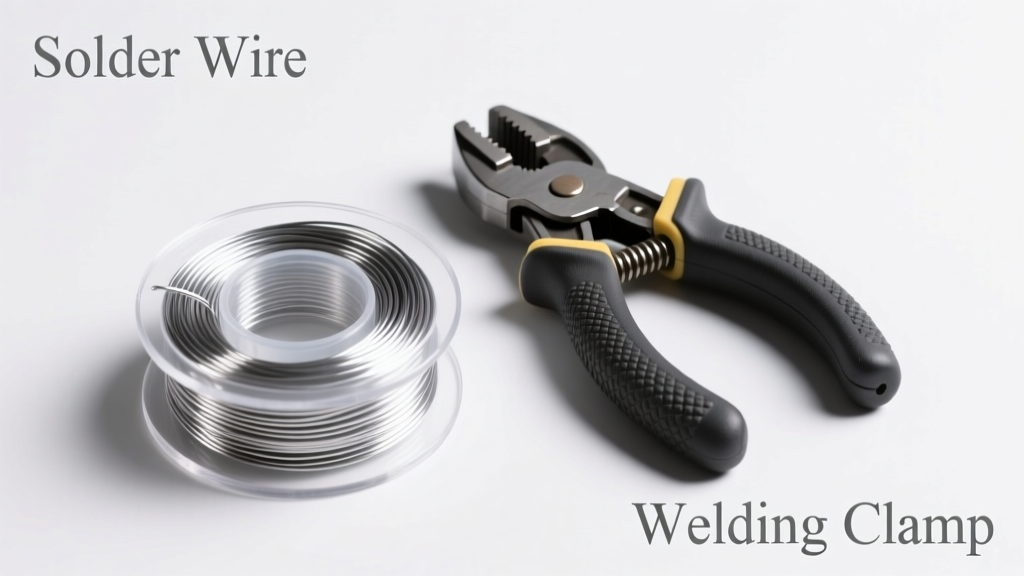
You’re holding a loose wire on a circuit board and a rusted bracket on a trailer — and suddenly wonder: should I reach for solder wire or a welding clamp? They’re both metal-joining tools, but they solve entirely different problems. Confusing them can waste time, money, or even create safety hazards.
Quick Verdict
Neither is "better" — they’re designed for fundamentally different jobs. Solder wire joins low-voltage electrical connections with heat and filler metal (typically tin-lead or lead-free alloys), while a welding clamp holds ferrous metal parts in place *before* high-heat fusion welding. Using solder wire to secure structural steel is unsafe; using a welding clamp to fix a headphone jack won’t conduct electricity. Choose based on whether you need conductivity, mechanical strength, or temporary alignment.
Side-by-Side Comparison
| Feature | Solder Wire | Welding Clamp |
|---|---|---|
| Purpose | Creates permanent, electrically conductive joints between metals at low temps (180–400°C) | Holds metal pieces rigidly during arc, MIG, or TIG welding (no joint creation itself) |
| Material Compatibility | Copper, brass, tinned steel, PCB traces — not for aluminum or stainless without special flux | Works only on ferromagnetic metals (steel, iron); ineffective on aluminum, copper, or stainless |
| Required Equipment | Soldering iron (20–60W) or hot air station | Welding machine + ground clamp + electrode/gas setup |
| Joint Strength | Low mechanical strength; relies on adhesion and surface wetting — not load-bearing | No joint created; provides zero strength — only positional stability before welding |
| Typical Use Case | Repairing electronics, wiring sensors, assembling LED strips | Aligning chassis panels, holding exhaust flanges, jigging frame repairs |
Deep Dive on Solder Wire
Solder wire is a consumable alloy—usually 60/40 tin-lead or 99.3/0.7 tin-copper (RoHS-compliant)—with a flux core that cleans oxide layers as it melts. It flows into tight gaps via capillary action and solidifies into a reliable electrical bridge.
- Pros: Low thermal input preserves delicate components; creates clean, repeatable electrical connections; widely available in gauges from 0.3mm to 1.6mm
- Cons: Not structurally sound under vibration or tension; unsuitable for outdoor/unsealed environments without conformal coating; lead-based variants require EPA-compliant disposal (U.S. EPA, 2022)
- Ideal for: Circuit board rework, automotive sensor harnesses, DIY audio gear, Arduino prototyping, and soldering wires together
Deep Dive on Welding Clamp
A welding clamp (often called a “C-clamp” or “locking pliers-style ground clamp”) is a heavy-duty, spring-loaded or screw-tightened device made of forged steel. Its job isn’t to join metal—it’s to eliminate movement so the welder can fuse two pieces without distortion or misalignment.
- Pros: Handles extreme heat proximity (up to 300°C near arc zone); jaw designs grip irregular shapes (e.g., pipe flanges, box sections); reusable thousands of times
- Cons: Useless without a welding power source; adds weight and clutter to small workspaces; magnetic versions fail on non-ferrous metals
- Ideal for: Trailer frame repairs, roll cage fabrication, exhaust system assembly, and any welding setup requiring precision alignment
When to Choose Solder Wire vs Welding Clamp
Choose solder wire when your priority is continuity—not clamping force. If you’re reconnecting a broken trace on a $200 motherboard, solder wire is mandatory. Choose a welding clamp only when you’ve already decided to weld—and need to hold 1/4" steel plates within 0.5mm tolerance before striking the arc.
- Fixing a frayed USB cable? → Solder wire
- Reattaching a bent trailer tongue? → Welding clamp + MIG welder
- Building a custom PC case with internal grounding straps? → Both: solder wire for strap-to-board connection, welding clamp to hold case panels during seam welding
- Repairing a corroded garden gate hinge? → Welding clamp first (to align), then weld—but never solder the hinge pin itself
Alternatives to Consider
Depending on your goal, neither option may be optimal. For quick electrical fixes where heat isn’t possible, consider conductive epoxy—a silver-filled adhesive that cures at room temperature and achieves ~10% the conductivity of copper (per Master Bond technical data sheet, 2023). For light-duty metal holding without welding, locking pliers or ratcheting bar clamps offer more adjustability than basic welding clamps. And for permanent low-stress metal bonding without soldering irons, rivets or PEM® self-clinching fasteners often outperform both in production environments.
Can I use solder wire to hold metal parts together?
No. Solder lacks tensile strength — even large-diameter 1.6mm solder joints typically fail under 5–10 lbs of pull force. According to the IPC-A-610 standard (2022), solder is rated solely for electrical continuity, not mechanical support.
Do welding clamps conduct electricity?
Yes—but poorly and unreliably. While steel clamps do carry ground current, their contact resistance varies wildly with surface rust, paint, or grease. The U.S. Occupational Safety and Health Administration (OSHA 1910.255) requires dedicated ground clamps *directly* on bare metal, not relying on secondary clamps for circuit integrity.
Is lead-free solder harder to work with?
Yes. Lead-free alloys (e.g., SAC305) melt at ~217°C versus 183°C for 60/40 tin-lead, requiring hotter irons and longer dwell times. That increases risk of pad lifting or component damage — especially on multi-layer PCBs. A 2021 study by the IPC found 23% higher rework rates with lead-free solder in hobbyist settings.
Can I weld without a welding clamp?
You can — but shouldn’t. Unclamped parts shift during heating, causing gaps, warping, or incomplete fusion. The American Welding Society (AWS D1.1:2020) specifies that fit-up must be maintained within ±1/16" before welding structural steel — impossible without mechanical restraint like clamps or fixtures.
What gauge solder wire should I buy for general use?
Start with 0.7mm or 0.8mm diameter for most electronics and small-gauge wire. Reserve 1.0mm+ for thicker stranded cables (e.g., 16 AWG speaker wire) or chassis grounding straps. Avoid ultra-fine 0.3mm unless working on 0402 SMD components — it dries out faster and bridges pads easily.
Are there insulated welding clamps?
Not really. Insulation would defeat their purpose — clamps must make direct metal-to-metal contact for proper grounding and heat dissipation. Some models feature rubber-coated handles for operator safety, but jaws are always bare steel. Never wrap tape or paint the jaws; that introduces dangerous resistance and arcing risk.
"Soldering and welding belong to separate disciplines — one is metallurgy of interfacial adhesion, the other is bulk-phase fusion. Confusing their tools is like using a torque wrench to measure voltage." — Dr. Lena Cho, Materials Engineering Lecturer, MIT, 2022
If your project involves joining metal, ask first: does it need electrons to flow, or does it need to hold a truck’s weight? Answer that, and the right tool reveals itself. For deeper guidance on related tasks, see our guides on choosing soldering iron wattage and types of welding clamps.