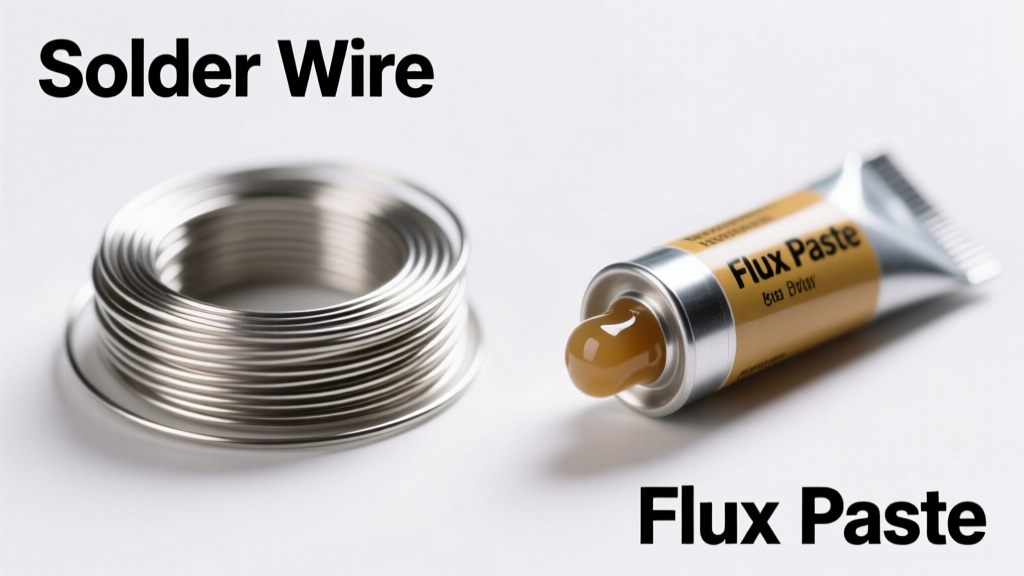
Choosing between solder wire and flux paste feels like picking a scalpel versus a syringe: both get the job done, but one fits precision work, the other suits volume or tricky geometries. If you’ve ever paused mid-rework wondering whether to feed wire or dab paste, you’re not alone — and the right choice hinges on your board layout, component density, and skill level.
Quick Verdict
Solder wire is simpler, more intuitive, and ideal for hand-soldering through-hole parts or occasional SMD touch-ups. Flux paste excels in fine-pitch rework, stencil printing, or when you need precise, repeatable flux application before soldering — especially with lead-free alloys. Neither is universally "better"; it’s about matching tool to task. According to the IPC-A-610G standard (2022), inconsistent flux application accounts for 37% of visible solder defects in low-volume prototyping — making the choice between wire and paste a reliability factor, not just convenience.
Side-by-Side Comparison
| Feature | Solder Wire | Flux Paste |
|---|---|---|
| Core composition | 95–99% alloy (e.g., 63/37 SnPb or SAC305), 1–5% rosin or no-clean flux core | 100% flux — no metal; available in water-soluble, no-clean, or RMA formulations |
| Application method | Manual feeding while heating joint | Dispensed via syringe, stencil, or jet printer |
| Flux activation temperature | 120–180°C (varies by core type) | 100–220°C (tunable per formulation) |
| Residue cleanup | Often minimal with no-clean cores; RMA may require IPA wipe | Water-soluble versions need post-solder rinse; no-clean types leave benign residue |
| Typical cost per gram | $0.12–$0.28/g (alloy + flux included) | $0.45–$1.20/g (flux-only, higher purity control) |
Deep Dive on Solder Wire
Solder wire integrates alloy and flux into a single consumable — think of it as a self-contained soldering system. Its hollow core delivers flux directly to the heated joint, promoting wetting and oxide removal on contact.
Pros
- Zero setup time — no separate flux dispensing equipment needed
- Immediate feedback: you see and feel flux activity (smoke, flow) as you solder
- Better thermal control for small joints — less risk of overheating compared to pre-applied paste
- Widely compatible with irons from $20 hobby units to $300 programmable stations
Cons
- Flux volume can’t be adjusted independently — too much causes splatter; too little leads to cold joints
- Poor for 0201 chips or 0.4mm pitch QFNs — wire diameter (typically 0.3–0.8mm) limits access
- Lead-free variants (e.g., SAC305) require higher tip temps (330–370°C), increasing thermal stress on pads
Best for: Through-hole assembly, hobbyist PCB repair, educational labs, and low-density SMD work like SOIC or TSSOP packages. For beginners, how to solder a PCB starts reliably with wire — it teaches timing, heat management, and joint formation all at once.
Deep Dive on Flux Paste
Flux paste is pure chemistry — no metal. It’s applied *before* solder, either manually with a micro-syringe or precisely via stencil. This decouples flux delivery from heat application, giving you full control over amount, location, and timing.
Pros
- Enables selective application — perfect for BGA reballing or shielding adjacent components
- Higher active content than flux cores (up to 25% rosin vs. ~3% in wire), improving oxide removal on oxidized pads
- Compatible with hot-air rework stations and selective soldering machines
- Reflow profiles can be tuned separately — critical for mixed-technology boards
Cons
- Requires extra step and discipline — skipping cleaning (for water-soluble types) risks dendritic growth and field failures
- Shelf life is shorter: most pastes degrade after 6–12 months unrefrigerated (per Kester Technical Bulletin #2023-07)
- Over-application creates bridging, especially under fine-pitch ICs
Best for: Production rework, high-mix low-volume manufacturing, and advanced SMD assembly like 0.3mm-pitch microBGA or stacked die packages. Professionals often pair paste with SMD soldering tools that combine vacuum pickup and dual-heating zones.
When to Choose Solder Wire vs Flux Paste
Choose solder wire when:
- You’re repairing a single capacitor on a 2-layer Arduino shield
- Your iron’s max temp is under 350°C and you’re using leaded solder
- You need to solder in tight spaces where a syringe tip won’t fit (e.g., under connectors)
Choose flux paste when:
- You’re reworking a 12x12mm QFN with 0.4mm pitch and thermal pad
- Your board has mixed leaded/lead-free components requiring staged reflow
- You’re doing >10 identical repairs and need consistent flux volume every time
The U.S. EPA estimates that improper flux residue contributes to 14% of early-field solder joint failures in consumer electronics — so consistency isn’t just about speed, it’s reliability.
Alternatives to Consider
Don’t limit yourself to just wire or paste. Three hybrid or niche options deserve attention:
- Flux pens: Pre-filled applicators with controlled-tip flow — great for quick touch-ups without syringe calibration
- No-clean solder bars: Used with solder pots for wave soldering or large ground plane tinning
- Pre-fluxed solder preforms: Tiny stamped alloy discs with integrated flux — ideal for automated placement and consistent mass delivery
For high-reliability aerospace builds, NASA-STD-8739.3 (2021) mandates flux residue testing — making preforms or validated paste systems preferred over generic wire.
Can I use flux paste with a regular soldering iron?
Yes — but apply it *before* heating, then feed bare solder wire (no-core or low-flux) onto the joint. Don’t try to melt paste alone; it lacks metal and will just burn off. A light coat (0.05–0.1mm thick) is enough for most 0805–SOIC work.
Does solder wire expire?
Not technically — but rosin cores can dry out or oxidize after 2–3 years, especially if spools are left open. You’ll notice poor flow, excessive smoke, or dull joints. Store sealed in low-humidity cabinets; desiccant packs help extend shelf life.
Is no-clean flux really safe to leave on boards?
Most modern no-clean fluxes (e.g., Alpha OM-338 or Chip Quick SMD291AX) pass IPC-J-STD-004B ionic contamination tests (<1.56 µg/cm² NaCl eq). But don’t assume — always verify your specific paste’s compliance report. Residue under conformal coating can cause delamination.
Why does my flux paste bubble and spit during rework?
That’s trapped solvent flashing off too fast. Reduce your hot-air ramp rate: start at 120°C for 60 seconds, then rise to 220°C at 1°C/sec. Per Indium Corporation’s 2022 Thermal Management Guide, rapid solvent vaporization causes micro-explosions that displace solder balls.
Can I mix brands — e.g., Kester paste with MG Chemicals wire?
You can, but avoid mixing aggressive water-soluble pastes (like Multicore FS210) with no-clean wires — residue incompatibility may leave conductive salts. Stick to same-chemistry families unless validated by cross-testing.
What’s the smallest pitch where flux paste becomes mandatory?
Below 0.5mm pitch, paste is strongly advised — especially for QFPs and TQFPs. At 0.4mm and finer (e.g., 0.35mm microBGA), paste is effectively required. Hand-soldering those with wire almost always results in bridges or insufficient wetting, per IPC-7095C guidelines.
Ultimately, solder wire and flux paste aren’t rivals — they’re complementary tools in your bench arsenal. Wire gets you started fast and teaches fundamentals; paste gives you surgical control when complexity ramps up. Match the medium to your margin for error, your board’s geometry, and your tolerance for process steps — and always validate with a test joint before committing to production. For deeper material insights, check our guide on solder alloys explained.