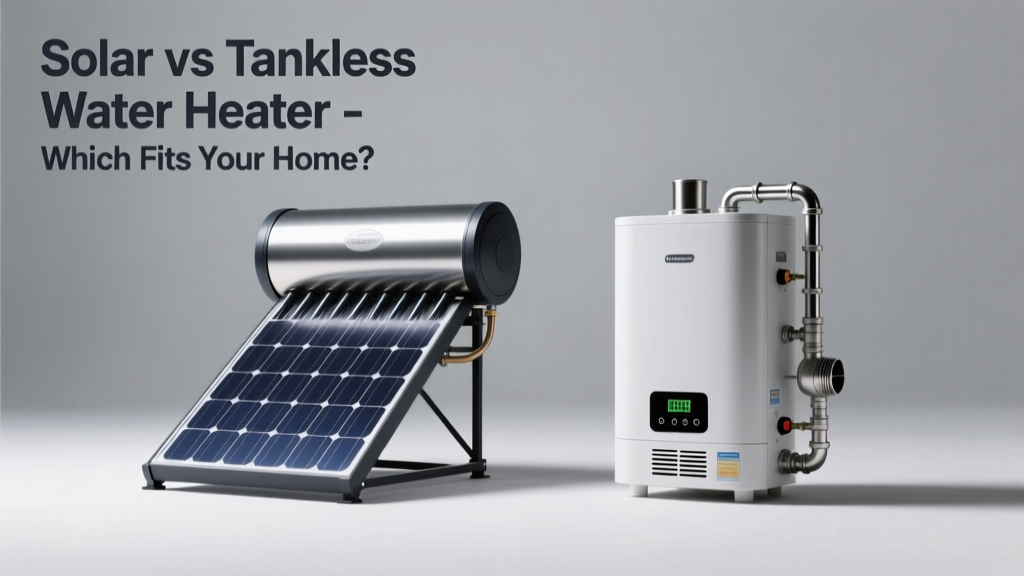
Facing rising utility bills and climate concerns, many homeowners weigh solar water heaters against tankless units — both promise energy savings, but they solve different problems in fundamentally different ways.
Quick Verdict
Solar water heaters cut long-term energy costs and emissions most dramatically — but only where sunlight is reliable year-round and upfront investment is feasible. Tankless units deliver instant, on-demand hot water with moderate efficiency gains and faster payback in colder or cloudier regions. Neither is universally 'better'; the right choice hinges on your roof exposure, local climate, household size, and budget timeline.
Side-by-Side Comparison
| Feature | Solar Water Heater | Tankless Water Heater |
|---|---|---|
| Average Upfront Cost (installed) | $5,000–$9,000 | $1,200–$3,500 |
| Energy Source | Sunlight (supplemented by electric/gas backup) | Natural gas or electricity |
| Efficiency (vs standard tank) | 50–80% less energy use (U.S. DOE, 2022) | 24–34% more efficient (ENERGY STAR, 2023) |
| Lifespan | 15–25 years (collector), 10–15 years (pump/tank) | 15–20 years (gas), 10–15 years (electric) |
| Maintenance Needs | Annual antifreeze check, biennial glycol replacement, collector cleaning | Descaling every 6–12 months (hard water areas), filter cleaning |
| Rebates & Incentives | Federal 30% tax credit (IRS Form 5695, 2024), plus state/local programs | Limited federal credit (only if ENERGY STAR certified & gas-powered; up to $600) |
Deep Dive on Solar Water Heater
Solar thermal systems use rooftop collectors (flat-plate or evacuated tube) to heat water directly or via a heat-transfer fluid. They’re most effective in USDA Hardiness Zones 6–10 — especially sunny, mild-winter areas like Arizona, California, or Texas.
Pros
- Lowest lifetime operating cost: After payback (typically 5–12 years), annual heating costs drop to near zero for 10+ years
- Significant carbon reduction: A typical residential system offsets ~1.5 tons of CO₂ annually (NREL, 2021)
- Works during grid outages (if paired with passive thermosiphon design or battery-backed pump)
Cons
- Weather-dependent performance: Output drops 40–70% on cloudy days; freezing temps require antifreeze or drain-down systems
- Roof compatibility issues: Requires unshaded south-facing roof space (40–60 sq ft minimum), structural reinforcement may be needed
- Higher installation complexity: Needs licensed solar thermal contractor — not all plumbers are certified
For homes with high hot water demand (4+ people), consistent sun exposure, and plans to stay put for 10+ years, solar delivers unmatched long-term value. See real-world solar installation cost breakdowns.
Deep Dive on Tankless Water Heater
Tankless units heat water instantly as it flows through a heat exchanger — no standby loss, no storage tank. Gas models dominate for whole-house use; electric versions suit point-of-use applications (e.g., under-sink in a bathroom).
Pros
- Space-saving: Mounts on wall, freeing up floor space previously occupied by a 50-gallon tank
- Endless hot water — within flow-rate limits (e.g., 5 GPM max for most residential gas units)
- Faster ROI: Payback often occurs in 3–7 years, especially when replacing an aging electric tank heater
Cons
- Flow-rate limitations: Simultaneous showers + dishwasher can overwhelm smaller units — sizing is critical
- Hard water damage: Scale buildup clogs heat exchangers; requires regular descaling (every 6 months in 15+ gpg water)
- No power = no hot water: Electric models fail during outages; gas models need electricity for ignition and controls
Tankless excels in moderate climates with stable gas supply and households prioritizing convenience and space savings over maximum sustainability. Use our sizing calculator to avoid undersizing.
When to Choose Solar vs Tankless
Choose solar if you live in Phoenix, Albuquerque, or Orlando — get 5+ peak sun hours daily, have a south-facing roof, and plan to own your home for at least 8 years. Choose tankless if you’re in Seattle, Cleveland, or Portland — where winter clouds limit solar yield, but gas infrastructure is robust and you want immediate upgrades without major roof work.
According to the Insurance Institute for Business & Home Safety's 2023 report, homes in high-sun regions saw 68% greater ROI from solar thermal than from tankless over a 15-year horizon — but that advantage vanished in northern latitudes where annual solar contribution fell below 30%.
"A solar water heater isn’t just a water heater — it’s a small-scale power plant for your plumbing. But if your roof faces west and gets shaded after noon, you’ll get better value installing a high-efficiency tankless unit and putting solar PV on your garage instead." — Elena Ruiz, NABCEP-certified solar thermal installer since 2011
Alternatives to Consider
Don’t overlook hybrid options that combine strengths:
- Heat pump water heaters (HPWH): 2–3× more efficient than standard electric tanks; works well in garages or basements with ambient temps above 40°F
- Hybrid solar-electric systems: Solar PV powers a heat pump water heater — avoids solar thermal complexity while still using renewable energy
- Condensing gas tank heaters: Modern 90%+ efficient tanks offer lower upfront cost and simpler install than tankless, with better cold-climate reliability
Each alternative balances cost, space, climate, and existing infrastructure differently. Compare HPWH vs tankless in cold-weather performance.
Can I install solar thermal and tankless together?
Yes — but rarely advisable. A solar pre-heat tank feeding a tankless unit adds complexity, cost, and failure points. Most experts recommend choosing one primary system and optimizing its sizing and backup strategy instead.
Do tankless units work with well water?
Yes, but sediment and iron content accelerate scale and corrosion. Install a whole-house sediment filter and consider a water softener — especially if iron exceeds 0.3 ppm (per EPA guidelines).
How much roof space do I need for solar thermal?
Typical 4-person household needs 40–60 sq ft of unshaded, south-facing roof. Evacuated tube collectors require less area than flat-plate but cost 20–30% more. Roof pitch should be within 15° of your latitude for optimal year-round yield.
Will a tankless heater lower my gas bill?
Yes — but not as much as you might expect. A 98% efficient condensing tankless unit uses ~10–15% less gas than a 90% efficient condensing tank heater (AHRI, 2022). The bigger savings come from eliminating standby loss — roughly 10% of total water heating energy.
Are there rebates for tankless water heaters in my state?
Only a few states offer meaningful incentives — e.g., Massachusetts’ Mass Save program covers up to $500 for qualifying gas tankless units. Most rebates target solar thermal or heat pump systems. Check the Database of State Incentives for Renewables & Efficiency (DSIRE) for current listings.
What’s the best option for a vacation home used seasonally?
Tankless wins here — no risk of tank corrosion or freezing during off-seasons. Set to vacation mode or shut off completely; restart takes minutes. Solar systems idle poorly and risk stagnation damage without proper controls.
Ultimately, your decision shouldn’t hinge on marketing claims about “efficiency” alone — it should reflect your roof’s reality, your utility rates, your local weather patterns, and how long you’ll enjoy the benefits. Both technologies matured significantly in the last decade, but they serve distinct roles in the modern hot water ecosystem.