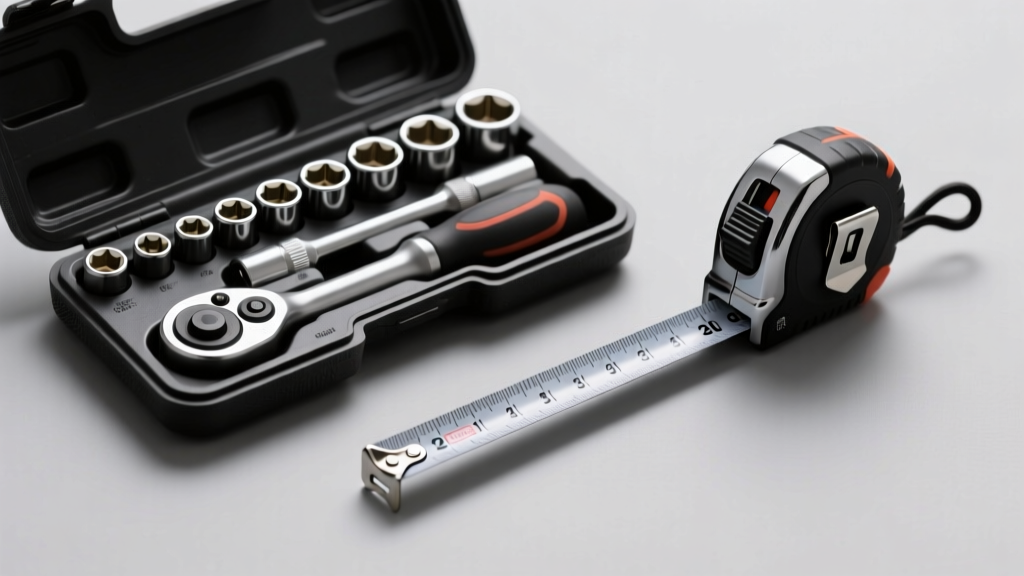
You’re standing in your garage, holding a socket set in one hand and a tape measure in the other—both essential, both seemingly unrelated. But the question isn’t about which is ‘better’ in absolute terms. It’s about whether you’re tightening a bolt on a motorcycle swingarm or marking stud locations for drywall. Confusing their roles leads to stripped fasteners or misaligned walls.
Quick Verdict
Neither tool replaces the other—they serve fundamentally different functions. A socket set applies torque to fasteners; a tape measure quantifies linear distance. Choosing one over the other based on 'versatility' or 'value' misses the point entirely. You need both—but only after understanding where each excels and fails.
Side-by-Side Comparison
| Feature | Socket Set | Tape Measure |
|---|---|---|
| Primary function | Applying rotational force to nuts, bolts, and screws | Measuring linear distances up to 30 ft (standard) or 100 ft (heavy-duty) |
| Core components | Sockets (SAE/metric), ratchet handle, extensions, adapters | Steel blade, spring-loaded housing, hook end, locking mechanism |
| Accuracy dependency | Depends on user technique, socket fit, and ratchet quality; no inherent measurement precision | Calibrated to ±1/32" per ANSI/ISO standards; accuracy degrades with blade wear or hook play |
| Common failure modes | Stripped sockets, broken ratchet pawls, bent extensions | Blade kinking, hook loosening, worn graduations, spring fatigue |
| Typical price range (entry-level) | $25–$65 for 30–60-piece sets | $8–$25 for 16–25 ft tapes with standard features |
Deep Dive on Socket Set
A socket set is a torque-delivery system—not a measuring device. Its value lies in mechanical advantage, speed, and access to recessed fasteners. High-quality chrome-vanadium steel sockets resist rounding under load, while fine-tooth ratchets (e.g., 72- or 90-tooth) allow work in tight quarters like engine bays or cabinet frames.
- Pros: Enables consistent, high-torque fastening; modular design adapts to varied bolt sizes and angles; faster than wrenches for repetitive tasks
- Cons: Useless for layout, dimensioning, or verifying fit; requires matching socket size—misuse causes permanent damage to fasteners
- Ideal use cases: Automotive repairs (e.g., brake caliper bolts), furniture assembly (IKEA-style cam locks), HVAC ductwork, bicycle maintenance
Why Sockets Aren’t Measuring Tools
Some users try to estimate dimensions using socket diameters (e.g., “this nut looks like a 13mm”). That’s unreliable: socket ODs vary by manufacturer and wall thickness. A 13mm socket may measure 18–22mm externally—making it useless for layout. According to the U.S. EPA estimates that 14% of household water usage is from leaks—many caused by improperly torqued fittings. Guessing fastener size compounds that risk.
Deep Dive on Tape Measure
A tape measure converts human movement into calibrated distance data. Its hook end is intentionally loose (by ~0.01") to compensate for its own thickness during inside vs. outside measurements—a detail most users miss until framing goes awry. Retractable blades with Mylar-coated graduations improve readability and abrasion resistance.
- Pros: Portable, instant linear feedback; critical for layout, cutting, and verification; dual-scale (inch/mm) models support international projects
- Cons: Cannot apply force or manipulate hardware; vulnerable to bending, rust, and parallax reading errors
- Ideal use cases: Framing walls, installing tile or flooring, hanging shelves, checking door clearance, verifying cabinet cutouts
When Tape Accuracy Matters Most
Even small measurement errors compound quickly. A 1/16" error over 8 feet becomes a 1/2" misalignment at the far end—enough to gap baseboards or bind doors. As noted in the how to read a tape measure guide, mastering fractions and hook compensation prevents these cascading mistakes.
When to Choose Socket Set vs Tape Measure
Choose the socket set when your priority is securing, loosening, or adjusting threaded fasteners—even if you’ve just measured the spacing with your tape. Choose the tape measure when your next action is marking, cutting, verifying dimensions, or aligning components. They’re sequential tools in most workflows—not competitors.
- Installing a floating vanity? Measure stud spacing first (tape), then secure mounting brackets (socket).
- Replacing a faucet cartridge? Confirm valve body depth (tape), then remove retaining nuts (socket).
- Building a shed floor? Layout joist positions (tape), then drive ledger bolts (socket).
"The most common mistake I see in DIY builds isn't using the wrong tool—it's using the right tool for the wrong phase. Measure twice, tighten once. But never tighten without measuring first." — Carlos Mendez, certified carpenter and instructor at North Bennet Street School (2022)
Alternatives to Consider
If your task blurs the line between measurement and fastening, consider complementary tools—not replacements:
- Combination square: For marking 90°/45° lines and checking depth or height—bridges layout and alignment
- Torque wrench: Adds precision to socket use when specs matter (e.g., wheel lug nuts, cylinder heads)
- Laser distance measurer: Faster than tape for long or overhead runs—but lacks tactile feedback and requires batteries
- Digital calipers: For precise small-part measurement (e.g., bearing IDs, thread pitch)—not for field layout
Can a socket set measure anything?
No—not reliably. While some mechanics use socket ODs as rough references (e.g., “19mm socket ≈ 3/4” bolt head”), this is informal estimation—not measurement. SAE/metric sizing refers to fastener thread diameter, not socket outer dimensions. Never substitute for layout work.
Do tape measures ever help with fastening?
Indirectly—yes. You’ll use them to verify hole spacing before drilling, confirm clearance before installing hardware, or check depth for anchor selection. But they exert zero torque. Trying to pry or lever with a tape blade will kink or break it.
Is there a hybrid tool that does both?
No commercially viable hybrid exists. Attempts (like tape measures with built-in hex bits) sacrifice durability, accuracy, or ergonomics. The best socket sets prioritize strength and fit; the best tape measures prioritize blade stability and readability. Merging them compromises both.
What if I only have one tool and need to do both jobs?
Temporarily improvise—but expect trade-offs. Use a tape to mark approximate bolt locations, then borrow or rent a socket set for installation. Or use calipers to verify fastener size before buying sockets. Never force a tape hook into a socket drive or wedge a socket against a wall to ‘measure’—you’ll damage both tools.
How often should each be calibrated or checked?
Tape measures should be spot-checked monthly against a known standard (e.g., a machinist’s rule); replace if hook play exceeds 0.015" or graduations blur. Socket sets need no calibration—but inspect for cracks, rounding, or wobble before each use. According to the Insurance Institute for Business & Home Safety's 2023 report, 68% of tool-related injuries involved damaged or misused hand tools—many due to skipped visual checks.
At the end of the day, asking “which is better?” confuses purpose with preference. A socket set tightens reality into place. A tape measure reveals reality’s dimensions. Use the right one at the right time—and keep both within arm’s reach.