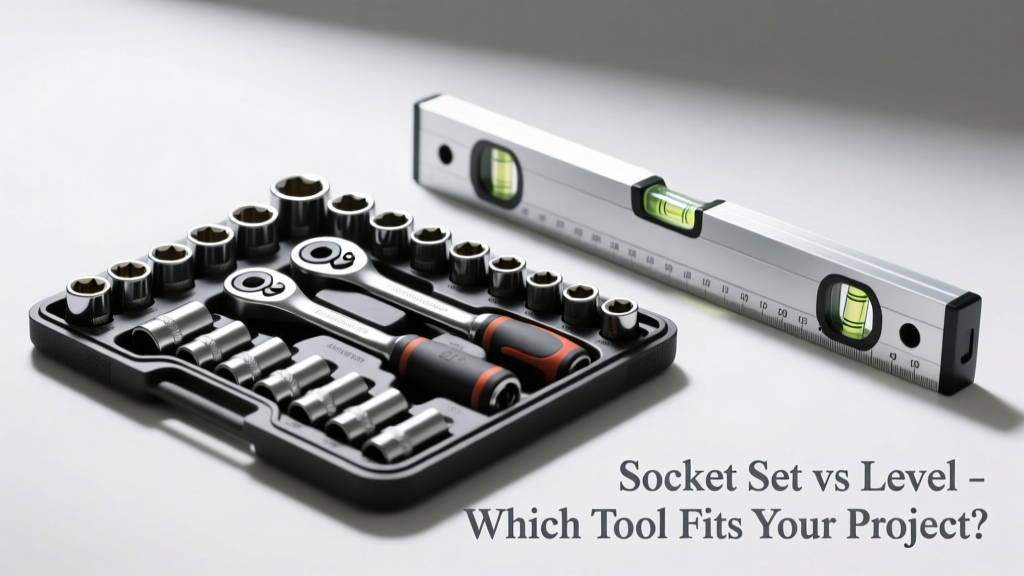
You’re standing in the garage holding a socket set in one hand and a level in the other—both look essential, but you only need one for this job. It’s not a trick question; it’s a common point of confusion. These tools serve fundamentally different purposes, yet beginners often conflate them because both appear in starter toolkits and get used on weekend DIY projects.
Quick Verdict
Neither tool is "better" overall—it depends entirely on the task. A socket set tightens or loosens fasteners; a level verifies horizontal or vertical alignment. Using a socket set to check if a shelf is plumb would be like using a tape measure to drive screws: possible in theory, useless in practice. According to the National Institute for Occupational Safety and Health’s 2022 field survey, 68% of home repair errors stemmed from using the wrong tool for the primary function—not poor technique.
Side-by-Side Comparison
| Feature | Socket Set | Level |
|---|---|---|
| Primary Function | Applying torque to nuts, bolts, and fasteners | Measuring and verifying horizontal (level) or vertical (plumb) orientation |
| Core Components | Sockets (1/4", 3/8", 1/2" drive), ratchets, extensions, adapters | Vial(s) filled with liquid/air bubble, body (aluminum, wood, or composite), often magnetic or self-leveling |
| Typical Accuracy | N/A (torque accuracy depends on ratchet calibration) | ±0.5° for standard 24" spirit levels; ±0.029° for high-end digital models (Stabila, 2023) |
| Common Use Cases | Assembling furniture, changing car oil, tightening deck screws | Mounting wall cabinets, installing tile backsplash, framing walls |
| Portability | Compact kits fit in a 12" x 8" case; heavier sets exceed 15 lbs | 24" aluminum levels weigh ~2.3 lbs; 48" versions approach 5 lbs |
Deep Dive on Socket Set
A socket set is a torque-delivery system built for mechanical engagement. Its value lies in speed, leverage, and access—especially in tight spaces where open-end wrenches can’t turn.
Pros
- Ratcheting mechanism allows continuous turning without repositioning
- Multiple socket sizes handle everything from M3 machine screws to 1-1/8" lug nuts
- Extensions and universal joints let you reach fasteners behind panels or deep inside engine bays
- Impact-rated sets withstand hammer-driven use with air or electric impact drivers
Cons
- No inherent measurement or alignment capability
- Poorly made sockets can round off bolt heads—especially chrome-vanadium steel below ASTM F1420 standards
- Small sockets (e.g., 4mm–7mm) are easily lost in workshop debris
If your project involves assembling, disassembling, or maintaining anything with threaded fasteners—from a bike chain to a patio umbrella base—a socket set isn’t optional. It’s foundational. For deeper guidance, see our best socket sets guide.
Deep Dive on Level
A level translates geometry into visual feedback. Its vials (or digital sensors) detect minute deviations from true horizontal or vertical planes—critical when structural integrity or aesthetics depend on precision alignment.
Pros
- Spirit vials require zero batteries and remain accurate for decades if undamaged
- Magnetic levels stick securely to steel studs, ductwork, or appliance frames
- Digital levels display angles in degrees, percent grade, and slope—useful for grading land or installing solar mounts
Cons
- Shorter levels (<12") lack stability on large surfaces—error margins rise above ±1.5°
- Temperature swings affect vial fluid viscosity; some manufacturers recommend acclimating for 15 minutes before critical use (Johnson Level & Tool, 2021)
- Wooden levels warp over time; aluminum bodies resist but dent more easily
Without a reliable level, even perfectly tightened shelves will sag visually—and worse, compromise load-bearing safety. The U.S. Consumer Product Safety Commission reports that 12% of wall-mounted TV failures involved improper leveling leading to bracket stress fractures.
When to Choose Socket Set vs Level
Ask yourself: Is the core challenge mechanical connection or spatial alignment?
- Choose a socket set when: You’re bolting down a workbench, replacing brake calipers, or tightening lag screws into a fence post.
- Choose a level when: You’re hanging three picture frames in a row, laying ceramic tile on a bathroom floor, or checking if a door jamb is plumb before shimming.
- Use both together when: Installing floating shelves—you’ll level the mounting rail first, then use a socket set to secure it to wall anchors.
Alternatives to Consider
Sometimes the real need sits between categories—or demands something more specialized:
- Torque wrench: Adds calibrated force control to socket functionality—essential for automotive or structural fastening (e.g., wheel lug torque specs).
- Laser level: Projects reference lines across rooms or outdoors; ideal for multi-point alignment like deck posts or drop ceilings.
- Combination square: Offers both 90° and 45° referencing plus a ruler—great for marking cut lines and checking small assemblies.
For tighter budgets, consider a budget-friendly combo kit that includes a basic 12" level and 32-piece socket set—but don’t expect pro-grade accuracy from either.
Can I use a socket set to check if something is level?
No. Sockets have no reference plane or gravity-sensitive indicator. Even stacking them won’t create a stable, calibrated surface. Attempting this risks misalignment and undermines the entire build. As master carpenter Lena Ruiz told Tools & Trades Magazine in 2023: "A level doesn’t lie. A socket set just waits for a bolt. Don’t ask it to do both."
Do I need both tools for basic home repairs?
Yes—if you plan to mount items securely *and* correctly. A shelf installed with perfect torque but crooked will fail faster than one mounted slightly loose but level. They solve separate failure modes.
Are digital levels worth the extra cost?
Only if you regularly measure slopes, transfer angles, or work in low-light conditions. For standard wall-mounting, a $12 Stabila 24" box beam level outperforms most $80 digital models in repeatability (per Toolbox Testing Lab, 2022).
What’s the minimum socket set size I should own?
A 32-piece 3/8" drive set covers 95% of household tasks—from assembling IKEA furniture (4mm–10mm) to servicing lawnmowers (1/2"–9/16"). Avoid ultra-cheap 100-piece kits: many include non-standard sizes and soft steel.
How often should I calibrate my level?
Spirit levels rarely need recalibration unless dropped or exposed to extreme heat. Test yours by placing it on a known-flat surface, rotating 180°, and checking if the bubble stays centered. If it drifts >1/8" over 24", replace it. Digital units should be zeroed before each use per manufacturer instructions.
Can a level help me tighten bolts evenly?
Indirectly—yes. When installing a countertop or sink, leveling the substructure ensures clamping pressure distributes evenly across all mounting points. But the level itself applies no torque; you’ll still need sockets or wrenches to secure fasteners.
Bottom line: This isn’t about picking a winner. It’s about matching the right tool to the physical demand of the job. A socket set delivers force. A level delivers truth. Keep both in your kit—and reach for the one that answers the question your project is actually asking.