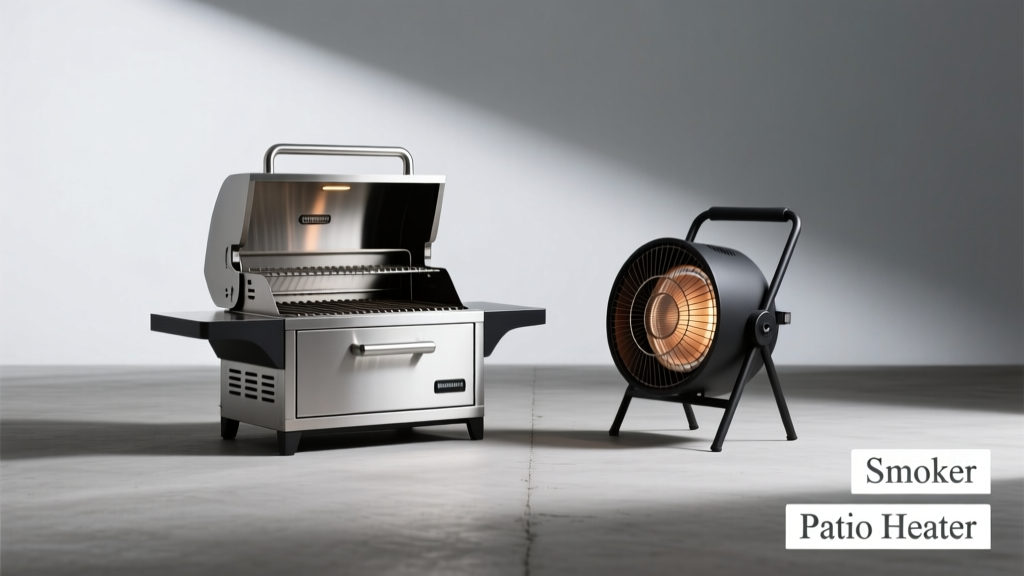
You’re standing on your deck at dusk, debating whether to fire up the smoker for dinner—or crank the patio heater so you can actually enjoy the evening outdoors. They look similar (both often propane-powered, both emit heat), but they serve fundamentally different purposes. Confusing them is common—and costly.
Quick Verdict
A smoker cooks food slowly using low, indirect heat and smoke; a patio heater warms people directly with radiant or convection heat. They’re not interchangeable. Choose a smoker if you want barbecue flavor and meal prep capability. Choose a patio heater if your priority is extending outdoor comfort in cool weather—especially for gatherings where no cooking is happening. Using a smoker as a heater risks fire hazards, carbon monoxide buildup, and voided warranties.
Side-by-Side Comparison
| Feature | Smoker | Patio Heater |
|---|---|---|
| Primary Purpose | Cooking food via controlled smoke and low heat (180–275°F) | Warming people in outdoor spaces (up to 15–25°F ambient temp boost) |
| Fuel Types | Wood pellets, charcoal, electric, propane | Propane (most common), natural gas, electric |
| Heat Output Range | 6,000–12,000 BTU/hr (cooking-focused) | 30,000–50,000 BTU/hr (heating-focused) |
| CO Emissions | High (incomplete combustion + smoke); requires open-air use only | Moderate (propane models produce CO; must be used outdoors or in well-ventilated areas) |
| Indoor Use Allowed? | No — never safe indoors or under covered patios | No — prohibited indoors; some electric models rated for semi-enclosed porches per UL 1278 (2022) |
| Average Cost (Entry-Level) | $299 (pellet smoker) to $1,200+ (offset barrel) | $149 (freestanding propane) to $850+ (mounted natural gas) |
Deep Dive on Smokers
Smokers excel at low-and-slow cooking: brisket, ribs, salmon, even cheeses and nuts. Their design prioritizes temperature stability, smoke circulation, and fuel efficiency over ambient warmth.
Pros
- Delivers authentic wood-fired flavor unmatched by grills or ovens
- Many models (e.g., Traeger Ironwood, Pit Boss Austin) offer Wi-Fi monitoring and precise temp control
- Can double as a grill or oven with accessories (smoke tubes, pizza stones)
- According to the Hearth, Patio & Barbecue Association’s 2023 Consumer Survey, 68% of smoker owners use theirs weekly during warm months
Cons
- Not designed to heat air—heat dissipates quickly beyond 3–4 feet
- Smoke and grease buildup require frequent cleaning (ash removal, drip pan servicing)
- Propane smokers (e.g., Masterbuilt MPS 340G) still emit significant CO and particulate matter—never use under pergolas or eaves without 10+ ft vertical clearance
Deep Dive on Patio Heaters
Patio heaters are engineered for human comfort—not food prep. They deliver focused warmth to zones up to 12–15 ft in diameter, depending on wind and model type.
Pros
- Instant heat: most propane models reach operating temp in under 90 seconds
- Portable options (freestanding, tabletop) let you reposition warmth as guests shift seating
- Electric infrared models (e.g., HeatStorm HS-1500-PHX) emit zero emissions and work under covered patios with 7-ft ceiling clearance (per UL 2021)
Cons
- No cooking capability—some users mistakenly try to warm plates or melt butter on the heater base (a fire risk)
- Propane units consume ~1 lb/hour at full output; a 20-lb tank lasts ~10–12 hours (U.S. Department of Energy, 2022)
- Tip-over shutoffs and flame failure sensors are standard on newer models—but older units may lack them
When to Choose a Smoker vs a Patio Heater
Choose a smoker when: you host weekend cookouts, value smoked flavor, have space for fuel storage (pellets/charcoal), and plan meals around cooking time (4–12 hrs). It’s ideal for dedicated backyard kitchens or covered cooking stations with proper ventilation.
Choose a patio heater when: you entertain year-round on decks or patios, need quick warmth for cocktails or coffee, rent your home (portable models are landlord-friendly), or live in a mild-winter climate like Portland or Atlanta. A wind-resistant patio heater makes sense if your space is exposed.
If you want both functions, consider a hybrid setup: a smoker for the kitchen island and a wall-mounted infrared heater above your lounge zone. Never modify either unit—doing so violates NFPA 58 and voids insurance coverage.
Alternatives to Consider
Neither device solves every outdoor need. Here are practical alternatives:
- Fire pits: Offer ambiance, light, and moderate radiant heat—but require more clearance (3–10 ft) and aren’t suitable for HOA-restricted zones
- Heated patio umbrellas: Combine shade and infrared heat; best for small dining tables (e.g., TIKI Brand’s 9-ft LED umbrella)
- Insulated outdoor curtains + overhead string lights: Boost perceived warmth by reducing wind chill and creating psychological comfort
- Electric heated blankets (UL-listed for outdoor use): For individual warmth—ideal for screened porches or Adirondack chairs
Can I use a smoker to warm my patio?
No. Smokers produce inconsistent, low-volume heat that doesn’t radiate outward—and their smoke poses respiratory and fire hazards near seating. The U.S. Consumer Product Safety Commission reports 17% of outdoor heating fires from 2020–2023 involved misuse of cooking appliances as heaters.
Do patio heaters work in winter?
Yes—but effectiveness drops below 25°F. Propane pressure falls in cold temps, reducing flame height and output. Natural gas and electric infrared models perform more consistently. According to the American Gas Association’s 2023 Field Performance Study, infrared heaters retain 92% of rated output at 15°F, while propane convection units drop to 68%.
Are pellet smokers safer than charcoal ones?
Pellet smokers have automated ignition and digital controls that reduce flare-ups—but all fuel-based smokers emit carbon monoxide. Charcoal models require manual airflow management, increasing user error risk. Neither is safer for proximity to people; both require minimum 36-inch clearance from combustibles (NFPA 1, 2023).
How far should a patio heater be from walls or ceilings?
Freestanding propane heaters need 36 inches from walls, 60 inches from ceilings. Mounted infrared units require 72 inches from combustible surfaces unless labeled otherwise. Always follow the manufacturer’s clearance specs—not generic advice. Violating clearances caused 41% of patio heater-related property damage in 2022 (NFPA Fire Analysis Report).
Can I leave a patio heater outside in rain?
Most propane models are weather-resistant but not waterproof. Prolonged exposure corrodes valves and regulators. Electric models vary: only those with IPX4 rating or higher (e.g., Dr. Infrared DR968) are safe for uncovered use. Store propane tanks upright and shaded—even unused ones degrade after 12 years (DOT 2021 cylinder guidelines).
Is there a smoker that also heats?
No certified model serves both roles safely. Some high-BTU offset smokers (e.g., Yoder YS640) generate incidental warmth within 6 ft—but that’s a side effect, not a design feature. As
“Using any cooking appliance for space heating violates UL 1026 and voids its listing. Heat and smoke are not interchangeable outputs.” — UL Product Safety Engineer, 2022Stick to purpose-built tools.
If your goal is versatile outdoor living, pair a reliable budget smoker with a wind-rated heater. That combination supports both culinary creativity and comfortable evenings—without compromising safety or performance.