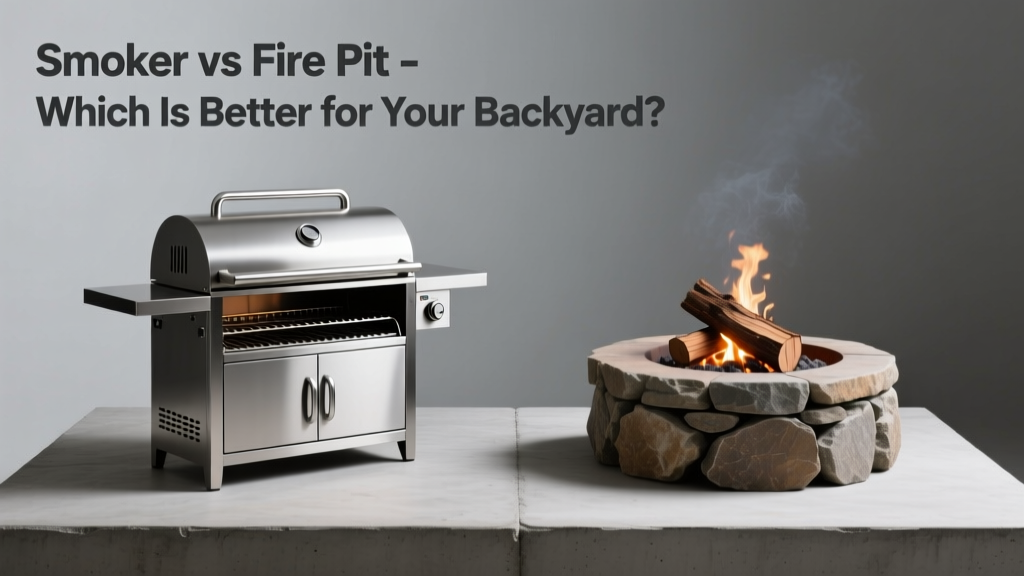
You’ve stood in the hardware store aisle, torn between a glossy offset smoker promising tender brisket and a rustic stone fire pit glowing with promise of s’mores and starlit chats. Both radiate warmth—but they solve different problems. Choosing wrong means wasted money, underused gear, or missed moments.
Quick Verdict
A smoker is purpose-built for low-and-slow cooking—think pulled pork, ribs, or smoked salmon—with precise temperature control and smoke infusion. A fire pit prioritizes heat, light, and social atmosphere; it’s not designed for food prep beyond roasting marshmallows or skewering hot dogs. If you cook weekly and care about flavor depth, lean smoker. If you host often, have limited storage, or want instant ambiance, choose fire pit. Neither replaces the other—they complement.
Side-by-Side Comparison
| Feature | Smoker | Fire Pit |
|---|---|---|
| Primary Function | Cooking via controlled smoke and convection | Radiant heat + ambiance; minimal cooking capability |
| Average Price Range | $299–$3,200 (electric, charcoal, pellet, offset) | $89–$1,400 (portable steel to built-in masonry) |
| Fuel Types | Wood chips, charcoal, pellets, electricity, propane | Hardwood logs, propane, natural gas, bioethanol |
| Indoor/Outdoor Use | Outdoor only (ventilation critical) | Most outdoor-only; some propane models rated for covered patios |
| Setup & Learning Curve | Moderate to steep (temp management, smoke timing) | Low (light, enjoy, extinguish) |
| Storage & Portability | Limited—most are heavy, fixed-footprint units | High—many compact, wheeled, or collapsible options |
Deep Dive on Smokers
Smokers excel when flavor, consistency, and food safety are non-negotiable. Pellet smokers like those from Traeger or Camp Chef offer digital thermostats and Wi-Fi alerts—ideal for beginners aiming for 225°F for 12 hours. Offset barrel smokers demand more attention but reward with authentic smoke rings and bark development.
Pros of Smokers
- Delivers complex, layered smoke flavor unmatched by grilling
- Consistent low-temp operation (critical for collagen breakdown in tough cuts)
- Many models support cold smoking (cheese, nuts, fish) with accessories
- Some dual-function units double as grills or sear stations
Cons of Smokers
- Require 30–60 minutes preheat and ongoing fuel monitoring
- Need dedicated outdoor space—minimum 3 ft clearance from structures
- Cleaning involves ash removal, grease tray emptying, and drip pan scrubbing
- Not suitable for spontaneous use—planning is part of the process
According to the USDA Food Safety and Inspection Service’s 2022 guidelines, maintaining internal meat temps above 140°F during smoking prevents bacterial growth—a requirement easier to meet with a quality smoker’s thermostat than an open flame.
Deep Dive on Fire Pits
Fire pits serve as backyard hearths—functional, aesthetic, and emotionally resonant. Propane models (like the Outland Living Series 401) ignite instantly and produce zero ash. Wood-burning versions generate real crackle and scent but require local burn permits in 27 states, per the EPA’s 2023 Air Quality Compliance Report.
Pros of Fire Pits
- Instant warmth and mood-setting light—no setup delay
- Encourages group gathering; natural focal point for conversation
- Many UL-listed propane units qualify for covered patios (check manual)
- Low maintenance: ash cleanup (wood) or wipe-down (propane)
Cons of Fire Pits
- No precise temperature control—roasting requires constant skewer rotation
- Wood smoke contributes to PM2.5 particulates; banned in some HOAs and metro areas
- Not designed for indirect cooking—no smoke infusion, no bark formation
- Can’t hold food safely for extended periods (no warming racks or insulated chambers)
When to Choose Smoker vs Fire Pit
Choose a smoker if: you cook for 4+ people monthly, prioritize food texture and flavor over speed, own a garage or shed for storage, and enjoy the ritual of tending wood or adjusting dampers. Choose a fire pit if: your yard is under 500 sq ft, you entertain 2–3 times per month, neighbors are close, or you value quick setup and visual impact over culinary precision.
"A smoker is a kitchen appliance that happens to live outside. A fire pit is furniture that happens to burn." — Greg Hinkle, certified BBQ judge and instructor at Kansas City Barbeque Society (2023)
Alternatives to Consider
Don’t overlook hybrid solutions. The Weber SmokeFire EX4 combines grill, smoker, and sear station in one footprint. For ambiance + light cooking, the Solo Stove Bonfire Pit includes a stainless steel cooking ring for grilling steaks or foil packets. And if space is tight, consider a tabletop electric smoker (like the Masterbuilt Digital Electric) paired with a small propane fire bowl—two compact tools covering both needs without compromise.
Can I use a fire pit to smoke meat?
Technically yes—but results are inconsistent. Without airflow control, smoke doesn’t penetrate evenly, and temps fluctuate wildly. You’ll get surface char, not true smoke ring. For occasional experiments, try soaking hickory chunks and placing them under a cast-iron Dutch oven lid—but don’t expect competition-level results.
Do smokers produce more air pollution than fire pits?
Yes—when misused. A poorly tuned charcoal smoker can emit up to 4x more fine particulate matter per hour than a certified EPA Phase II wood stove (EPA Clean Air Act Data, 2022). Pellet and electric smokers run cleaner. Fire pits burning dry hardwood emit fewer VOCs than green wood, but still exceed residential emission limits in cities like Denver and Seattle.
Is a fire pit safe on a wooden deck?
Only if explicitly rated for it—and even then, with precautions. UL-certified propane fire pits (e.g., AZ Patio Heaters) may be approved for composite or treated decks when used with a non-combustible base pad. Never place wood-burning pits directly on wood; ember fallout risks ignition. Always check local fire codes first—many municipalities prohibit any open flame on elevated decks.
How much space do I need for a smoker?
Minimum: 3 ft clearance on all sides, plus overhead clearance (6 ft for vertical smokers, 10 ft for offset units with tall chimneys). You’ll also need level ground and access to electrical outlets (for pellet/electric) or fuel storage. Compare that to a portable fire pit, which fits on a 36” x 36” patio tile with 2 ft clearance.
Can I use my smoker year-round?
Yes—with caveats. Cold weather slows heat recovery; wind disrupts airflow. Pellet smokers with insulated chambers (like the Pit Boss Navigator) perform best below 30°F. Charcoal users report longer warm-up times and increased fuel consumption. In contrast, fire pits actually gain utility in winter—providing direct radiant heat when ambient temps dip.
If you’re still weighing options, start small: rent a pellet smoker for a weekend cook-off, or borrow a neighbor’s fire pit for a fall bonfire. Real-world testing beats specs every time. And remember—your ideal setup might be both: a compact smoker for Sundays, and a sleek fire pit for Friday night wind-downs.