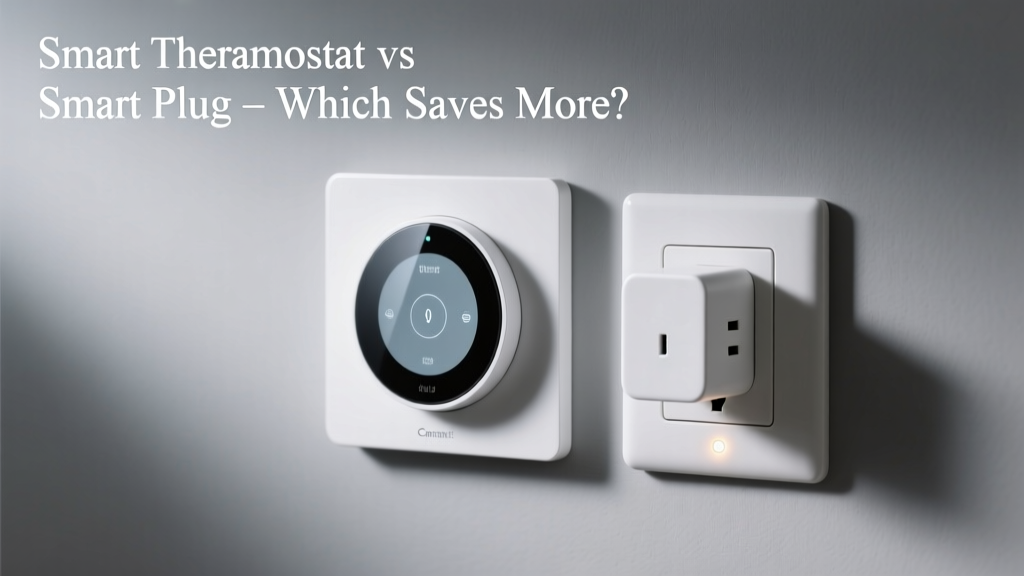
You’re trying to cut energy bills and add convenience, but you’re stuck between two popular smart home devices: a smart thermostat that controls your HVAC system, and a smart plug that turns any lamp or space heater into a connected device. They look similar on the surface — both promise scheduling, remote control, and energy tracking — but they solve fundamentally different problems.
Quick Verdict
A smart thermostat is the better choice if you want to optimize whole-home heating and cooling — it learns your habits, integrates with HVAC systems, and delivers measurable energy savings (up to 10–12% annually, per ENERGY STAR’s 2022 analysis). A smart plug shines when you need granular control over individual appliances — think coffee makers, fans, or holiday lights — at a fraction of the cost and without professional installation. Neither replaces the other; they complement each other in a mature smart home.
Side-by-Side Comparison
| Feature | Smart Thermostat | Smart Plug |
|---|---|---|
| Primary Function | Regulates HVAC system temperature via built-in sensors and algorithms | Switches power on/off to a single appliance or outlet |
| Average Upfront Cost | $129–$249 (e.g., Nest Learning Thermostat, Ecobee SmartThermostat) | $15–$35 (e.g., TP-Link Kasa KP115, Wemo Mini) |
| Installation Complexity | Moderate: Requires wiring compatibility check; may need C-wire or professional help | Low: Plug-and-play; no tools or wiring needed |
| Energy Monitoring | Yes — estimates HVAC usage; some models show kWh impact per degree change | Yes — real-time wattage and kWh tracking (varies by model) |
| HVAC Integration | Full integration (heat pump, gas furnace, multi-stage systems) | No HVAC control — only powers accessories like portable heaters or AC units |
| Learning Capability | Yes (e.g., Nest adapts schedule after ~1 week of manual adjustments) | No — relies on user-defined schedules or voice triggers |
Deep Dive on Smart Thermostats
Smart thermostats are engineered for climate control at the system level. They use occupancy sensing, geofencing, humidity data, and local weather forecasts to adjust temperatures automatically. The Ecobee SmartThermostat with Voice Control, for example, includes room sensors that detect whether a bedroom is occupied before lowering heat there — a feature no plug can replicate.
Pros
- Reduces HVAC runtime by up to 12% annually, according to ENERGY STAR’s 2022 Residential Energy Consumption Survey
- Supports zoning via remote sensors (Ecobee, Honeywell T9)
- Qualifies for utility rebates — $50–$100 in 32 U.S. states as of 2024 (DSIRE database)
- Integrates with HomeKit, Matter, and major voice assistants for unified automation
Cons
- Requires compatible HVAC wiring — 20% of U.S. homes lack a C-wire, adding $75–$150 for an adapter or electrician
- Doesn’t control non-HVAC devices (e.g., space heaters plugged into outlets)
- Learning period can be frustrating if household routines shift weekly
Deep Dive on Smart Plugs
Smart plugs excel at retrofitting dumb devices — especially those that draw power even when idle (‘vampire load’). A study by the Natural Resources Defense Council found that standby power accounts for 23% of residential electricity use from plugged-in electronics. Smart plugs let you eliminate that waste with precision.
Pros
- Works instantly — no wiring, no HVAC compatibility checks
- Enables energy monitoring for high-draw devices (e.g., a 1500W space heater uses ~1.8 kWh/hr; track exactly how long it runs)
- Can trigger automations: ‘Turn off coffee maker 30 minutes after sunrise’ or ‘Power down aquarium pump during Wi-Fi outages’
- Stackable — deploy across multiple rooms for under $100
Cons
- No temperature sensing or environmental adaptation — just on/off timing
- Cannot replace a thermostat for central HVAC control (and shouldn’t — doing so risks overheating or freezing pipes)
- Some models lack UL certification; third-party firmware (like Tasmota) adds risk if misconfigured
When to Choose a Smart Thermostat vs Smart Plug
If your furnace or air conditioner runs constantly — especially during shoulder seasons — a smart thermostat pays for itself in under two years through reduced runtime. But if you’re using a portable oil-filled radiator in your home office, or a window AC unit in a spare room, a smart plug with energy tracking gives you visibility and control without touching your main HVAC system.
Homeowners in rental units often choose smart plugs first: they’re landlord-friendly, portable, and require zero modifications. Meanwhile, homeowners planning a 5+ year stay typically prioritize a thermostat upgrade — especially if their current unit is over 10 years old and lacks programmability.
Alternatives to Consider
Before committing to either, consider hybrid options:
- Smart vents (e.g., Keen Home): Offer room-level HVAC control without replacing your thermostat — useful in homes with ducted systems and uneven heating
- Wi-Fi enabled HVAC controllers (e.g., Sensi Touch): Simpler, cheaper thermostats ($89) with app control but no learning — ideal for renters or second homes
- Smart power strips: Manage groups of devices (entertainment centers, home offices) with one switch and surge protection — see our comparison of smart power strips vs smart plugs
Can a smart plug replace a smart thermostat?
No — and attempting to do so is unsafe. Smart plugs lack temperature sensors, safety shutoffs, and HVAC-specific logic. Turning a window AC unit on/off via plug may cause compressor short-cycling, reducing its lifespan by up to 40%, per ASHRAE’s 2021 Equipment Maintenance Guidelines.
Do smart plugs save energy on HVAC?
Only indirectly — for example, by cutting power to a portable heater when a smart thermostat raises the main house temperature. But they don’t influence your furnace or central AC directly. According to the U.S. EPA, 14% of household water usage is from leaks — but similarly, uncontrolled plug loads account for ~5% of total home electricity use (Lawrence Berkeley National Lab, 2023).
Is a smart thermostat worth it in mild climates?
Yes — especially if you use heat pumps. In Pacific Northwest homes, Ecobee users reported 8–9% seasonal savings even with average winter highs of 45°F, thanks to adaptive recovery and defrost cycle optimization.
Can I use both together?
Absolutely — and it’s recommended. Use the thermostat to manage base load, and smart plugs to handle supplemental devices. For instance: set your thermostat to 68°F during the day, then use a plug to power a desk heater only while you’re seated — avoiding blanket heating of unused rooms.
What about privacy and security?
Both device types collect usage data, but thermostats often store more sensitive behavioral patterns (e.g., sleep/wake times inferred from temperature changes). Look for devices with local processing (like Home Assistant-compatible plugs) or end-to-end encryption. The
NIST Cybersecurity Framework recommends reviewing device permissions annually — especially for devices with microphone or location access, like some thermostats (NIST SP 800-213, 2023).
Do utility companies offer discounts on smart plugs?
Rarely — rebates focus on whole-home efficiency upgrades. Only three utilities (BGE, ConEd, and SMUD) currently offer plug-specific incentives, usually capped at $5 per unit. Thermostats remain the primary rebate target.
Ultimately, the smarter choice isn’t one device over the other — it’s matching the tool to the job. A smart thermostat manages your home’s thermal envelope. A smart plug manages your devices’ electrical envelope. Use them in concert, and you’ll gain both comfort and clarity over where your energy dollars go.