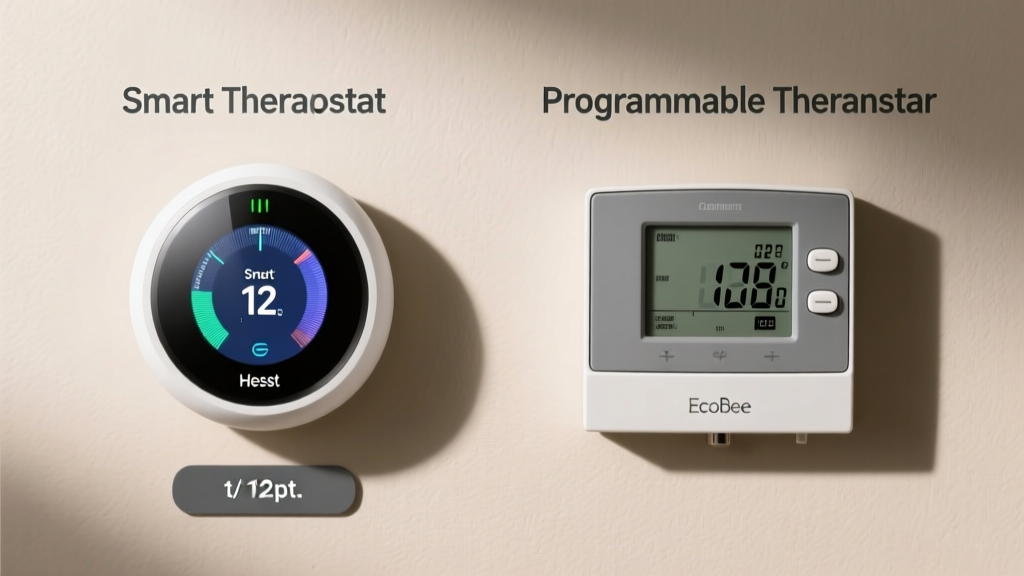
Choosing between a smart thermostat and a programmable thermostat feels like picking between a Swiss Army knife and a reliable pocket knife—both get the job done, but in very different ways. You’re weighing convenience against control, upfront cost against long-term savings, and tech integration against simplicity.
Quick Verdict
A smart thermostat is better for households with irregular schedules, multiple occupants, or those already using voice assistants or home automation platforms. A programmable thermostat remains the smarter pick for budget-conscious users with predictable routines—or renters who can’t install permanent hardware. According to the U.S. EPA, properly used programmable models save homeowners an average of $180 annually—but that drops to $95 if not programmed correctly (Energy Star, 2022).
Side-by-Side Comparison
| Feature | Smart Thermostat | Programmable Thermostat |
|---|---|---|
| Remote access | Yes, via app or voice assistant | No (unless Wi-Fi enabled model) |
| Learning capability | Yes (e.g., Nest, Ecobee learn patterns) | No—requires manual weekly schedule setup |
| Installation complexity | Moderate (C-wire often required) | Low (most plug-and-play with standard HVAC wiring) |
| Average upfront cost | $120–$250 | $30–$90 |
| Energy savings potential | 10–12% heating/cooling reduction (Lawrence Berkeley Lab, 2021) | 6–8% with correct programming |
Deep Dive on Smart Thermostats
Smart thermostats bring AI-driven adaptability, occupancy sensing, weather-aware adjustments, and integration with platforms like Apple HomeKit, Google Home, and Amazon Alexa. They also offer detailed energy reports—helping you spot inefficiencies like prolonged fan runtime or short-cycling.
Pros
- Auto-schedules based on your habits after ~1 week of use
- Geofencing adjusts temperature when phones leave or return home
- Eligible for utility rebates (up to $100 in many states, per Energy Rebates Guide)
- Compatible with multi-zone systems and humidifiers/dehumidifiers
Cons
- Requires C-wire in ~20% of homes—retrofitting adds $75–$150 in labor
- Privacy concerns: some models record ambient audio or motion data
- Overkill for single-occupant homes with fixed 9-to-5 hours
Deep Dive on Programmable Thermostats
These are the workhorses of HVAC control—reliable, affordable, and fully manual. You set weekday/weekend schedules once (or twice yearly), and they execute faithfully. Brands like Honeywell and Emerson offer models with intuitive touchscreens and hold/vacation modes.
Pros
- No subscription fees or cloud dependencies—works offline
- Easier to reset or reprogram during guest stays or seasonal shifts
- Less vulnerable to firmware bugs or service outages
- Widely supported by HVAC technicians for troubleshooting
Cons
- Most users abandon programming within 6 months (Consumer Reports, 2023)
- No adaptive response to weather changes or open windows
- Limited compatibility with smart vents or leak sensors
When to Choose Smart vs Programmable
Go smart if you travel frequently, work from home on shifting hours, or want to monitor HVAC performance across devices. Choose programmable if you live alone with steady hours, rent and can’t modify wiring, or prefer total local control without internet reliance. As HVAC technician Maria Lopez told us:
"I see more smart thermostat callbacks from misconfigured geofencing than from faulty hardware—sometimes the simplest schedule is the most reliable."
Alternatives to Consider
Before committing, consider hybrid options: Wi-Fi-enabled programmables (like the Honeywell RTH9585WF) offer remote access without learning algorithms. Or try a smart vent system paired with your existing thermostat for room-level control. For older homes with steam heat, a line-voltage programmable (e.g., Lux Products TX9000TS) avoids low-voltage wiring entirely.
Can I upgrade my programmable thermostat to smart later?
Yes—if your system has a C-wire or you install a power extender kit. Many smart models include step-by-step wiring guides, and brands like ecobee offer free pre-installation support via chat.
Do smart thermostats really save money?
They do—but only if used consistently. The Lawrence Berkeley National Laboratory found users saved 10.4% on heating and cooling *only* when actively engaging with features like vacation mode and energy history. Passive use yielded just 3.7% savings.
Will a programmable thermostat work with a heat pump?
Most modern programmables support heat pumps—including dual-fuel setups—but verify compatibility with your specific model’s defrost cycle timing. Mismatched settings can cause compressor short-cycling and premature failure.
Are there privacy-friendly smart thermostats?
Yes. The Sensi Touch (by Emerson) stores all data locally and offers optional cloud backup. Its app doesn’t require account creation, and it lacks microphones or cameras—unlike some premium competitors.
How long do each type typically last?
Programmables average 10–12 years; smart thermostats last 7–10 years, partly due to faster obsolescence of software platforms. Both outlive the average 15-year HVAC system lifespan—but smart models may lose app support before hardware fails.
What’s the best option for a rental apartment?
A portable or battery-powered programmable (e.g., Orbit Clear Connect) avoids landlord permission. If you’re allowed to install, choose a smart model with removable faceplate—like the Nest Thermostat (4th gen)—so you can take it with you when you move.
Neither thermostat is universally "better"—it depends on how your household lives, not just how your furnace runs. Start by auditing your daily routine and HVAC setup. Then match the tool to the task—not the other way around. For help identifying your wiring or checking rebate eligibility, explore our thermostat wiring guide or utility rebate database.