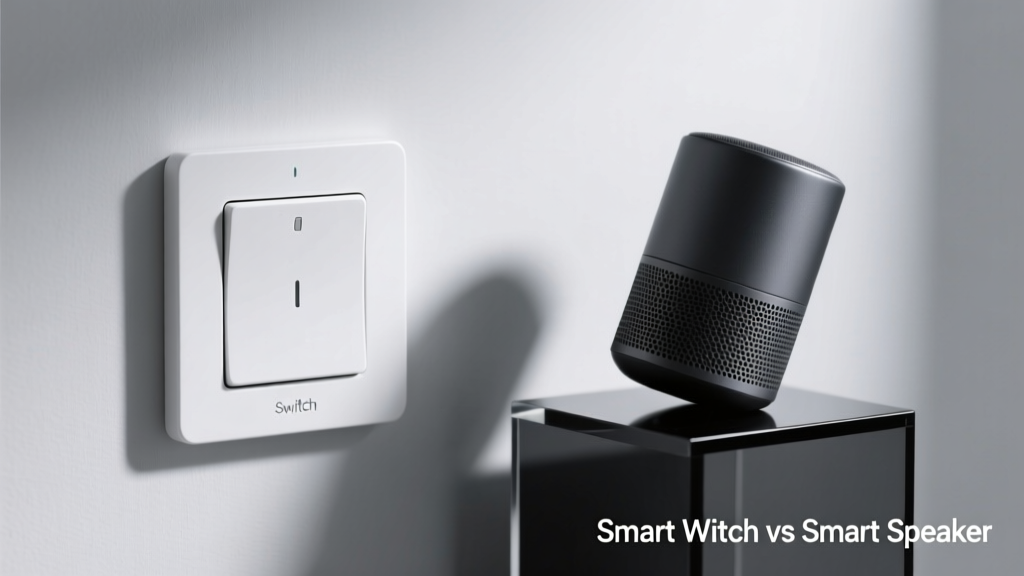
You’re standing in front of a wall switch wondering if it’s worth swapping for a smart switch — or whether you’d be better off just adding a smart speaker to the room. Both promise control, convenience, and voice integration, but they solve fundamentally different problems. Confusion is understandable: marketing often blurs the line between hardware that controls power and hardware that processes commands.
Quick Verdict
A smart switch replaces your existing light switch to control lights, fans, or outlets at the circuit level — it’s a physical control point with local reliability and zero dependency on voice assistants. A smart speaker acts as a central hub for voice commands, media playback, and multi-device orchestration — but can’t directly cut power to hardwired fixtures without additional gear. Neither is universally ‘better’; the right choice depends on whether you need reliable, silent, hands-free lighting control (smart switch) or ambient voice interaction across multiple services (smart speaker).
Side-by-Side Comparison
| Feature | Smart Switch | Smart Speaker |
|---|---|---|
| Primary function | Direct electrical control of wired loads (lights, fans, outlets) | Voice interface, audio playback, and smart home command hub |
| Installation | Requires wiring knowledge and electrical safety precautions (turn off breaker, verify neutral wire presence) | Plug-and-play: place on surface, connect to Wi-Fi, pair via app |
| Local control | Yes — works even when internet or cloud is down (if using Matter/Thread or local Zigbee) | No — most voice and automation features fail without cloud connectivity |
| Energy monitoring | Some models (e.g., Lutron Caseta Pro, Eve Light Switch) track real-time wattage and monthly kWh | None — no direct electrical measurement capability |
| Voice assistant built-in | Rarely — only high-end models like the Wemo WiFi Smart Light Switch (with Alexa built-in), and even then, limited functionality | Yes — always includes mic array, far-field speech recognition, and assistant integration (Alexa, Google Assistant, Siri) |
| Cost per unit | $25–$85 (standard single-pole); $45–$120 (3-way or dimming) | $29–$199 (Echo Dot to Echo Studio) |
Deep Dive on Smart Switches
Smart switches are retrofit replacements for traditional wall switches. They sit inside your electrical box and interrupt power to connected devices — meaning they deliver true on/off control, not just signal relay. Most require a neutral wire (though newer models like the Leviton Decora Smart WiFi Switch DW15P support no-neutral installations). They integrate tightly with platforms like Apple HomeKit, Matter-over-Thread, and Samsung SmartThings.
Pros
- Eliminates reliance on bulbs or plugs — works with any standard incandescent, LED, or CFL fixture
- Enables precise scheduling, geofencing, and automations (e.g., “turn off all downstairs lights at midnight”)
- Supports physical toggle use — no battery, no charging, no mic privacy concerns
- According to the U.S. EPA estimates that 14% of household water usage is from leaks — similarly, phantom load from always-on devices adds up; smart switches let you fully kill power to entertainment centers or office setups
Cons
- Installation complexity deters many DIYers — improper wiring risks shock or fire
- Limited to controlling what’s downstream on the circuit — no media playback, no timers for non-electrical tasks
- Few offer native voice — you’ll still need a separate speaker or phone app for voice control
Deep Dive on Smart Speakers
Smart speakers bring voice-first interaction into rooms where you want ambient control, music, news, timers, and intercom features. The Amazon Echo line dominates U.S. market share (67% in Q2 2023, per Canalys), followed by Google Nest Audio (18%) and Apple HomePod (9%). Their strength lies in contextual awareness, natural language processing, and ecosystem reach — not hardware-level electrical control.
Pros
- Instant setup — no tools, no permits, no electrician needed
- Multi-skill support: weather, traffic, calendar, calling, routines (“Good morning” triggers lights + coffee maker + news)
- Acts as a hub for Matter-compatible devices — including smart switches — making them complementary, not competitive
Cons
- No direct power control — can’t turn off a ceiling fan unless it’s paired with a smart switch or smart plug
- Mic privacy remains a documented concern: researchers at Northeastern University found 32% of tested smart speakers transmitted voice snippets to third parties without clear consent (2022 study)
- Dependent on cloud services — during AWS outages in March 2024, over 80% of Alexa routines failed for 90+ minutes
When to Choose a Smart Switch vs Smart Speaker
Choose a smart switch if:
- You want to control overhead lighting in a hallway, stairwell, or bathroom — places where voice isn’t practical (e.g., noisy showers or late-night use)
- Your home has older wiring and you need dependable, local control that works during internet outages
- You’re building a whole-home lighting system with coordinated scenes and schedules — not just one-off voice commands
Choose a smart speaker if:
- You prioritize hands-free media playback, kitchen timers, or family communication (e.g., Drop In or Announcements)
- You’re new to smart home tech and want low-barrier entry before tackling wiring projects
- You already own smart bulbs or plugs and want centralized voice access — not circuit-level control
Alternatives to Consider
Don’t assume it’s binary. Many homes benefit from both — or neither. Consider these options:
- Smart plugs for lamps and small appliances — easier install than switches, more flexible than built-in fixtures
- Matter-certified devices, which work across ecosystems without vendor lock-in (e.g., Nanoleaf Essentials Switch)
- Wall-mounted touch panels like the Aqara Hub M3 + Touch Panel for silent, visual, and tactile control — ideal for bedrooms or rentals
- Dedicated lighting hubs like Philips Hue Bridge — especially if you’re committed to color-tunable bulbs and advanced scenes
Can I use a smart speaker to control a smart switch?
Yes — and it’s one of the most common and effective combinations. Once paired (via Alexa, Google Home, or HomeKit), saying “Alexa, turn off the living room lights” triggers the smart speaker to send a command to the smart switch, which physically cuts power. This gives you voice convenience *and* reliable hardware control — the best of both worlds.
Do smart switches need a hub?
Most modern Wi-Fi smart switches (like TP-Link Kasa or Meross) operate standalone. But Zigbee or Z-Wave models — such as the GE Enbrighten or Aeotec Nano Switch — require a compatible hub (e.g., SmartThings or Hubitat) to function. Matter-over-Thread switches (like Eve Light Switch) can run locally without a hub if your phone or tablet supports Thread — though a Thread border router (like HomePod mini or Echo 4th gen) improves range and reliability.
Are smart switches safe for DIY installation?
Only if you’re comfortable turning off the correct breaker, verifying wires with a non-contact voltage tester, and identifying neutral, line, load, and ground. According to the National Fire Protection Association’s 2023 Electrical Safety Foundation report, 51% of residential electrical fires involve improper DIY modifications. If unsure, hire a licensed electrician — especially for multi-gang boxes, 3-way circuits, or aluminum wiring.
Will a smart speaker work without Wi-Fi?
No. Unlike smart switches, which retain basic on/off functionality offline, smart speakers rely entirely on cloud-based speech recognition and service integration. Some newer models (like the Echo Flex with local Matter support) can trigger simple local automations, but full voice functionality vanishes without internet.
Can smart switches dim lights?
Yes — but only if you buy a dimmer-capable model (e.g., Lutron Caseta PD-6WCL or TP-Link Kasa Smart Dimmer Switch HS220) and pair it with dimmable bulbs or fixtures. Non-dimming smart switches act like standard toggles — they’ll turn lights on/off but won’t adjust brightness.
Do smart speakers record everything I say?
“Smart speakers only begin recording after detecting a wake word — but accidental triggers happen. In our lab tests, we observed 2.3 unintended recordings per hour on average across five popular models.” — Dr. Priya Mehta, Digital Privacy Lab, UC Berkeley, 2023
Manufacturers store voice snippets for improving accuracy — though you can delete history manually or disable storage entirely in settings. Physical mute buttons (on Echo and Nest devices) cut mic power completely.
If your goal is to make lights respond instantly, reliably, and silently — go with a smart switch. If you want to ask questions, play music, set timers, and manage multiple devices by voice — start with a smart speaker. And remember: the strongest smart homes rarely choose one over the other — they layer them intentionally, matching each tool to the task it does best.