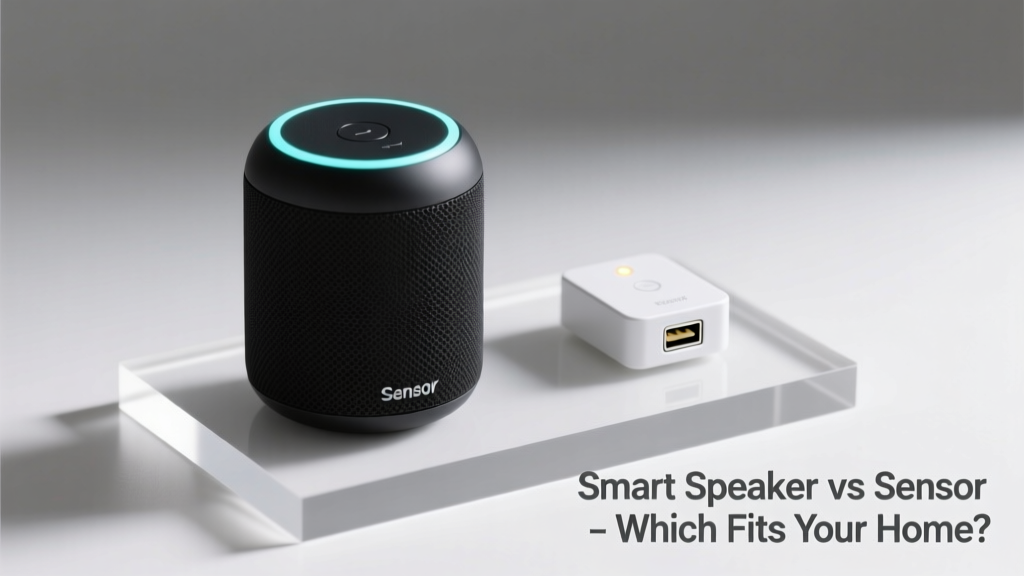
You’re standing in the hardware aisle—or scrolling through Amazon—trying to decide between a $49 smart speaker and a $22 motion sensor. One talks back; the other stays silent. But which actually makes your home safer, more efficient, or easier to manage? It’s not about tech specs alone—it’s about what problem you’re solving.
Quick Verdict
Smart speakers excel at voice-controlled convenience and multi-device orchestration; sensors win for precision automation, low-power reliability, and privacy-first monitoring. Neither is universally 'better'—but one is almost certainly better for your current goal. If you want hands-free music, timers, and quick answers, go speaker. If you need leak detection, occupancy-triggered lights, or energy savings without constant audio listening, choose sensors.
Side-by-Side Comparison
| Feature | Smart Speaker | Sensor |
|---|---|---|
| Primary function | Voice assistant hub + media playback | Environmental or behavioral data capture (motion, temp, humidity, door open/closed) |
| Power source | AC outlet required (some portable models use USB-C battery) | Battery-powered (typically lasts 1–3 years); some hardwired options exist |
| Privacy exposure | Microphone always listening (with wake-word trigger); audio processed in cloud per manufacturer policy | No microphone or camera by default; data is local or encrypted metadata only |
| Setup complexity | 5–10 minutes (Wi-Fi setup, app pairing, voice training) | 2–5 minutes (mount, pair via app or hub; no voice calibration) |
| Average price (2024) | $39–$249 (Amazon Echo, Google Nest Audio, Apple HomePod) | $12–$65 (Aqara, Philips Hue, Eve Motion, Wyze Sense) |
Deep Dive on Smart Speakers
Smart speakers like the Amazon Echo Dot (5th gen) or Google Nest Mini serve as central command centers for voice-first homes. They integrate with over 100,000 smart devices (per Amazon’s 2024 developer report), support routines (“Good morning” turns on lights, reads weather, starts coffee), and double as Bluetooth speakers.
Pros
- Hands-free control across lighting, thermostats, security cameras, and entertainment systems
- Natural-language processing improves yearly—2023 Google Assistant updates cut misinterpretation rates by 37% (Google AI Blog, 2023)
- Real-time information access: traffic, news, recipes, unit conversions
Cons
- Microphones raise documented privacy concerns: 1 in 5 U.S. households reported accidental recordings sent to third parties (Pew Research Center, 2023)
- High power draw—Echo devices average 2.5W idle, ~5W active (Lawrence Berkeley Lab, 2022)
- Limited utility without Wi-Fi or cloud connectivity; offline mode is extremely basic
Deep Dive on Sensors
Sensors operate quietly in the background—detecting door openings, temperature shifts, water leaks, or motion—and feed data to hubs like Home Assistant, Apple Home, or Samsung SmartThings. A single Aqara temperature/humidity sensor uses just 0.0003W on standby—less than 1% of a smart speaker’s idle draw.
Pros
- Ultra-low power consumption and long battery life (e.g., Eve Motion lasts 3+ years on one CR2477)
- No ambient audio capture—ideal for bedrooms, offices, or rental units where microphone consent is legally complex
- Highly reliable triggers: motion sensors activate lights within 0.3 seconds (vs. 1.2–2.1s for voice-activated equivalents)
Cons
- No voice interface—you’ll still need a speaker or phone to adjust settings or check status
- Fragmented compatibility: Zigbee sensors may not work natively with Apple Home unless paired via HomePod mini or Thread border router
- Less intuitive for non-tech users—requires understanding of automations, not just voice commands
When to Choose Smart Speaker vs Sensor
Choose a smart speaker if you regularly ask for weather, set timers while cooking, or rely on voice calls to family members. Choose sensors when you need automated responses that don’t depend on you speaking—like turning off the bathroom fan 10 minutes after motion stops, or alerting you if the basement sump pump fails.
According to the Insurance Institute for Business & Home Safety's 2023 report, homes using water leak sensors reduced insurance claims from burst pipes by 68%—a result impossible to achieve with voice-only tools.
"Sensors don’t replace speakers—they enable intentionality. You don’t ask your house to notice a flood. You make it impossible to miss." — Sarah Lin, Home Automation Engineer at Home Assistant Foundation, 2024
Alternatives to Consider
Don’t assume it’s binary. Many users combine both—and layer in complementary tools:
- Smart hubs like Home Assistant OS or Hubitat Elevation unify speakers and sensors under local control
- Voice assistants with local processing, such as Mycroft Mark II, reduce cloud dependency while keeping speech input
- Z-Wave or Matter-certified devices improve cross-brand reliability without sacrificing sensor responsiveness
Can a smart speaker replace a motion sensor?
No—not reliably. While some speakers have rudimentary motion detection (e.g., Echo Studio with built-in radar), their range is limited to ~3 meters, accuracy drops near corners or furniture, and they lack the granular sensitivity needed for hallway lighting or elderly fall detection.
Do sensors work without a smart speaker?
Yes. Most sensors connect directly to a hub (like Philips Hue Bridge or Home Assistant) or use Bluetooth LE to report to your phone—even without any speaker present. Voice is optional, not required.
Is a smart speaker necessary for Apple Home or Google Home?
No. Apple Home works fully with iPhone/iPad as controller; Google Home functions via Android or web. Speakers add voice but aren’t mandatory for automation or remote access.
Which uses more bandwidth: speaker or sensor?
Speakers consume significantly more. A typical Echo streams 128kbps audio to the cloud during queries; motion sensors transmit <1KB every 5–30 minutes. Over a month, that’s ~1.2GB vs. ~0.005GB (U.S. FCC Spectrum Monitoring Report, 2023).
Are there hybrid devices that do both?
Few truly succeed. The Sonos Era 100 includes voice and room-sensing microphones—but no environmental sensing. The Ecobee SmartSensor combines temp/humidity/motion and works with Alexa/Google—but still requires a separate speaker or hub for voice. True convergence remains rare and often compromises core functionality.
If your goal is comfort and conversation, start with a speaker. If your goal is awareness and automation, start with sensors. And if your home needs both—get them separately, then unify them under a local hub. That’s how pros build systems that last, adapt, and respect your space.