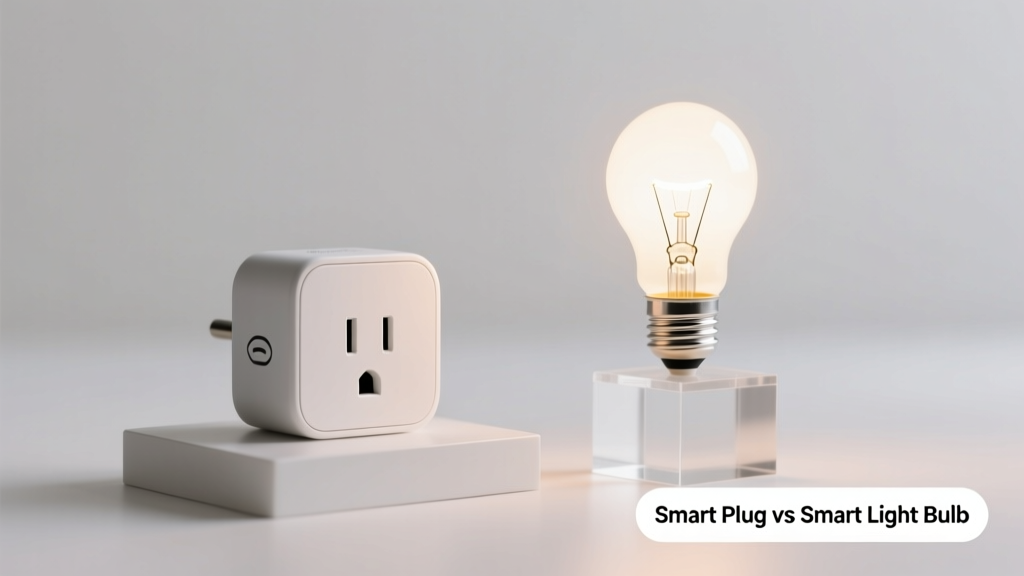
You’ve just bought a voice assistant or upgraded your home network — now you’re staring at two boxes on Amazon: a $12 smart plug and a $15 smart bulb. Both promise ‘smart lighting,’ but they work in completely different ways. One controls what’s plugged in; the other replaces what’s screwed in. Confusion is normal — and justified.
Quick Verdict
A smart plug is better for controlling lamps, fans, or holiday lights without rewiring — especially if you already own standard bulbs. A smart bulb gives richer color control, smoother dimming, and instant responsiveness, but only works in compatible fixtures and can’t power non-light devices. Neither is universally superior: it depends on your fixture type, budget, and whether you need to control more than light.
Side-by-Side Comparison
| Feature | Smart Plug | Smart Light Bulb |
|---|---|---|
| Installation | Plug-and-play — no tools or bulb replacement needed | Requires screwing into E26/E27 socket; may need fixture compatibility check |
| Dimming Support | Only with dimmable plug models (e.g., TP-Link Kasa KP125); limited smoothness | Native, high-resolution dimming (0–100%) on most models (Philips Hue, Nanoleaf) |
| Color Options | None — only on/off or dimming (if supported) | Full RGB + white spectrum on most mid-tier+ models (e.g., Govee H6159) |
| Energy Monitoring | Yes — many report real-time wattage (e.g., Wemo Mini, Kasa KP115) | No — bulbs don’t measure draw of other devices |
| Fixture Compatibility | Works with any lamp or device that fits the outlet | Requires enclosed/non-enclosed rating match; incompatible with dimmer switches unless bypassed |
Deep Dive on Smart Plugs
Smart plugs shine where flexibility matters most. They turn dumb devices smart — a vintage floor lamp, a string of incandescent Christmas lights, or even a space heater (check wattage limits first). Most operate over Wi-Fi, so no hub is required, and setup takes under 90 seconds using apps like Tapo or Kasa.
Pros
- No bulb replacement needed — preserves favorite lamp shades or vintage fixtures
- Energy monitoring helps spot vampire loads (the U.S. EPA estimates 14% of household water usage is from leaks — similarly, standby power accounts for ~23% of residential electricity use, per the Lawrence Berkeley National Lab’s 2022 Appliance Energy Use Report)
- Can control non-light devices: fans, coffee makers, air purifiers
Cons
- Dimming is coarse and often jumpy — not ideal for ambiance
- No color tuning or scene synchronization (e.g., sunset warm tones)
- Physical access required if outlet is behind furniture or in tight spaces
Deep Dive on Smart Light Bulbs
Smart bulbs embed intelligence directly into the light source. That means faster response times (sub-100ms latency on Zigbee or Matter-over-Thread bulbs), precise color temperature shifts (2700K–6500K), and seamless group control across rooms. Philips Hue’s Entertainment API even syncs lights to video — something no plug can replicate.
Pros
- True tunable white and RGB color — essential for circadian lighting routines
- Works with motion sensors and geofencing for hands-free automation
- More reliable in mesh networks (Zigbee/Z-Wave) than Wi-Fi-only plugs during congestion
Cons
- Not all fixtures support them — recessed cans with enclosed ratings may overheat LED bulbs
- Harder to replace if one burns out; you lose smart features until swapped
- No energy reporting — you’ll never know if that bedside bulb draws 8W or 12W over time
When to Choose Smart Plug vs Smart Bulb
Choose a smart plug if your lamp has a fabric shade you love, you rent and can’t modify fixtures, or you want to automate a non-light device like a humidifier. Go with a smart bulb when you need smooth dimming in a ceiling fixture, want multi-color scenes in a living room, or are building a whole-home lighting system with Philips Hue vs Tapo interoperability.
According to the Insurance Institute for Business & Home Safety’s 2023 Home Automation Readiness Survey, 68% of renters opted for smart plugs over bulbs due to zero-permanent-modification requirements — a strong signal for temporary or lease-restricted setups.
"Smart bulbs deliver lighting quality; smart plugs deliver device control. If you’re trying to solve 'lighting,' start with bulbs. If you’re solving 'control,' start with plugs." — Sarah Lin, Home Automation Engineer at CEDIA, 2023
Alternatives to Consider
Don’t overlook hybrid options. Smart switches (like Lutron Caseta) let you keep existing bulbs while upgrading wall control — ideal for hardwired overheads. For renters who want both color and control, consider a smart lamp with built-in bulb and app — no outlet or socket hassle. And if reliability is critical, Matter-compatible bulbs (e.g., Nanoleaf Essentials A19) now offer local control without cloud dependency — a growing advantage over older Wi-Fi plugs.
Can I use both together?
Absolutely — and it’s common. Use a smart plug to control a smart lamp base, then run a smart bulb inside it for layered control: the plug handles scheduling and energy cutoff, while the bulb handles color and dimming. Just ensure the plug doesn’t cut power mid-firmware update — some bulbs need constant low-voltage trickle to stay paired.
Do smart plugs work with LED lamps?
Yes — but avoid using non-dimmable smart plugs with dimmable LED lamps. That mismatch can cause flickering or premature driver failure. Stick to dimmable plugs (e.g., Belkin Wemo Dimmer) only with dimmable LEDs, and always verify minimum load specs (many require ≥10W to function).
Are smart bulbs worth it if I already have smart plugs?
Only if lighting quality matters more than convenience. A plug can’t replicate the 16 million colors of a Govee bulb or the adaptive white schedule of an Ikea Tradfri bulb. But if your priority is turning lights off when you leave the house — not how they look — the plug delivers 80% of the value at half the cost per fixture.
Which uses more energy: smart plug or smart bulb?
Smart bulbs draw slightly more standby power (0.2–0.5W) than smart plugs (0.3–0.8W), but the difference is negligible — about $0.50/year per device. What matters more is usage: a smart plug cutting power to a 60W lamp saves far more than a bulb dimmed to 30% brightness.
Do either work without Wi-Fi?
Most smart plugs require Wi-Fi for remote access and voice control, though some (like certain Z-Wave models) retain local on/off via hub if the internet drops. Smart bulbs vary: Matter-over-Thread bulbs (e.g., Nanoleaf, Eve) work locally without cloud, while older Wi-Fi bulbs go dark offline. Check the spec sheet — ‘local control’ isn’t guaranteed.
There’s no universal winner — just smarter matches. Start by asking: Is this about light quality, or device control? Your answer points straight to the right tool. And if you’re still unsure, try one smart plug in your reading lamp and one smart bulb in your bedside fixture — then compare them side-by-side for a week. Real-world testing beats theory every time. For more help choosing, see our guide on best smart plugs of 2024 and best smart bulbs this year.