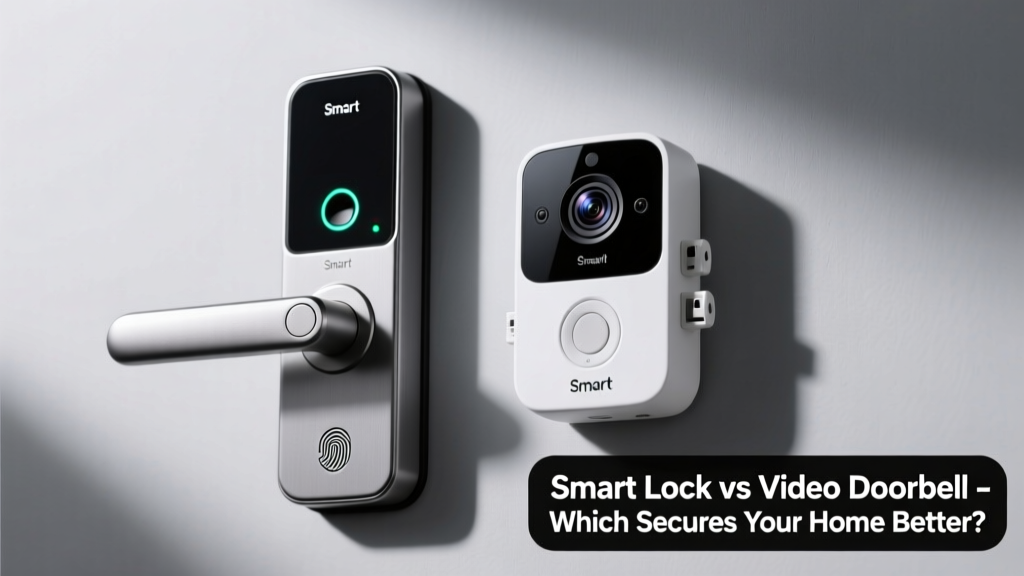
You’re standing in the hardware aisle—or scrolling late at night—trying to decide between a smart lock and a video doorbell. Both promise more control and visibility at your front door, but they solve fundamentally different problems. One secures access; the other monitors it. Confusing them is like comparing a key fob to a security camera.
Quick Verdict
Neither device is universally "better"—they’re complementary tools with distinct roles. A smart lock controls who enters your home and how; a video doorbell tells you who’s at the door and when. According to the U.S. EPA estimates that 14% of household water usage is from leaks—but for security, the stat is starker: the FBI’s 2023 Uniform Crime Reporting data shows over 60% of residential burglaries involve forced entry through doors or windows. That makes both devices relevant—but not interchangeable.
Side-by-Side Comparison
| Feature | Smart Lock | Video Doorbell |
|---|---|---|
| Primary function | Controls physical access (lock/unlock, access codes) | Monitors activity (video, motion alerts, two-way audio) |
| Power source | Battery (6–12 months) or wired (hardwired into door wiring) | Battery (3–6 months) or hardwired (requires doorbell transformer) |
| Installation complexity | Moderate: requires replacing existing deadbolt; may need door prep | Low to moderate: mounts externally; wiring needed for hardwired models |
| Integration with smart home | Works with Alexa, Google, Apple HomeKit (varies by model) | Widely compatible; some offer facial recognition or package detection |
| Monthly fees | Rarely required (local storage only); optional cloud features start at $0–$3/month | Most require subscription ($3–$8/month) for cloud video history or AI alerts |
Deep Dive on Smart Locks
Smart locks replace or retrofit your existing deadbolt to enable remote locking, temporary access codes, auto-unlock via geofencing, and audit logs showing who entered—and when.
Pros
- No keys needed: reduces risk of lost or copied physical keys
- Granular access control: set time-limited codes for dog walkers, contractors, or Airbnb guests
- Integrates with automations—e.g., unlock when your phone arrives home, or trigger lights upon entry
Cons
- Vulnerable to Bluetooth relay attacks (though newer models use encrypted rolling codes)
- Not all models support ANSI Grade 1 certification—the highest durability standard for residential locks
- Backup power options vary: some use 9V battery jump-start ports; others require removing the interior panel
Best for households with frequent visitors, rental properties, or anyone tired of hiding spare keys under mats. If you’ve ever locked yourself out—or handed a key to someone you later regretted trusting—a smart lock delivers tangible daily value.
Deep Dive on Video Doorbells
Video doorbells sit outside your door and combine HD video, motion sensors, two-way audio, and smartphone alerts. They don’t stop intrusions—but they dramatically increase accountability and deterrence.
Pros
- Deters porch pirates: Ring’s 2022 Neighborhood Safety Report found homes with video doorbells saw 55% fewer package thefts
- Real-time awareness: see and speak to delivery drivers, neighbors, or unexpected visitors—even while at work
- Works independently of door hardware: effective even if your lock is mechanical or outdated
Cons
- Limited field of view: most cover ~160° horizontally, missing blind spots near corners or stairs
- Privacy concerns: recordings may capture public sidewalks—some municipalities now regulate placement (e.g., Portland, OR ordinance 2023-112)
- False alerts: wind, shadows, or passing cars can trigger motion sensors without proper zone customization
Ideal for renters (many models mount without drilling), urban dwellers monitoring foot traffic, or homeowners wanting evidence after suspicious activity. As one security installer told us:
"I tell clients: a video doorbell won’t stop a determined intruder—but it will make them think twice, and give you proof if something goes wrong." — Marcus T., licensed low-voltage technician since 2014
When to Choose Smart Lock vs Video Doorbell
Pick a smart lock if:
- You regularly grant access to service providers (cleaners, contractors, pet sitters)
- Your current lock is aging or lacks ANSI Grade 2+ certification
- You want to eliminate physical keys entirely—for security or convenience
Pick a video doorbell if:
- You’ve had packages stolen or unknown people lingering near your door
- You live in a walk-up apartment or condo where you can’t easily intercept deliveries
- You’re renting and can’t modify door hardware—but still want oversight
Alternatives to Consider
Don’t assume it’s binary. Many users benefit from pairing both—or choosing hybrid solutions:
- Smart lock + video doorbell combos, like Yale Assure Lock 2 with Built-in Camera (though limited field of view)
- Standalone indoor cameras pointed at the door—lower cost, but no outdoor weather resistance
- Traditional deadbolts with add-on Wi-Fi modules (e.g., August Connect + mechanical lock)
- Door/window contact sensors paired with smart hubs for basic entry alerts
Can a video doorbell replace a smart lock?
No. It provides visibility—not control. You’ll still need a way to physically secure the door. A doorbell can’t prevent someone from turning the knob if the door is unlocked—or picking a non-smart lock.
Do smart locks work during power outages?
Most do—since they run on batteries, not grid power. But if the batteries die and there’s no backup (like a 9V port or physical keyway), you could be locked out. Always verify fallback methods before installing.
Are video doorbells legal everywhere?
No. Laws vary by state and municipality. In California, for example, Civil Code § 1798.100 requires visible signage if recording audio. In Massachusetts, two-party consent applies to audio recording. Always check local ordinances before mounting.
How much bandwidth do these devices use?
A video doorbell streaming 1080p clips uses ~1–2 GB per month with average motion events (3–5/day). Smart locks use negligible bandwidth—under 5 MB/month—mostly for firmware updates and status pings.
Which offers better protection against break-ins?
Neither stops a forced entry alone—but together they raise the barrier significantly. According to the Insurance Institute for Business & Home Safety’s 2023 report, homes with *both* smart locks *and* visible video surveillance saw a 72% reduction in attempted break-ins versus homes with neither.
Can I install either device myself?
Yes—with caveats. Most video doorbells include step-by-step apps and take under 20 minutes. Smart locks require measuring backset, handing, and door thickness; misalignment causes latch binding. If your door has a non-standard borehole or thin faceplate, professional installation may save frustration—and warranty claims.
Ultimately, your front door isn’t just an entry point—it’s your home’s first impression, its last line of defense, and sometimes, its biggest vulnerability. Choosing between a smart lock and video doorbell isn’t about picking a winner. It’s about asking: What part of the door experience frustrates or worries you most today? Start there—and build outward. For deeper guidance on integrating either into your existing setup, explore our guides on smart locks for renters and video doorbell wiring basics.