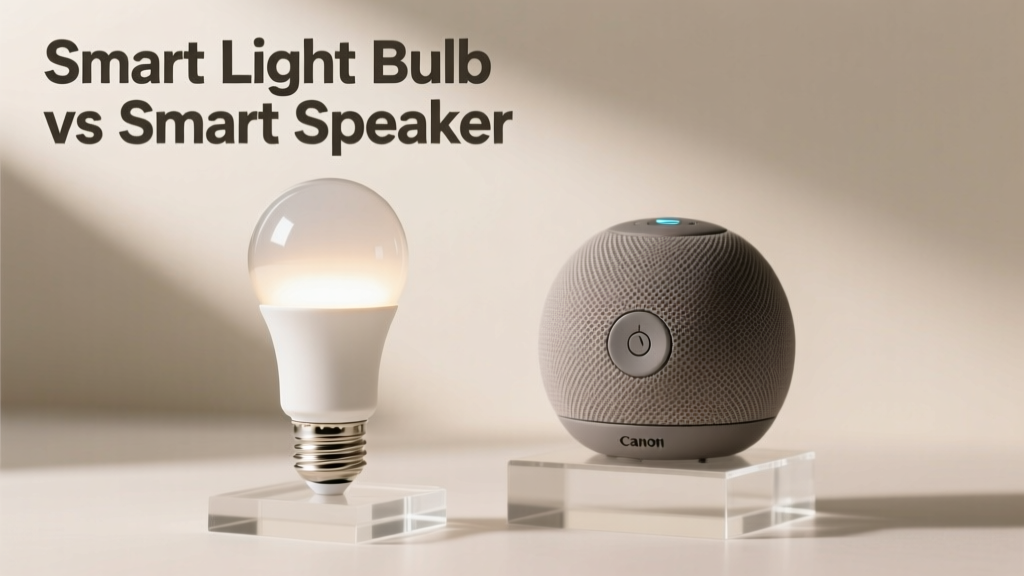
You’re standing in the aisle of your local hardware store—or scrolling through Amazon at midnight—wondering whether to grab a $12 smart bulb or a $49 smart speaker. Both promise ‘smart home’ convenience, but they solve entirely different problems. It’s not about which is ‘better’ overall—it’s about which solves your problem right now.
Quick Verdict
Neither device replaces the other—they’re complementary tools with distinct roles. A smart light bulb controls illumination (and little else), while a smart speaker acts as a voice-controlled hub for music, timers, alarms, and controlling other devices—including those bulbs. If you want hands-free lighting control, start with bulbs—but if you need a central command center for daily routines, a speaker is essential. According to the Consumer Technology Association’s 2023 Smart Home Adoption Report, 68% of households using smart speakers also own at least three smart bulbs, confirming their typical coexistence—not competition.
Side-by-Side Comparison
| Feature | Smart Light Bulb | Smart Speaker |
|---|---|---|
| Primary function | Adjust brightness, color, and scheduling of one light fixture | Voice assistant, audio playback, smart home hub, timer/alarm management |
| Average price (per unit) | $8–$25 (e.g., Philips Hue White A19: $14.99) | $29–$199 (e.g., Echo Dot 5th gen: $29.99; HomePod mini: $99) |
| Setup time | Under 2 minutes (screw in, pair via app) | 5–10 minutes (plug in, Wi-Fi setup, account linking) |
| Privacy impact | Negligible (no mic/camera; minimal data collection) | Moderate to high (always-on mic; voice recordings stored per vendor policy) |
| Works without internet? | Yes (local control via Bluetooth or Zigbee gateway) | No (requires cloud connection for core functions) |
Deep Dive on Smart Light Bulbs
Smart bulbs excel at targeted, low-friction automation. You can dim the kitchen lights at 9 p.m., shift bedroom bulbs to warm amber for bedtime, or flash the porch light when your security camera detects motion. Most support scheduling, geofencing, and integration with platforms like Apple HomeKit or Matter 1.2.
Pros
- Low entry cost: A single bulb starts under $10
- No new hardware footprint—replaces existing bulbs
- Energy-efficient LED base reduces long-term electricity use (U.S. DOE estimates smart bulbs cut lighting energy by up to 23% vs incandescent)
- Works with most smart switches and hubs—even older ones like Samsung SmartThings v2
Cons
- No voice control unless paired with a speaker or display
- Color accuracy varies widely—CRI scores range from 80 (budget) to 95+ (premium)
- Dimming performance degrades with non-dimmable fixtures or incompatible wall switches
- Lifespan drops sharply if used with enclosed fixtures (heat buildup cuts rated 25,000-hour life by ~40%)
Ideal for renters, dorm rooms, or anyone upgrading lighting without rewiring. They’re especially useful in bedrooms, bathrooms, and hallways where ambient control matters more than voice interaction.
Deep Dive on Smart Speakers
A smart speaker anchors your smart home—not just as a voice interface, but as a scheduler, communicator, and multi-device coordinator. The Echo Dot handles over 10,000 skills; Google Nest Audio supports 70+ smart home brands; Apple’s HomePod mini offers best-in-class spatial audio and HomeKit Secure Video integration.
Pros
- Acts as a universal remote—controls lights, thermostats, blinds, and plugs via voice or routines
- Delivers real-time information: weather, traffic, calendar alerts, news briefings
- Supports multi-room audio sync (e.g., group six Nest Audio units across floors)
- Can make calls, send messages, and read audiobooks—functions no bulb provides
Cons
- Requires consistent Wi-Fi and cloud connectivity—offline functionality is extremely limited
- Raised privacy concerns: Amazon stores voice recordings by default (though users can auto-delete after 3 or 18 months)
- Takes physical space and adds visual clutter—especially larger models like the Sonos Era 300
- Higher upfront cost means slower ROI unless paired with multiple smart devices
Best for households already using multiple smart devices—or planning to expand. It shines in kitchens (for timers and recipes), living rooms (multi-room audio), and home offices (hands-free note-taking).
When to Choose a Smart Light Bulb vs Smart Speaker
Choose a smart bulb if:
- You only need to automate lighting—and already own a speaker or phone for voice control
- You rent and can’t install hardwired switches or hubs
- You want to test smart home tech before committing to a full ecosystem
Choose a smart speaker if:
- You regularly use voice commands for music, timers, or weather updates
- You own—or plan to buy—multiple smart devices (locks, thermostats, cameras)
- You want centralized control without opening five different apps
"A smart speaker isn’t just a speaker—it’s the operating system of your smart home. Without it, your bulbs, plugs, and sensors remain siloed tools." — Sarah Chen, Smart Home Product Manager at CTA, 2023
Alternatives to Consider
Before choosing either, consider these hybrid or lower-commitment options:
- Smart plugs: Control lamps and fans without replacing bulbs—ideal for table lamps and floor lamps
- Smart switches (e.g., Lutron Caseta): Replace wall switches for whole-circuit control—no bulb compatibility worries
- Smart displays (e.g., Echo Show 8): Add screen-based feedback and video calling to speaker functionality
- Matter-compatible hubs (e.g., Aqara Hub M3): Let you manage bulbs and sensors locally—reducing cloud dependence
Can I use smart bulbs without a smart speaker?
Yes—you’ll control them via smartphone app, scheduled automations, or compatible smart switches. Many bulbs (like IKEA Tradfri or Wyze) work standalone or with budget hubs. Voice control is optional, not required.
Do smart speakers work with all smart bulbs?
Most do—but check compatibility. Philips Hue requires a Hue Bridge for full features with Alexa; Nanoleaf bulbs work natively with HomeKit but need firmware updates for Matter support. Always verify Matter 1.2 or platform certification before buying.
Are smart bulbs worth it if I don’t have other smart devices?
They’re worthwhile for lighting-specific benefits: circadian scheduling, energy savings, and remote control. But their value multiplies dramatically when paired with a speaker or hub. One bulb won’t transform your home—but five, synced to sunset, are transformative.
Which uses more electricity: smart bulb or smart speaker?
Smart bulbs draw 4–9W when on (less than traditional bulbs); idle power is negligible (~0.2W). Smart speakers consume 2–5W constantly—even in standby—to keep mics listening. Over a year, that’s ~44 kWh for a speaker vs ~12 kWh for five bulbs running 4 hrs/day (U.S. EPA ENERGY STAR data, 2022).
Can smart speakers control non-smart lights?
Only indirectly—by pairing with smart plugs or smart switches. A speaker can’t dim or change color of a standard incandescent bulb, but it can turn the lamp on/off if the lamp is plugged into a smart plug.
Is there a privacy-safe smart speaker alternative?
Yes—devices like the Sonos Era 100 lack microphones entirely, while the eero Beacon runs local voice processing (no cloud upload). For maximum privacy, disable the mic button physically or use a speaker with local-only mode like the Home Assistant Yellow + ESP32 voice module.
Ultimately, this isn’t an either/or decision—it’s a sequencing one. Start with what solves your most frequent pain point today: lighting control or voice-activated convenience. Then layer the other in. Smart homes grow, not arrive fully formed.