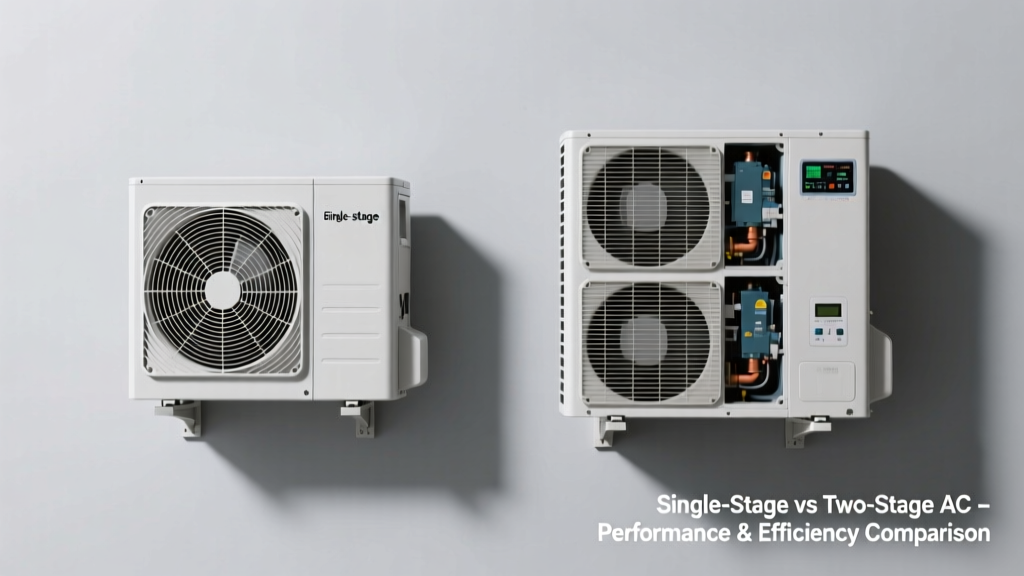
Choosing between a single-stage and two-stage AC feels like picking between reliability and refinement—both cool your home, but they do it in fundamentally different ways. You’re not just buying hardware; you’re investing in how quietly, evenly, and efficiently your home stays comfortable all summer long.
Quick Verdict
Two-stage ACs deliver superior temperature consistency, humidity control, and energy savings—especially in humid or variable climates—but cost $800–$1,600 more upfront. Single-stage units are simpler, cheaper to install and repair, and perfectly adequate for dry, consistently hot regions or smaller homes under 1,500 sq ft. If your utility bills spike in July and your thermostat reads 72°F while the bedroom feels muggy, two-stage is likely worth the premium.
Side-by-Side Comparison
| Feature | Single-Stage AC | Two-Stage AC |
|---|---|---|
| Compressor operation | Runs at full capacity (100%) or off | Runs at low stage (~65%) most of the time; kicks up to high only during peak demand |
| Average SEER rating | 13–16 | 16–22 |
| Annual energy use (vs. baseline) | Baseline (100%) | 12–20% less, per U.S. Department of Energy’s 2022 HVAC Efficiency Report |
| Indoor humidity removal | Less effective—short, aggressive cycles don’t dehumidify well | Up to 30% more moisture removal during low-stage operation (AHRI, 2023) |
| Lifespan (typical) | 12–15 years | 14–18 years (lower compressor stress) |
| Installation complexity | Standard ductwork and wiring | May require upgraded thermostat (e.g., communicating or multi-stage), sometimes duct sealing |
Deep Dive on Single-Stage AC
Single-stage systems have one speed: full blast. When the thermostat calls for cooling, the compressor and blower kick on at 100% until the setpoint is reached—then everything shuts off. It’s simple, rugged, and widely supported by contractors across the U.S.
Pros
- Lower upfront cost: $3,200–$4,800 installed (vs. $4,500–$6,400 for two-stage)
- Fewer components = fewer failure points and easier, cheaper repairs
- Compatible with basic thermostats and older duct systems
Cons
- Temperature swings of 2–4°F between cycles—noticeable in larger or poorly insulated homes
- Poor humidity control in coastal or southeastern climates; contributes to mold risk if unaddressed
- Higher long-term electricity costs in homes that run AC >1,800 hours/year
Best for: Homes in arid climates (e.g., Phoenix, Las Vegas), rental properties, or budget-constrained retrofits where ductwork can’t be modified. Also a solid choice if you pair it with a standalone dehumidifier and use a smart thermostat with adaptive recovery.
Deep Dive on Two-Stage AC
Two-stage units operate at two distinct capacities: a low stage (typically 60–70% output) handles ~80% of cooling demand, and a high stage engages only during heat waves or rapid cooldowns. This mimics how a car uses cruise control instead of flooring the accelerator every time you need speed.
Pros
- Steadier indoor temps—±0.5°F variance versus ±3°F for single-stage (based on field data from ACCA’s 2023 Residential Performance Survey)
- Quieter operation: low-stage noise averages 62 dB vs. 72+ dB at full blast
- Better air filtration and circulation due to longer, slower cycles
Cons
- Higher initial investment—and not all contractors are trained to properly commission two-stage systems
- Requires compatible thermostat; mismatched controls can force high-stage-only operation
- Low-stage performance drops if ducts leak >15% (a common issue in older homes)
According to the Insurance Institute for Business & Home Safety's 2023 report, homes with two-stage ACs in humid zones saw 22% fewer moisture-related service calls over five years—mostly tied to reduced condensate drain clogs and coil mold.
"Two-stage isn’t about raw cooling power—it’s about precision timing. A unit that runs 18 minutes at low stage removes more latent heat than one that runs 8 minutes at full blast, even if both move the same BTUs." — HVAC engineer Maria Chen, ASHRAE Journal, 2022
When to Choose Single-Stage vs Two-Stage AC
Select single-stage if:
- You live in a desert climate (AZ, NM, NV) with low humidity and consistent 95°F+ days
- Your home is under 1,400 sq ft and well-insulated
- You plan to sell within 3–5 years and won’t recoup the premium via energy savings
Choose two-stage if:
- You’re in the Southeast, Midwest, or Pacific Northwest—where humidity and shoulder-season cooling dominate
- Your home has vaulted ceilings, open floor plans, or inconsistent room temperatures
- You’ve recently upgraded insulation, windows, or ductwork—making your load profile more moderate and steady
Alternatives to Consider
Before locking in either option, weigh these alternatives:
- Variable-speed AC: Offers up to 10+ stages and even finer control—but starts at $6,800+ installed and demands expert sizing (see full breakdown)
- Ductless mini-split: Excellent for additions or homes without ducts; many models offer two-stage-like modulation at lower total cost
- AC + whole-house dehumidifier: A cost-effective hybrid path for single-stage owners in humid areas—adds $1,200–$2,000 but targets the root cause of mugginess
Does two-stage AC work with a smart thermostat?
Yes—but only if the thermostat supports multi-stage cooling (e.g., Nest Learning Thermostat 5th gen, Ecobee SmartThermostat Premium). Basic Wi-Fi thermostats often default to single-stage mode, negating the benefit. Always verify compatibility before purchase.
Can I upgrade my single-stage AC to two-stage?
No—not practically. The compressor, control board, and refrigerant circuit are fundamentally different. Retrofitting would cost more than a full replacement and void warranties. However, you can upgrade your thermostat, duct sealing, and insulation now to make a future two-stage install more effective.
Is two-stage worth it for a 100-year-old home?
Only if ducts are sealed and insulated, attic ventilation is adequate, and static pressure tests show airflow meets design specs. In many historic homes, upgrading ductwork alone costs $2,500–$4,000—so factor that into your ROI calculation alongside equipment cost.
Do two-stage units qualify for tax credits or rebates?
Yes—if rated at least 16 SEER2 and 13 EER2 (per IRS guidelines updated in 2023), you may claim a $600 federal tax credit. Many utilities (like PG&E and Duke Energy) also offer $300–$800 rebates for two-stage and variable-speed units meeting local efficiency tiers.
How much longer does a two-stage AC last?
On average, 2–3 years longer than single-stage—mainly because the compressor avoids repeated high-stress startups. According to the National Association of Home Builders’ 2024 Equipment Lifespan Study, two-stage compressors averaged 16.2 years vs. 14.1 for single-stage in matched-climate installations.
If your current AC is over 12 years old and you’re replacing it anyway, the incremental cost of two-stage is often justified—not just by energy savings, but by quieter operation, better air quality, and fewer mid-summer service calls. For new construction or major renovations, two-stage should be the default unless budget or climate strongly dictates otherwise.