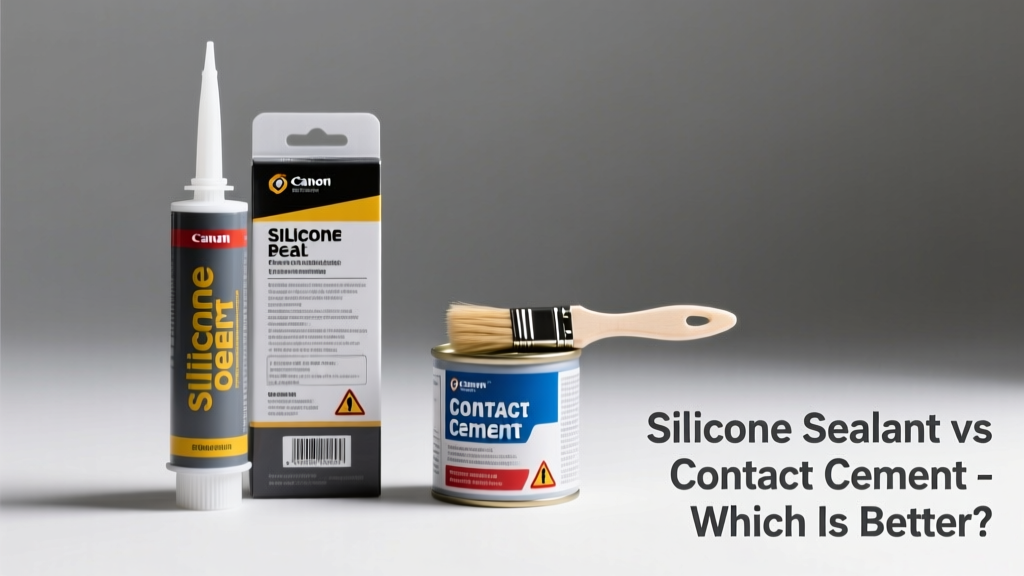
You’re holding two tubes—one labeled 'silicone sealant,' the other 'contact cement'—and you’re not sure which will hold your bathroom trim in place or bond that laminate countertop edge. They look similar, but their chemistries, strengths, and failure modes are worlds apart.
Quick Verdict
Silicone sealant excels at flexible, waterproof sealing where movement or moisture is expected—think shower corners or window perimeters. Contact cement dominates rigid, high-strength bonding of non-porous materials like vinyl flooring or Formica countertops. Neither is universally 'better'; choosing wrong risks delamination, mold, or brittle failure within months.
Side-by-Side Comparison
| Feature | Silicone Sealant | Contact Cement |
|---|---|---|
| Primary function | Sealing + limited adhesion | High-shear bonding |
| Cure mechanism | Moisture-cured (acetic or neutral) | Solvent-evaporation (dries to tacky film) |
| Flexibility after cure | Extremely flexible (300–700% elongation) | Rigid; minimal movement tolerance |
| Water resistance | Excellent—even underwater long-term | Poor once cured; degrades with prolonged moisture |
| Gap-filling ability | Strong (fills up to ¼") | Weak (requires tight, flush contact) |
| Typical cure time to handling strength | 12–24 hours (surface dry), 7 days full cure | 15–60 minutes (tack time), full bond in 24 hrs |
Deep Dive on Silicone Sealant
Silicone sealants are polymer-based formulations—typically acetoxy (vinegar-smelling) or neutral-cure (amine or oxime). They form durable, UV- and temperature-resistant seals from -75°F to 400°F. Their flexibility makes them ideal for joints between dissimilar materials (e.g., tile and wood) that expand and contract at different rates.
Pros
- Unmatched water and weather resistance—used by marine and HVAC industries
- Resists mold and mildew when formulated with biocides (e.g., GE Advanced Silicone II)
- Stays pliable for 20+ years under stable conditions (per Dow Corning’s 2022 product lifecycle data)
Cons
- Poor adhesion to some plastics (e.g., polyethylene, polypropylene)
- Cannot be painted unless explicitly labeled 'paintable' (most aren’t)
- Acetoxy types corrode metals and damage mirrors—avoid near aluminum frames or silver-backed glass
Ideal use cases include sealing around bathtubs, shower bases, exterior window/door perimeters, and HVAC duct joints. For a detailed breakdown of compatible substrates, see our silicone sealant substrate compatibility guide.
Deep Dive on Contact Cement
Contact cement is a solvent-based or water-based adhesive containing synthetic rubber (neoprene or SBR) suspended in acetone, toluene, or latex emulsion. It bonds on contact—no clamping needed—because both surfaces are coated, allowed to flash off solvents, then pressed together. The bond forms instantly and permanently.
Pros
- Instant, high-tack bond—ideal for large, flat laminates where alignment is critical
- Handles shear and peel forces better than most construction adhesives (ASTM D1002 lap-shear strength ≥1,200 psi)
- Works on glossy surfaces like melamine, PVC, and stainless steel where epoxies or polyurethanes struggle
Cons
- VOC-heavy formulas require ventilation (EPA limits: ≤550 g/L for architectural coatings, per 2023 NESHAP rules)
- No gap-filling—any surface irregularity causes weak spots or air pockets
- Fails catastrophically if moisture wicks under edges (common cause of kitchen countertop delamination)
Best for bonding laminate to particleboard, attaching rubber gym flooring, or mounting acoustic panels to drywall. For safe application tips, check our contact cement safety guide.
When to Choose Silicone Sealant vs Contact Cement
Choose silicone sealant when: you need a waterproof barrier that moves with the structure (e.g., sealing a skylight frame); you’re working in high-humidity areas like steam rooms; or you’re sealing around plumbing penetrations where minor shifts occur.
Choose contact cement when: bonding large-format non-porous sheets (e.g., 5' × 12' plastic laminate); installing rubber or cork flooring over concrete; or repairing veneer that’s lifting but still intact.
"Contact cement isn’t forgiving—if you misalign during assembly, you can’t reposition. With silicone, you get seconds to smooth and tool before skinning begins." — Carlos M., certified flooring installer with 18 years’ experience, quoted in Flooring Contractor Magazine, 2023
Alternatives to Consider
Neither product fits every job. For structural wood-to-wood bonding, consider polyurethane construction adhesive—it expands slightly to fill gaps and cures moisture-resistant. For temporary or repositionable holds, spray adhesives like 3M Super 77 work well on foam and fabric. And for ceramic tile backsplashes where both bond and seal matter, modified thinset mortar often outperforms both silicone and contact cement.
Can I use silicone sealant to bond laminate countertops?
No. Silicone lacks the initial grab and long-term shear strength needed. Laminates bonded with silicone often lift at front edges within 6–12 months due to thermal cycling and foot traffic vibration.
Is contact cement safe for bathroom use?
Only if fully sealed from moisture exposure—e.g., behind a vanity panel that never contacts water. Never use it to adhere shower wall panels or tub surrounds. The U.S. EPA estimates that 14% of household water usage is from leaks, many originating from failed adhesive joints in wet areas (2023 WaterSense report).
Does silicone sealant stick to cured contact cement?
Rarely—and never reliably. Silicone adheres poorly to many rubberized or plasticized surfaces. If you must transition between systems, mechanically scarify the contact cement surface and prime with a silicone primer like Dow Corning® 1200 OS.
Can I paint over contact cement?
Yes—but only after full cure (24–48 hrs) and only with water-based acrylics. Solvent-based paints may soften or dissolve the bond layer. Always test adhesion on a scrap piece first.
How long does contact cement last outdoors?
Not long. Most solvent-based formulas degrade under UV exposure within 1–2 years. For outdoor laminates, use exterior-grade neoprene contact cement (e.g., Barge All-Purpose) and shield from direct sun/rain.
What’s the shelf life of opened silicone sealant?
3–6 months if the nozzle is cleaned and capped tightly. Once the tip skins over, moisture can’t penetrate the tube neck, halting cure. Store upright in a cool, dry place—heat accelerates polymer degradation.
If your project involves both sealing *and* bonding—like installing a glass shower door with metal framing—consider using contact cement for the frame-to-wall bond and silicone sealant for the glass-to-frame perimeter. Layering the right product for the right job beats searching for one 'magic' solution.