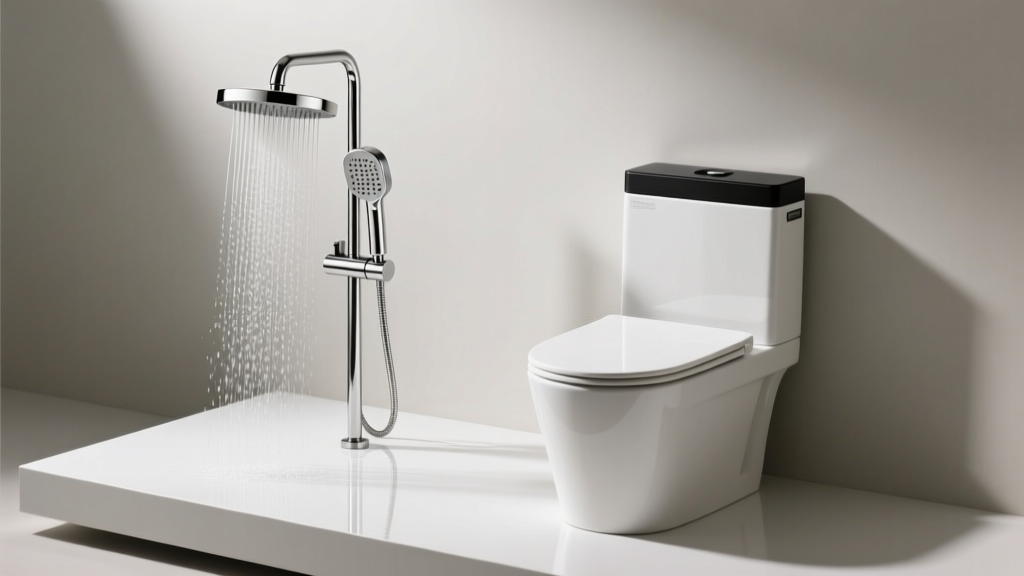
You’re standing in the hardware aisle—or scrolling late at night—staring at two very different bathroom fixtures: a sleek rainfall showerhead and a high-efficiency toilet. It feels like comparing apples to drainpipes. But the question isn’t absurd if you’re renovating on a tight budget, troubleshooting low water pressure, or trying to cut utility bills. Both impact daily comfort, water use, and long-term maintenance—and choosing wrong means wasted money and daily frustration.
Quick Verdict
Neither is "better" outright—they serve fundamentally different functions. A showerhead delivers pressurized water for bathing; a toilet manages waste removal and hygiene. Choosing one over the other isn’t logical unless you’re misdiagnosing the problem—like buying a new showerhead to fix a clogged sewer line, or replacing a toilet because your shower lacks temperature stability. Focus on the symptom, not the shiny object.
Side-by-Side Comparison
| Feature | Showerhead | Toilet |
|---|---|---|
| Primary Function | Deliver controlled, pressurized water for bathing | Remove human waste and toilet paper via gravity/siphon or pressure-assist |
| Average Water Use per Use | 1.5–2.5 gallons per minute (GPM) during use | 1.28 gallons per flush (standard), as low as 0.8 GPF for dual-flush models |
| Lifespan | 5–10 years (sooner with hard water buildup) | 15–25 years (tank components may need replacement sooner) |
| Typical Replacement Cost (DIY) | $25–$250 | $120–$600 (gravity-fed) or $300–$900 (pressure-assist) |
| Common Failure Signs | Low pressure, uneven spray, mineral clogging, leaking at arm connection | Running tank, weak flush, phantom flushes, slow refill, pooling water at base |
Deep Dive on Showerhead
Modern showerheads range from basic fixed-mount units to smart thermostatic systems with Bluetooth controls and flow sensors. Most U.S. models comply with the EPA’s WaterSense standard of ≤2.0 GPM, and many deliver surprisingly strong pressure—even at reduced flow—thanks to air-injection or laminar-flow nozzles.
Pros
- Quick install: most replace existing units in under 20 minutes with no tools beyond an adjustable wrench
- Immediate comfort upgrade: better spray patterns, temperature consistency, and noise reduction
- Water savings add up: switching from a 2.5 GPM to a 1.75 GPM head saves ~1,200 gallons/year for a family of four (U.S. EPA WaterSense, 2023)
Cons
- Won’t fix underlying plumbing issues—low pressure caused by corroded galvanized pipes or undersized supply lines won’t improve with a new head
- Vulnerable to hard water: calcium and magnesium deposits can clog nozzles in 6–18 months without regular cleaning
- Premium models ($150+) often require proprietary parts or apps that become obsolete within 3–5 years
Deep Dive on Toilet
The toilet remains one of the most engineered—and overlooked—fixtures in the home. Today’s best models combine MaP (Maximum Performance) testing scores (≥1,000 grams of solid waste removed per flush) with quiet-fill valves, leak-resistant seals, and ADA-compliant heights. Dual-flush and pressure-assist options offer trade-offs between water savings and reliability.
Pros
- Dramatic water savings: replacing a pre-1994 3.5+ GPF toilet with a 1.28 GPF model cuts flushing water use by 60% (Alliance for Water Efficiency, 2022)
- Long-term reliability: well-maintained toilets rarely fail catastrophically—unlike showerheads, which degrade visibly and functionally
- Health and hygiene impact: poor flushing contributes to bacterial buildup, lingering odors, and cross-contamination risk
Cons
- Installation complexity: requires shut-off, draining, wax ring replacement, leveling, and secure bolting—mistakes cause leaks or floor damage
- Code compliance matters: some municipalities require certified backflow prevention or specific MaP scores for new installs
- Hidden costs: flapper kits, fill valves, and tank levers average $25–$45/year in maintenance for older units
When to Choose Showerhead vs Toilet
Choose a new showerhead when: you notice inconsistent spray, hear hissing at the arm connection, want better temperature control, or aim to reduce shower water use without changing habits. Choose a new toilet when: your current unit runs constantly, requires multiple flushes, shows cracks in the tank or bowl, or fails MaP testing (you can test with 10 toilet paper squares and 1 cup of coffee grounds—good toilets clear it all in one flush).
According to the Insurance Institute for Business & Home Safety's 2023 report on residential plumbing failures, 68% of water damage claims linked to fixtures involved either leaking toilet supply lines or failed wax rings—not showerhead connections.
"A dripping showerhead wastes water—but a failing toilet seal can saturate subflooring in days. Prioritize based on consequence, not convenience." — Carla Mendez, Master Plumber & Plumbing Inspector, IAPMO Certified (2024)
Alternatives to Consider
Before replacing either, rule out simpler fixes. A $5 showerhead cleaner kit restores 80% of lost performance in mineral-heavy areas. A $12 flapper replacement stops 90% of phantom flushes. And don’t overlook integrated solutions: some modern bidet seats include heated seating and oscillating wash—reducing toilet paper use and improving hygiene without full toilet replacement.
- How to clean a showerhead — step-by-step vinegar soak method
- Toilet flapper replacement guide — video + torque specs
- How to test home water pressure — identify root causes before buying new fixtures
Can a showerhead affect toilet performance?
No—showerheads and toilets operate on separate branch lines in nearly all residential plumbing systems. However, if both fixtures show low pressure simultaneously, the issue likely lies upstream: a partially closed main shutoff valve, corroded main supply pipe, or municipal pressure drop.
Do high-efficiency toilets work with low water pressure?
Yes—but with caveats. Gravity-fed high-efficiency toilets (1.28 GPF) rely on tank height and trapway design—not incoming pressure—so they perform well even at 30 PSI. Pressure-assist models require ≥40 PSI minimum; below that, flushes become incomplete or noisy.
Is it worth upgrading both at once?
Only if you’re doing a full bathroom remodel. Simultaneous upgrades rarely yield synergistic benefits—and strain budgets unnecessarily. Tackle the fixture showing active failure first, then address the other during next year’s maintenance cycle.
What’s the biggest mistake people make when choosing either?
Ignoring rough-in measurements. Shower arms vary in thread pitch (NPT vs. BSP), and toilets require precise bowl-to-wall distance (12-inch standard, but 10- or 14-inch variants exist). Ordering the wrong size means returns, delays, or unsafe improvisation.
Are smart showerheads or toilets worth the premium?
Smart showerheads (with app-controlled temp presets) appeal to tech-forward users but add little functional value—and introduce Wi-Fi dependency and firmware obsolescence. Smart toilets (with auto-lift lids, leak detection, or usage tracking) offer genuine utility for aging-in-place or rental property monitoring, but cost 2–3× more than reliable mechanical equivalents.
If your shower feels weak but your toilet flushes fine, reach for the showerhead—not the toilet seat. And if your bathroom floor stays damp near the base of the bowl, skip the rain shower fantasy and call a plumber first. Fix the right thing, not the loudest thing.