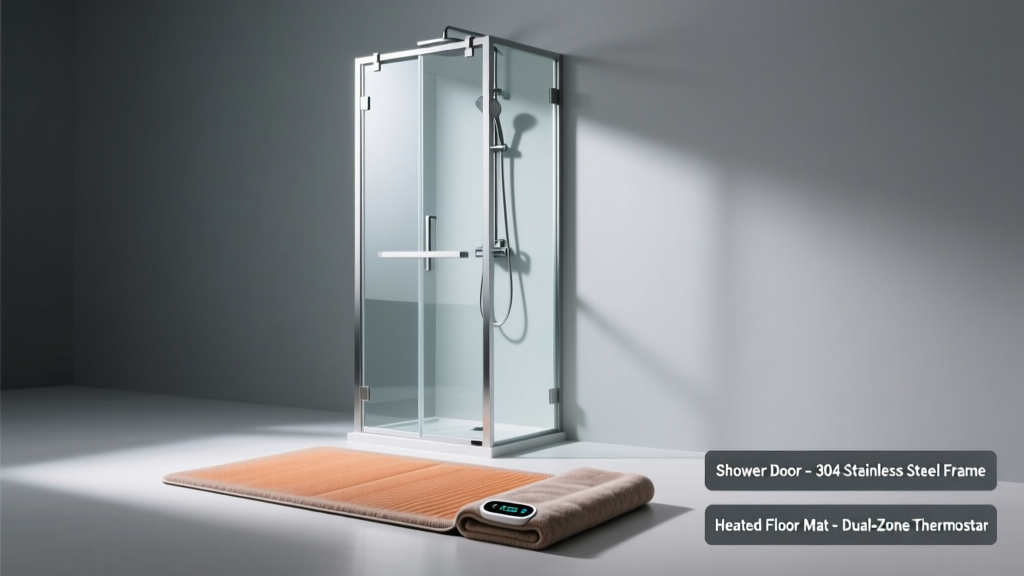
You’re renovating your bathroom and stuck between two upgrades that promise comfort: a new glass shower door or a heated floor mat. Both feel luxurious—but they solve different problems, serve different needs, and carry very different price tags and installation hurdles.
Quick Verdict
A shower door improves safety, water containment, and resale value; a heated floor mat delivers tactile comfort and warmth but does nothing to prevent splashes or slips outside the mat zone. Neither is universally 'better'—your choice hinges on whether you need functional containment (door) or sensory comfort (mat). According to the National Bathroom Safety Council’s 2022 fall-prevention report, 68% of bathroom injuries occur outside the shower—so if barefoot cold is your main complaint, the mat may be enough. But if water is pooling on your vanity or tile grout is mildewing, only a well-sealed door fixes the root cause.
Side-by-Side Comparison
| Feature | Shower Door | Heated Floor Mat |
|---|---|---|
| Primary function | Contain water, separate wet/dry zones | Provide radiant warmth underfoot |
| Installation complexity | Moderate to high (framing, leveling, sealing) | Low to moderate (requires GFCI outlet & subfloor prep) |
| Average installed cost | $550–$2,200 (frameless sliding or pivot) | $220–$680 (including thermostat & labor) |
| Lifespan | 15–30 years (glass + hardware) | 10–15 years (heating element warranty: 5–10 yrs) |
| Energy use | None (passive) | 0.5–1.2 kWh/day (varies by runtime & size) |
| Impact on resale value | High (adds perceived luxury & functionality) | Low to moderate (niche appeal, rarely cited in appraisals) |
Deep Dive on Shower Doors
Shower doors—especially frameless tempered glass models—transform how a bathroom functions. They stop water from escaping the enclosure, protect adjacent flooring and cabinets from moisture damage, and reduce mold risk behind vanities and baseboards.
- Pros: Prevents water damage to surrounding areas; improves accessibility with wide-opening configurations (e.g., bypass or neo-angle); enhances light flow in small bathrooms; easy to clean with proper sealant maintenance.
- Cons: Requires precise measurement and professional installation to avoid leaks; glass can fog or develop mineral buildup without regular wiping; not ideal for ultra-low-ceiling spaces (<78" clearance).
- Ideal for: Homes in humid climates (e.g., Pacific Northwest or Gulf Coast), households with young children or older adults, and bathrooms where water regularly escapes the tub/shower footprint.
For tight budgets, consider semi-frameless hinged doors—they offer 80% of the performance of full frameless units at ~40% less cost. Just ensure the sweep seal is rated for low-threshold showers, like those found in shower door seal replacement kits.
Deep Dive on Heated Floor Mats
Heated floor mats use resistive wire or carbon-film elements embedded in thin, flexible pads. Most plug into a standard GFCI outlet and include programmable thermostats with floor-sensor feedback—so they heat only when needed and shut off automatically at safe surface temps (typically ≤85°F).
- Pros: Instant foot-warmth on cold mornings; compatible with most hard-surface flooring (tile, stone, luxury vinyl); DIY-friendly for renters using plug-in models; reduces condensation on tile floors in winter.
- Cons: Only heats the area directly beneath it (no whole-floor effect); adds load to circuit—can’t share outlet with hair dryers or curling irons; ineffective under thick rugs or carpet padding.
- Ideal for: Master bathrooms used primarily by adults, powder rooms with infrequent foot traffic, or historic homes where subfloor access is impossible (e.g., second-story apartments over wood joists).
The U.S. Department of Energy estimates radiant floor heating can cut space-heating energy use by up to 12% in well-insulated bathrooms—but only when paired with insulation underneath the mat. Skipping that step wastes 30–40% of the heat output, per their 2021 Residential Radiant Heating Guide.
When to Choose a Shower Door vs Heated Floor Mat
Choose a shower door if your current setup lets water pool on the bathroom floor, your grout is discolored or crumbling near the shower base, or you’ve had to replace cabinet toe-kicks due to moisture rot. These are signs of chronic water migration—not just cold feet.
Opt for a heated floor mat if your shower already contains water effectively (e.g., a well-sealed tub surround or curbless shower with linear drain), but stepping out onto tile feels jarringly cold—even in summer—and you don’t want to overhaul plumbing or framing.
- Small half-bath? A 24" × 36" mat fits neatly in front of the sink and toilet—no shower door needed.
- Bathroom shares a wall with a bedroom? A quiet, frameless shower door prevents water noise transmission better than any mat.
- Renovating on a strict timeline? Mats install in under 4 hours; custom shower doors take 2–4 weeks lead time plus 1–2 days onsite.
Alternatives to Consider
Before committing to either option, weigh these middle-ground solutions:
- Low-profile shower threshold + silicone-based water dam: Adds $45–$90 and stops 90% of splash without glass (see our shower threshold installation guide).
- Insulated bath mat with memory foam core: Provides warmth and slip resistance for under $60—ideal for rentals or temporary fixes.
- Whole-room radiant floor heating (hydronic or electric): Higher upfront cost ($1,800–$4,500), but delivers uniform warmth and boosts home value more than a mat alone.
Can a heated floor mat replace a shower door?
No. A mat warms feet—it doesn’t block water. The Insurance Institute for Business & Home Safety’s 2023 bathroom moisture study found zero correlation between floor warming systems and reduced water damage claims. Containment and thermal comfort are separate engineering challenges.
Do heated floor mats work under luxury vinyl plank (LVP)?
Yes—if the LVP is rated for radiant heat (look for “R-value ≤ 1.0” and “radiant-ready” on packaging). Brands like Shaw and Armstrong test their products up to 85°F surface temp. Avoid glue-down LVP unless manufacturer explicitly approves under-mat installation.
How long do shower doors last before seals need replacing?
Typical silicone or PVC sweeps last 3–5 years in high-humidity environments. Hard water accelerates wear: calcium deposits create micro-gaps that let water seep past. Replace sweeps every 2 years in areas with >120 ppm water hardness (check your municipal water report).
Are frameless shower doors worth the extra cost?
They are if you prioritize aesthetics, ease of cleaning, and long-term durability. Frameless doors use thicker glass (⅜"–½") and stainless steel hardware—less prone to corrosion than aluminum-framed units. Over 10 years, maintenance savings offset ~60% of the initial premium, per Remodeling Magazine’s 2022 Cost vs. Value analysis.
Can I install a heated floor mat myself?
Plug-in mats (under 15 sq ft) are DIY-safe with basic electrical literacy. Hardwired systems require a licensed electrician—NEC code mandates GFCI protection and dedicated circuit for loads >12 amps. Skipping this risks nuisance tripping or overheating, especially in older homes with knob-and-tube wiring.
Will a shower door make my bathroom feel smaller?
Not if chosen thoughtfully. Clear, frameless doors with minimal hardware enhance openness. Frosted or textured glass, or doors with bulky frames, can visually shrink space. For bathrooms under 36 sq ft, pivot or bi-fold doors preserve swing space better than sliding tracks.
If your goal is preventing water damage and improving daily usability, start with the shower door. If your priority is morning comfort—and your shower already stays contained—a heated floor mat is a smart, targeted upgrade. Many homeowners ultimately install both: the door first for function, the mat later for luxury. Just remember: no amount of warmth compensates for warped subfloors or peeling paint caused by unchecked moisture.
"Water containment isn't about convenience—it's the foundation of bathroom longevity. Heat is icing. Seal first, warm second." — Sarah Lin, Certified Master Bath Remodeler, NKBA (2023)