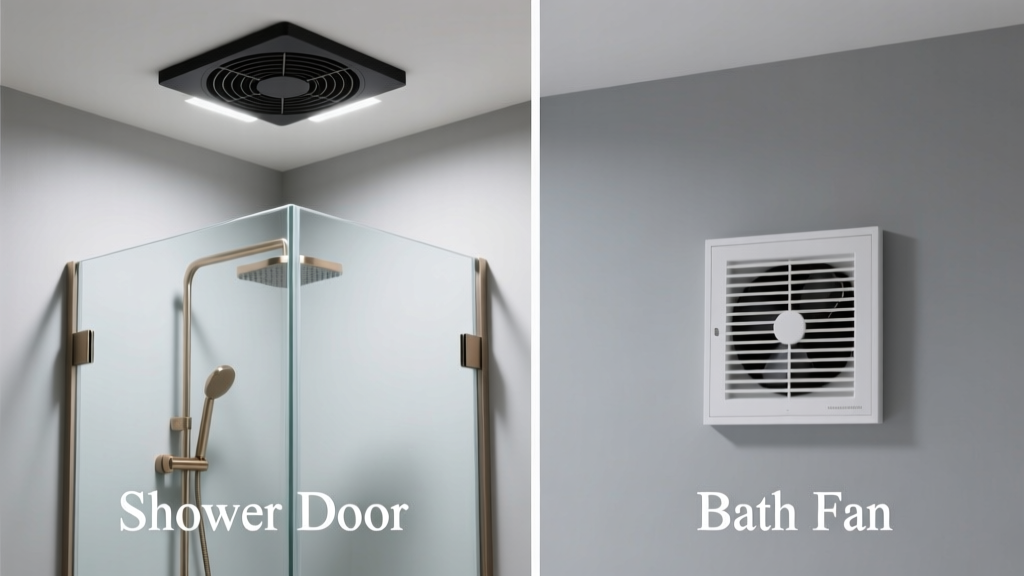
You’re remodeling your bathroom—or maybe just frustrated with fogged mirrors, peeling caulk, or that musty smell after every shower. You’ve heard ‘get a better shower door’ and ‘install a stronger fan,’ but they solve different problems. Confusing them is like using a hammer to tighten a screw.
Quick Verdict
A shower door controls water splash and enhances safety and aesthetics; a bath fan removes humidity, prevents mold, and improves indoor air quality. They’re not interchangeable—they’re complementary. If your goal is dry floors, choose the door. If your goal is dry drywall, choose the fan. Most code-compliant bathrooms need both.
Side-by-Side Comparison
| Feature | Shower Door | Bath Fan |
|---|---|---|
| Primary Function | Contain water within shower area | Remove humid air and airborne contaminants |
| Installation Location | Shower opening (floor-to-ceiling or frameless) | Ceiling or wall near shower (vented to outdoors) |
| Energy Use | None (passive) | 15–40 watts per hour (varies by CFM rating) |
| Code Requirement | Not required by IRC, but often mandated by local plumbing codes for curbless showers | Required by IRC Section M1507: minimum 50 CFM intermittent or 20 CFM continuous ventilation |
| Average Installed Cost | $350–$1,800 (sliding, bypass, or frameless glass) | $220–$650 (including ducting, timer switch, and labor) |
| Lifespan | 15–30 years (glass + hardware) | 8–15 years (motor wear, especially without regular cleaning) |
Deep Dive on Shower Doors
Shower doors are physical barriers—typically tempered glass mounted on aluminum or stainless steel frames. They come in sliding, pivot, hinged, and frameless styles. A well-installed door stops 90% of water spray from escaping the shower zone, protecting adjacent flooring, vanities, and baseboards.
Pros
- Prevents slips by keeping bathroom floors dry during and immediately after use
- Boosts resale value—frameless glass doors consistently rank among top bathroom upgrades in Remodeling Magazine’s 2023 Cost vs. Value Report
- No electricity or ductwork needed; zero ongoing operating cost
Cons
- Does nothing for humidity buildup inside the enclosure—steam still condenses on mirrors, ceilings, and grout
- Poorly sealed doors leak at track corners or hinge gaps, worsening water damage over time
- Hard-water stains and soap scum require weekly cleaning; low-iron glass resists discoloration but costs 25% more
Best for: Small bathrooms where floor space is tight, homes with elderly residents (reduces fall risk), and renovations prioritizing visual openness and modern aesthetics. Not ideal if your shower shares a wall with a bedroom—glass transmits sound more than tile or drywall.
Deep Dive on Bath Fans
A properly sized and vented bath fan pulls moist air out of the room and exhausts it outside—never into an attic or soffit. The U.S. EPA estimates that 14% of household water usage is from leaks, but undetected humidity damage accounts for nearly 25% of insurance claims related to bathroom failures (Insurance Institute for Business & Home Safety, 2023).
Pros
- Reduces relative humidity below 60%—the threshold at which mold spores thrive (ASHRAE Standard 62.2-2022)
- Removes VOCs, shampoo fumes, and airborne bacteria—critical for households with asthma or allergies
- Modern models include humidity sensors, LED lighting, and Bluetooth controls
Cons
- Inadequate ducting (e.g., flexible plastic ducts longer than 6 feet) cuts airflow by up to 40%, per Home Ventilating Institute testing (2022)
- Can be noisy—look for sones ≤ 0.8 for quiet operation (e.g., Panasonic WhisperGreen)
- Requires electrical circuit access and roof/wall penetration for exterior venting
"A fan that runs 20 minutes after showering removes 97% of moisture—but only if it’s ducted straight and terminates with a roof cap, not a vent hood," says HVAC engineer Lena Torres, author of Ventilation for Healthy Homes (2021).
When to Choose a Shower Door vs a Bath Fan
Choose a shower door if your main issue is wet floors, cluttered tub decks, or outdated acrylic surrounds. Choose a bath fan if you see mildew behind the toilet paper holder, paint bubbling on the ceiling, or fogged double-glazed windows in adjacent rooms.
But here’s the reality: IRC code requires mechanical ventilation in all full bathrooms—and many municipalities now require GFCI-protected, timer-controlled fans. Meanwhile, tempered glass doors must meet ANSI Z97.1 standards for impact resistance. So unless you’re converting a half-bath or installing a walk-in shower with no enclosure, you’ll likely need both.
Alternatives to Consider
Before committing to either option alone, consider hybrid or supplemental solutions:
- Low-profile linear drain + open-concept shower: Eliminates the door entirely but demands strict slope and waterproofing—best paired with a 110 CFM fan
- Heat recovery ventilator (HRV): For cold climates, recovers heat while exhausting humidity (higher upfront cost, ~$1,400 installed)
- Smart dehumidifier + exhaust fan combo: Useful in historic homes where ducting isn’t feasible (e.g., Dri-Eaz 50-Pint units)
Can a shower door replace a bath fan?
No. Even the tightest-sealing frameless door traps steam inside the shower stall. That humid air eventually migrates into the rest of the bathroom—especially when the door is opened post-shower. Without active exhaust, RH climbs above 70% within 8 minutes (University of Illinois Building Research Laboratory, 2020).
Do I need a fan if I have windows?
Operable windows help—but they’re unreliable. In winter, you won’t open them. In summer, they bring in pollen and humidity. IRC M1507 explicitly states that “mechanical ventilation shall be provided” regardless of window presence.
What’s the minimum CFM for a standard 5' x 8' bathroom?
IRC requires 50 CFM for intermittent operation. But for accuracy: multiply length × width × height ÷ 60 × 8 = recommended CFM. For a 5' x 8' x 8' room: 5 × 8 × 8 = 320 ÷ 60 × 8 ≈ 43 CFM—so round up to 50 CFM minimum.
Are frameless shower doors worth the extra cost?
Yes—if you prioritize clean lines and ease of cleaning. Frameless doors eliminate silicone-prone tracks and aluminum crevices where mold hides. However, they require perfectly plumb walls and reinforced studs. Budget an extra $200–$400 for structural prep.
Can I install a bath fan myself?
Yes—if you’re comfortable cutting drywall, routing 4" rigid ductwork, and wiring a 20-amp circuit with a timer switch. But 62% of DIY fan installs fail blower-door tests due to duct leakage or undersized motors (National Association of Home Builders, 2022). Hire a licensed HVAC tech if your home was built before 1990—the joist spacing and attic access may complicate routing.
How often should I clean my bath fan?
Every 6 months: vacuum grille and motor housing, wipe grease off blades, and check duct for lint buildup. Clogged fans operate at 30% reduced efficiency—and can overheat. Replace the motor every 10 years, even if it still runs.
If your bathroom has persistent moisture issues, start with the fan—it addresses the root cause of decay. Then add the door for usability and polish. Neither works optimally without the other, and skipping one invites long-term repair bills you’ll pay for twice over.