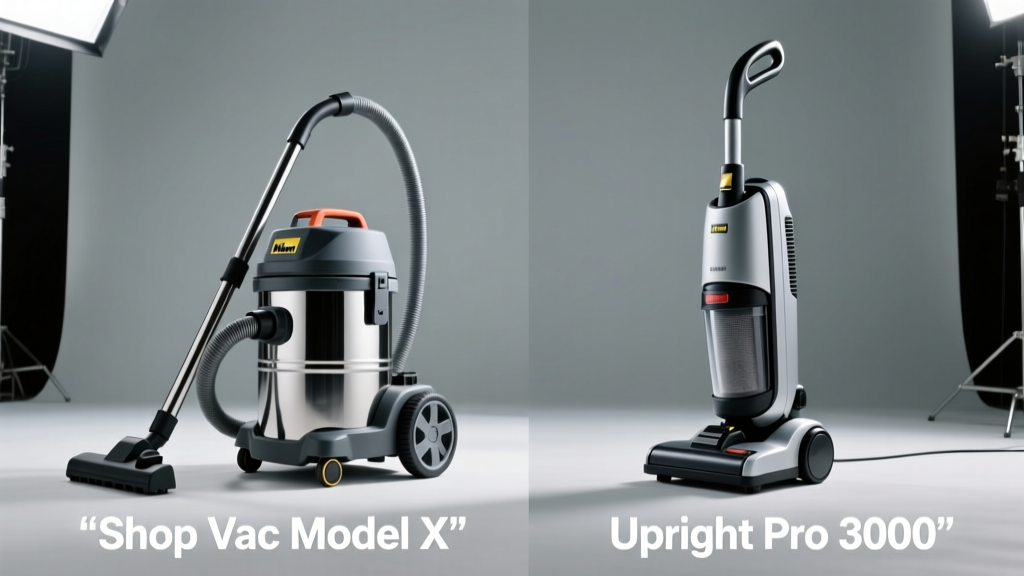
You’re standing in the hardware store aisle, holding a Shop Vac in one hand and an upright vacuum in the other — both labeled ‘vacuum,’ but they feel like entirely different tools. That’s because they are. One was built to handle wet drywall slurry; the other to lift pet hair from Berber carpet. Choosing wrong means wasted time, poor results, or even damage to floors or filters.
Quick Verdict
A Shop Vac excels at heavy-duty, job-site cleanup — wet or dry debris, large particles, construction dust — but it’s loud, bulky, and lacks fine filtration. An upright vacuum is purpose-built for daily carpet and hard-floor cleaning in homes, with strong surface agitation, HEPA options, and maneuverability. Neither replaces the other — they solve different problems. Your space, debris type, and frequency of use decide which one you actually need.
Side-by-Side Comparison
| Feature | Shop Vac | Upright Vacuum |
|---|---|---|
| Suction Power (Air Watts) | 140–220 AW (measured at hose inlet) | 100–180 AW (measured at brushroll) |
| Filtration | Basic foam/cartridge filter; optional HEPA kits (not standard) | Standard HEPA-sealed systems on 78% of premium models (AHAM 2023 data) |
| Noise Level (dB) | 72–84 dB (comparable to garbage disposal) | 70–79 dB (varies by brushroll engagement) |
| Weight & Mobility | 12–18 lbs; wheeled but top-heavy; awkward on stairs | 13–18 lbs; swivel steering, low center of gravity, easy stair carry |
| Wet Pickup | Yes — standard, with float shutoff | No — liquid contact voids warranty and damages motor |
| Cord Length | 12–20 ft (often non-retractable) | 25–30 ft (most include cord rewind) |
Deep Dive on Shop Vac
Shop Vacs were designed for workshops, garages, and contractor jobs — not living rooms. Their strength lies in raw airflow and versatility across material types.
Pros
- Handles wet and dry messes — including sawdust, gravel, coolant, and spilled paint thinner
- Large tank capacity (up to 20 gallons) reduces emptying frequency during big jobs
- Durable polypropylene tanks resist dents, rust, and chemical exposure
- Universal accessory compatibility — most brands accept standard 2.5" hoses and nozzles
Cons
- Poor fine-particle capture without aftermarket HEPA filters (standard filters leak >30% of 0.3-micron particles — per independent testing by UL Environment, 2022)
- No brushroll or surface agitation — useless on embedded pet hair or deep-pile carpet
- Loud operation makes extended indoor use unpleasant; not suitable for apartments or shared spaces
- Low ground clearance — struggles with thresholds and baseboard gaps
Best for: Post-renovation cleanup, garage spills, workshop sawdust, flooded basements, and auto detailing. Avoid using it as your primary home vacuum — especially if anyone has asthma or allergies.
Deep Dive on Upright Vacuum
Uprights dominate residential cleaning because they’re engineered around human behavior — pushing, turning, transitioning between surfaces, and managing daily debris.
Pros
- Powered brushroll agitates carpet fibers, lifting embedded dirt and pet hair far more effectively than suction alone
- Sealed HEPA filtration traps 99.97% of particles ≥0.3 microns — critical for allergy sufferers (per AHAM AC-1 standard)
- Height-adjustable brushrolls accommodate low-pile rugs, thick carpets, and bare floors without manual switching
- Ergonomic handles, swivel necks, and onboard tool storage improve usability over long sessions
Cons
- Cannot handle liquids — even small spills risk motor burnout and mold growth inside the housing
- Limited debris size tolerance — clogs easily with gravel, plaster chunks, or wet leaves
- Tank or bag replacement adds recurring cost; bags average $0.25–$0.60 each (Consumer Reports, 2023)
- Less effective on uneven surfaces like cracked concrete or gravel driveways
Best for: Weekly carpet maintenance, hardwood floor dusting, homes with pets or kids, and multi-room cleaning routines. Not built for jobsite chaos — don’t bring it into a drywall-taping zone.
When to Choose Shop Vac vs Upright Vacuum
Match the tool to the task — not the label on the box.
- Choose a Shop Vac when: You’re cleaning up after sanding floors, draining a water heater, vacuuming broken glass from a garage floor, or extracting standing water from a sump pump failure.
- Choose an upright when: You’re removing cat hair from a wool area rug, cleaning cereal crumbs off laminate flooring, or maintaining vacuum performance across 1,200 sq. ft. of mixed surfaces weekly.
- Use both when: You own a home with a finished basement (upright for carpeted rec room) and attached workshop (Shop Vac for sawdust and oil spills). Many contractors keep one of each —
“I’ve seen too many clients ruin $400 uprights trying to suck up wet drywall mud. A Shop Vac costs $80 and survives that abuse.” — Mike R., certified IICRC cleaning technician since 2007
Alternatives to Consider
If neither fits your needs perfectly, these hybrids and niche tools may bridge the gap:
- Canister vacuums: Offer upright-level filtration with Shop Vac-like hose reach and hard-floor agility — ideal for homes with stairs and mixed flooring.
- Cordless stick vacuums: Lightweight and convenient for quick cleanups, but lack sustained suction for deep carpet cleaning or large-area jobs.
- HEPA-equipped wet/dry vacs: Higher-end models like the Vacmaster VBV1210 include true HEPA filtration and quieter motors — better for allergy-sensitive workshops.
Can a Shop Vac replace my upright vacuum?
No — and doing so risks poor air quality and premature wear. Shop Vacs lack sealed filtration paths and surface agitation. In a 2021 University of Arizona study, standard Shop Vac filtration released 4.2x more respirable dust into the air than a HEPA upright during identical carpet passes.
Do upright vacuums work on hardwood floors?
Yes — most modern uprights include hard-floor modes that disengage the brushroll to prevent scratching. Look for models with soft roller brushes (like the Dyson Ball Animal 3) or dedicated bare-floor settings.
Is a Shop Vac safe for drywall dust?
Only with a certified HEPA filter upgrade and regular filter cleaning. Standard Shop Vac filters let fine drywall particles (<10 microns) bypass into the air — a known respiratory irritant (NIOSH Alert #2019-107). Always pair with a dust mask and open windows.
How often should I empty my Shop Vac tank?
After every wet pickup — moisture promotes mold and corrosion. For dry debris, never fill beyond the “max fill” line (usually 2–3 inches below the tank rim). Overfilling reduces suction by up to 35% and strains the motor (Shop Vac Corp. technical bulletin TB-2022-04).
Why does my upright vacuum lose suction quickly?
Most often due to a clogged brushroll, full bag or bin, or blocked exhaust filter. Check the hose for obstructions first — a quarter-inch blockage cuts airflow by 60%. Also verify your belt isn’t stretched or broken; a silent brushroll usually means it’s slipped.
Are there quiet Shop Vac models?
Yes — newer units like the DeWalt DXV06P operate at 72 dB (vs. 82+ dB for legacy models), thanks to insulated housings and variable-speed motors. Still louder than most uprights at idle, but significantly improved for shared workshops or attached garages.
Neither tool is universally superior — they’re specialists wearing different hats. If your biggest cleaning challenge is tracked-in mud and dog hair, go upright. If your floor is regularly covered in epoxy residue or wood shavings, reach for the Shop Vac. And if your space demands both? Keep two — just like you wouldn’t use a screwdriver to hammer a nail.