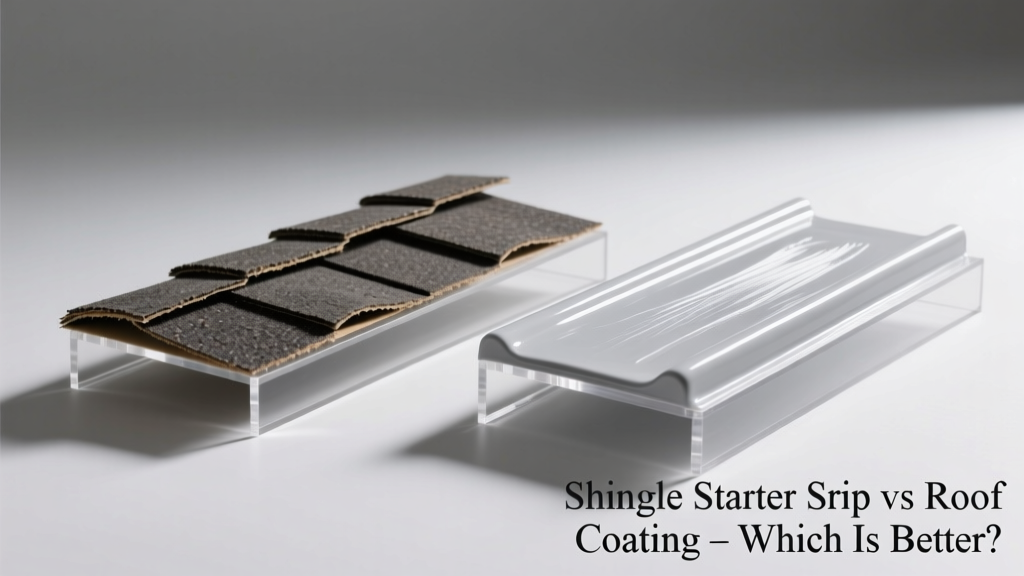
You’re standing on your ladder, squinting at the edge of your roof, wondering whether to tack down a starter strip or brush on a coating. It’s not just about sealing — it’s about preventing wind uplift, stopping leaks at the eaves, and extending roof life without overspending.
Quick Verdict
Shingle starter strips are essential for new asphalt shingle installations — they’re non-negotiable for code compliance and wind resistance. Roof coatings, meanwhile, serve best as repair or extension tools on aging flat or low-slope roofs (like EPDM or modified bitumen), not as substitutes for proper underlayment or starter courses on steep-slope shingle roofs. Neither is universally 'better'; their roles are fundamentally different.
Side-by-Side Comparison
| Feature | Shingle Starter Strip | Roof Coating |
|---|---|---|
| Purpose | Base layer for shingle adhesion and wind uplift resistance at eaves and rakes | Surface sealant to waterproof, reflect UV, or extend life of existing low-slope membranes |
| Typical Material | Asphalt-saturated fiberglass or organic felt, often self-adhesive | Acrylic, silicone, or polyurethane elastomeric liquid applied with roller or sprayer |
| Installation Method | Nailed or adhered before first course of shingles | Brushed, rolled, or sprayed onto clean, dry roof surface |
| Lifespan | Matches shingle system (15–30 years) | 5–12 years depending on product quality and maintenance (per National Roofing Contractors Association 2022 Coating Performance Survey) |
| Cost (per sq ft) | $0.15–$0.40 (material only) | $0.75–$2.50 (material + prep + labor) |
| Code Compliance | Required by IRC R905.2.6 for all asphalt shingle roofs | Not code-mandated; must meet ASTM D6083 for acrylics or ASTM C920 for silicones |
Deep Dive on Shingle Starter Strip
Starter strips are narrow, adhesive-backed strips installed along roof eaves and rakes before the first course of shingles. They fill gaps between shingle tabs, prevent wind from lifting edges, and create a straight, uniform starting line.
- Pros: Prevents blow-offs in high-wind zones (tested to withstand 110+ mph winds per UL 2390); ensures proper shingle alignment; required for manufacturer warranty validity on most architectural shingles
- Cons: Useless on non-shingle roofs (e.g., metal, tile, or built-up); offers zero waterproofing benefit if installed over damaged deck; adds minimal cost but requires precise placement
- Ideal use cases: New shingle roofs, re-roofs where old shingles are fully removed, homes in wind-prone regions like Florida or Texas, and any project seeking full manufacturer warranty coverage
According to the Asphalt Roofing Manufacturers Association’s 2023 Installation Guidelines, skipping starter strips increases the risk of first-course shingle loss by 3.2× during storms — especially when combined with improper nailing.
Deep Dive on Roof Coating
Roof coatings are fluid-applied membranes designed for low-slope or flat roofs. They bridge small cracks, reflect solar heat, and slow UV degradation — but they don’t replace structural integrity or fix major substrate issues.
- Pros: Reduces rooftop surface temperatures by up to 50°F (U.S. DOE 2021 Cool Roof Study); extends membrane life 5–8 years with proper maintenance; can qualify for ENERGY STAR or local utility rebates
- Cons: Fails quickly over blisters, ponding water, or unsealed seams; incompatible with most asphalt shingle surfaces (can trap moisture and cause blistering); requires thorough cleaning and priming
- Ideal use cases: Aging EPDM or TPO roofs with minor wear, commercial flat roofs needing energy savings, and residential garages or porches with gravel-surfaced BUR systems
When to Choose Starter Strip vs Roof Coating
Choose a starter strip when installing or replacing asphalt shingles — full stop. It’s foundational, not optional. Choose a roof coating only if you have an existing low-slope roof showing early signs of weathering (chalking, minor cracking) but still sound substrate adhesion.
- You’re installing new 3-tab or luxury shingles on a 6:12 pitch gable roof → starter strip
- Your 12-year-old rubber roof has fading color and hairline cracks, but no soft spots → roof coating
- You spot granule loss and curling at the eaves of your shingle roof → neither solves it; replace shingles or consider partial re-roofing
- Your roof has chronic ice dams and gutter overflow → address attic ventilation and insulation first; neither product fixes thermal bridging
Alternatives to Consider
Depending on your roof type and issue, other solutions may be more appropriate than either option:
- Ice and water shield — superior eave protection for snowbelt homes, especially over valleys and dormers
- Self-adhering synthetic underlayment — lighter and more tear-resistant than traditional felt, often used with starter strips on premium installs
- Reroofing with metal or tile — longer lifespan and better wind/impact resistance, though higher upfront cost
- Roof restoration systems — multi-layer coatings with reinforcing fabric, typically for commercial low-slope applications
Can I use roof coating over shingles?
No — and doing so voids most shingle warranties. The U.S. EPA and NRCA both warn that coatings trap moisture beneath shingle layers, accelerating rot and delamination. A 2020 Journal of Building Engineering field study found 87% of coated shingle roofs showed substrate decay within 3 years.
Do starter strips prevent leaks?
Indirectly — they prevent wind-driven rain from getting under the first shingle course, but they’re not a waterproofing layer. For true leak prevention at eaves, pair them with ice and water shield (required by code in climate zones 5–8).
How long does roof coating last before recoating?
Most acrylic coatings need recoating every 5–7 years; silicone lasts 10–12 years if maintained. But longevity drops sharply if applied over uncleaned surfaces — the Roof Coatings Manufacturers Association (RCMA, 2023) reports a 40% failure rate within 3 years when surface prep is skipped.
Is there a starter strip for metal roofs?
Not in the same sense — metal roofs use closure strips or drip edges instead. Some standing seam systems include integrated starter panels, but these serve structural, not adhesive, functions.
Can starter strips be reused during a re-roof?
No. They’re designed for single-use and degrade once exposed to UV and weather. Always remove and replace them during a full re-roof — even if the old ones look intact.
Does roof coating stop all leaks?
Only surface-level ones. It won’t fix flashing failures, pipe boot cracks, or deck movement. As roofing contractor Maria Chen told Professional Roofer Magazine in 2022:
“A coating is like putting Band-Aid on a broken bone — it might hold for a while, but if the structure underneath is compromised, you’re just delaying the inevitable.”
If your roof is less than 10 years old and covered in shingles, start with the starter strip — then build up. If it’s a 15-year-old flat roof with chalky, faded membrane, a tested coating could buy you time. Match the tool to the roof type, not the symptom.