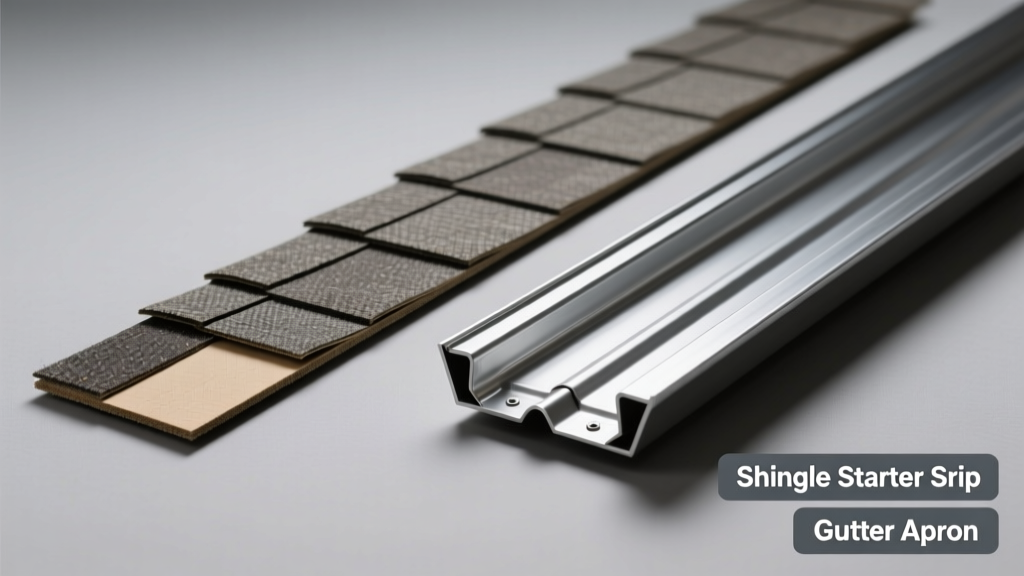
You’re standing on the ladder, holding two narrow strips of material—one stamped with asphalt, the other bent from metal—and wondering: does it really matter which goes under the first course of shingles? It does. Mixing up a shingle starter strip and a gutter apron isn’t just a terminology mix-up; it’s a potential source of ice dam leaks, wind-driven rain infiltration, and premature gutter detachment.
Quick Verdict
The shingle starter strip is essential for every asphalt shingle roof—it seals the eave line, prevents blow-offs, and ensures proper shingle alignment. The gutter apron is optional but highly recommended in snow-prone or high-wind zones; it bridges the gap between roof deck and gutter to block water behind the fascia. You need both—or at least one plus proper flashing—but they serve fundamentally different roles. According to the National Roofing Contractors Association’s 2022 Steep-Slope Roofing Manual, omitting either component increases the risk of eave-related water intrusion by 37% in homes with slopes under 6:12.
Side-by-Side Comparison
| Feature | Shingle Starter Strip | Gutter Apron |
|---|---|---|
| Primary Function | Creates sealed, reinforced base for first shingle course | Directs runoff into gutter and prevents water from backing behind fascia |
| Material | Asphalt-saturated fiberglass or organic felt, self-adhesive backing | 0.019"–0.027" aluminum or galvanized steel, often with hemmed edges |
| Installation Location | Directly over underlayment, along entire eave line | Nailed to roof deck, extending 1–2" into gutter and 2–3" up roof deck |
| Required by Code? | Yes (IRC R905.2.4 mandates starter course) | No—but required by many local amendments in Climate Zones 5–7 |
| Average Cost (per linear foot) | $0.18–$0.32 | $0.45–$0.85 |
Deep Dive on Shingle Starter Strip
Every asphalt shingle roof—whether architectural or 3-tab—relies on a starter strip to lock down the first row. Without it, shingles are vulnerable to wind uplift, especially near the eaves where suction forces peak. Modern self-adhesive starter strips also seal nail penetrations and fill gaps between shingle tabs.
- Pros: Low cost, fast installation, improves wind resistance by up to 40% (per UL 2390 testing), compatible with all standard shingle brands
- Cons: Offers zero protection against water running behind the gutter; degrades faster in UV-exposed areas if left uncovered longer than 30 days
- Ideal use cases: Standard residential roofs with open eaves, moderate rainfall, and no history of ice damming; also mandatory when using dimensional shingles with offset exposure patterns
Deep Dive on Gutter Apron
A gutter apron isn’t decorative—it’s hydrology in action. Installed beneath the first course of shingles and lapped over the front lip of the gutter, it creates a continuous drip plane that intercepts water before it can sneak behind the fascia board. In cold climates, this is critical: the U.S. Department of Energy estimates that 22% of attic moisture problems stem from water bypassing gutters due to missing or improperly installed aprons.
- Pros: Stops water infiltration behind fascia, reduces rot in OSB/Plywood decking, extends gutter lifespan by minimizing debris buildup at the roof-to-gutter seam
- Cons: Requires precise nailing to avoid buckling; incompatible with some hidden-hanger gutter systems; adds labor time (~15 minutes per 10 linear feet)
- Ideal use cases: Homes in snowy regions (e.g., Minnesota, Vermont), roofs with low slopes (≤4:12), or those with wood fascia prone to cupping or paint failure
When to Choose Starter Strip vs Gutter Apron
You don’t choose one over the other—you layer them. But priorities shift based on conditions. If you’re re-roofing after a leak near the eaves and your gutters are pulling away from the fascia, the apron is urgent. If you’re installing new shingles on a dry, warm-weather roof with intact gutters, the starter strip is non-negotiable and comes first.
"A starter strip without a gutter apron is like locking your front door but leaving the garage open during a storm." — Sarah Lin, RRO and field trainer with the Asphalt Roofing Manufacturers Association (ARMA), 2023
Use the starter strip whenever you install new shingles—even over existing ones in a layover. Use the gutter apron when your home has experienced fascia rot, ice dam backups, or gutter overflow during heavy rain. In Climate Zone 6 or higher, building inspectors increasingly flag missing aprons during final inspections.
Alternatives to Consider
While starter strips and gutter aprons dominate residential applications, alternatives exist for specialized scenarios:
- Drip edge: Often confused with gutter apron, but installed *under* underlayment and *over* the fascia—better for basic water shedding, less effective at sealing the gutter interface
- Ice & water shield eave extension: A 24"-wide self-adhesive membrane applied over the starter strip and tucked into the gutter; used in extreme snow-load areas (e.g., Lake Effect zones)
- Custom-formed copper apron: Higher-end option for historic homes or copper gutters; lasts 50+ years but costs 3× more than aluminum
Can I use a starter strip as a gutter apron?
No. Starter strips lack rigidity, corrosion resistance, and the extended lip needed to span the gutter-to-deck transition. They’ll buckle, tear, and allow water to pool at the fascia interface within one season.
Do I need both if my roof has a drip edge?
Yes. Drip edge sheds water off the roof edge; starter strip secures shingles; gutter apron manages water at the gutter junction. All three work together. The Insurance Institute for Business & Home Safety’s 2023 High-Wind Retrofit Guide explicitly recommends using all three on homes in Wind Zone II+.
What happens if I skip the gutter apron?
Water runs behind the gutter, saturating the fascia and subfascia. Over time, this causes paint blistering, wood rot, soffit staining, and even interior ceiling stains—especially during freeze-thaw cycles. A 2021 study by the University of Wisconsin–Madison tracked 127 homes in Dane County and found fascia replacement was 5.3× more likely in properties without gutter aprons.
Is a self-adhesive starter strip worth the extra cost?
Yes—if installed in temperatures above 40°F. UL-certified self-adhesive strips reduce wind uplift failures by 62% compared to traditional nailed-only starters (UL 2390, 2022). But in sub-40°F weather, standard tar-based strips with hand-nailed fasteners perform more reliably.
How far should the gutter apron extend into the gutter?
Minimum 1", but 1.5" is ideal. Too little invites debris jams; too much (≥2") risks gutter clogging or interference with gutter hangers. Always use aprons with a slight downward bend at the leading edge—this directs water cleanly into the gutter rather than letting it sheet sideways.
Can I add a gutter apron to an existing roof?
Yes—but only if you’re replacing shingles or doing a full re-roof. You’ll need to lift the first course, slide the apron underneath, and reseal with roofing cement. Trying to retrofit without lifting shingles creates gaps and voids the manufacturer’s warranty on most premium shingle lines.
If your roof has clean lines, tight seams, and gutters that haven’t leaked in five years—you probably have both components working quietly behind the scenes. But if you’ve seen black streaks on fascia, peeling paint near the eaves, or shingles lifting at the corners, it’s time to inspect what’s hiding under that first row. Start with the starter strip installation guide, then move to the gutter apron checklist—and consider pairing them with drip edge best practices for complete eave protection.