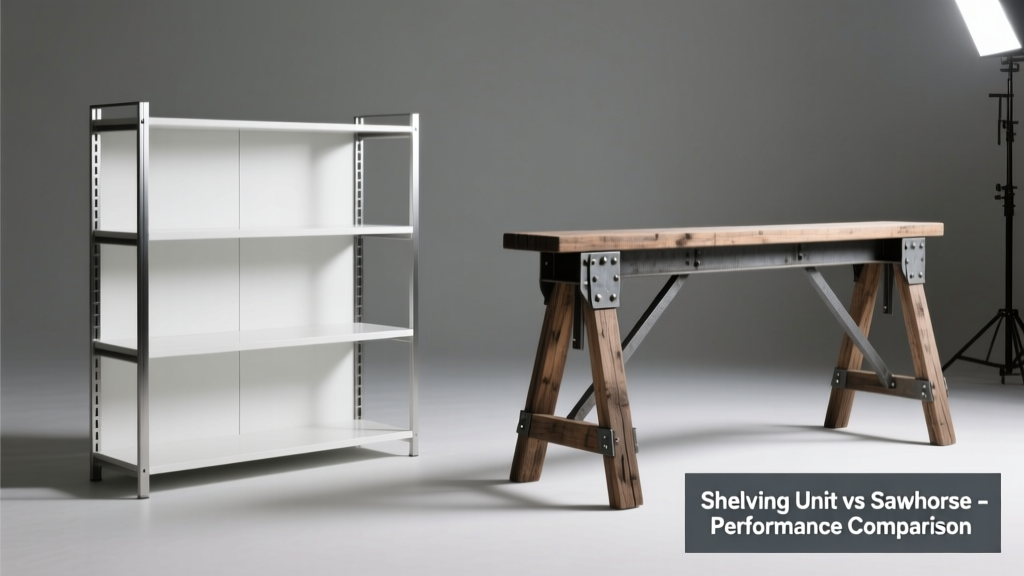
You’re standing in your garage with a stack of plywood, a half-built bookshelf, and two options on the floor: a metal shelving unit and a pair of wooden sawhorses. Both hold things up—but they solve different problems. Choosing wrong means wobbling cuts, wasted space, or back strain.
Quick Verdict
A shelving unit excels at organized, long-term storage—think tools, bins, or seasonal gear—with load capacities up to 1,500 lbs per shelf (Heavy-Duty Shelving Institute, 2022). A sawhorse is purpose-built for temporary, stable work support—ideal for cutting lumber or assembling furniture—offering height adjustability and zero assembly time. Neither is universally 'better'; the right choice depends on whether you need structure or support.
Side-by-Side Comparison
| Feature | Shelving Unit | Sawhorse |
|---|---|---|
| Primary function | Vertical storage & organization | Horizontal work surface support |
| Typical load capacity | 300–1,500 lbs per shelf | 500–1,200 lbs per pair (static) |
| Foldability/portability | Rarely foldable; often bolted or heavy (45–120 lbs) | Most fold flat; average weight: 12–28 lbs per unit |
| Assembly time | 30–90 minutes (bolt-together or clip-lock) | 0 minutes (ready to use out of box) |
| Surface stability for cutting | Poor—shelves flex; not designed for dynamic loads | Excellent—wide stance, non-slip feet, optimized leg angles |
Deep Dive on Shelving Units
Shelving units—especially bolt-together steel models like those from Heavy-Duty Shelving Units—deliver unmatched vertical efficiency. They let you stack bins, hang hooks, and separate categories by height: paint cans on bottom, power tools mid-level, and fragile accessories on top.
Pros
- Maximizes unused wall or corner space in garages and basements
- Customizable with add-ons: shelf dividers, casters, or pegboard panels
- Consistent height and level surfaces—critical for storing liquids or electronics
Cons
- Not rated for impact loads—drop a hammer on a shelf? It may sag or warp
- Poor lateral stability if overloaded asymmetrically (per OSHA’s 2021 warehouse safety bulletin)
- Hard to move once loaded—most lack integrated wheels unless upgraded
Deep Dive on Sawhorses
Sawhorses are the unsung heroes of the job site. From framing a deck to refinishing a dining table, they provide a rigid, adjustable platform that adapts to material length—not your ceiling height. Modern versions like the Best Sawhorses for Woodworking include integrated clamps, quick-release legs, and rubberized feet.
According to carpenter and instructor Lena Ruiz, who teaches at North Bennet Street School:
"A good sawhorse isn’t just about holding wood—it’s about giving your body neutral posture, reducing fatigue over 6+ hour builds. If your sawhorse wobbles when you push sideways, it’s already costing you accuracy and safety."
Pros
- Instant setup—no tools required for most folding models
- Height-adjustable (typically 24″–36″) to match your workbench or ladder
- Compatible with other supports: pair with a workbench plan or use as a base for a portable table saw
Cons
- No built-in storage—tools sit on the ground or require a separate tote
- Limited utility when idle (unlike shelves, which always hold something)
- Wooden models degrade outdoors without sealing; aluminum versions cost 2–3× more
When to Choose Shelving Unit vs Sawhorse
Choose a shelving unit if you’re organizing a cluttered garage, stocking inventory for a small shop, or building a home office supply station. It pays off over months—not minutes.
Choose sawhorses if you’re cutting drywall for a remodel, sanding cabinet doors, or staging materials on an uneven job site. Their ROI is measured in hours saved and cuts kept square.
And yes—you can own both. Many contractors keep a compact shelving unit near their truck for tool staging, and foldable sawhorses in the bed for immediate deployment.
Alternatives to Consider
- Workbenches with storage: Combine support + shelving (e.g., modular workbenches with under-bench cabinets)
- Rolling tool carts: Mobile, low-profile, and great for hand tools—but not for sheet goods
- Adjustable-height folding stands: Lighter than sawhorses but lower max load (usually ≤350 lbs)
Can I use a shelving unit as a sawhorse?
No—not safely. Shelving units aren’t engineered for cantilevered loads or lateral force. The U.S. Consumer Product Safety Commission logged 172 injury reports (2020–2023) tied to makeshift work surfaces collapsing under saws or routers.
Do sawhorses need maintenance?
Yes—especially wooden ones. Check leg joints every 3 months for play; tighten bolts, sand rough spots, and reseal with spar urethane if used outdoors. Aluminum models only need occasional wipe-downs and hinge lubrication.
Are there shelving units rated for workshop use?
Yes. Look for units labeled “industrial-grade” with welded steel frames and 14-gauge uprights (not 16- or 18-gauge). These meet ANSI MH10.2.1-2022 standards for static load testing and resist twisting better than retail-grade units.
How many sawhorses do I really need?
Two is standard for most tasks. For longer sheets (e.g., 4′ × 8′ plywood), add a third in the middle—or use one sawhorse plus a roller stand. Never rely on just one unless supporting lightweight trim or molding.
Can I build my own sawhorse?
Absolutely—and many do. A basic A-frame design uses 2×4s, takes under 90 minutes, and costs ~$12 in lumber. Just ensure leg angles stay between 65°–75° for optimal stability (per Fine Woodworking’s 2021 joinery guide).
If your goal is order, choose shelving. If your goal is action, choose sawhorses. And if you’re serious about both—start with one of each, then refine based on how you actually work—not how catalogs say you should.