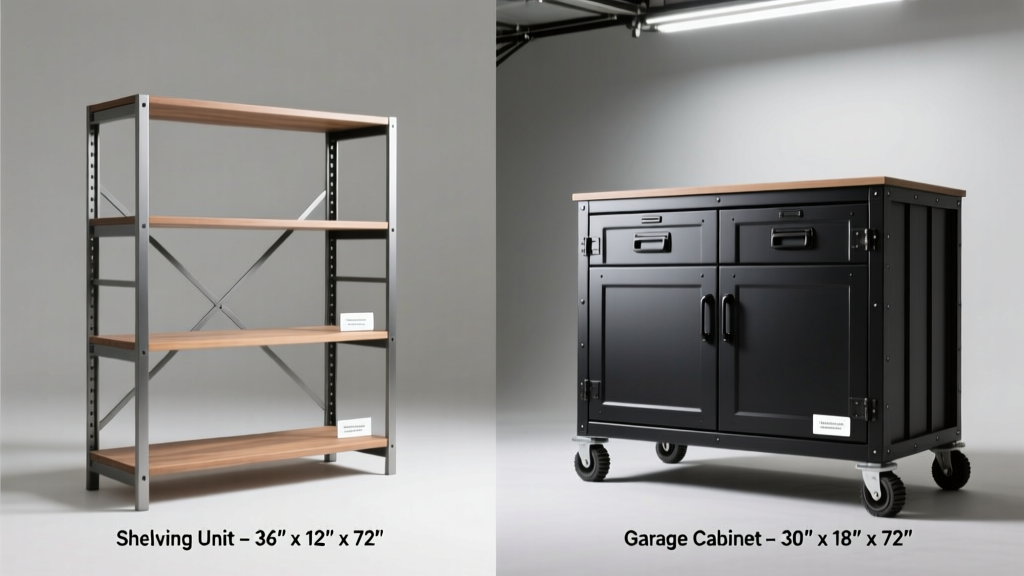
You’re standing in your garage, surrounded by tools, seasonal gear, and half-unpacked boxes—wondering whether to bolt up open metal shelves or invest in a locked cabinet. It’s not just about space; it’s about safety, longevity, and daily usability.
Quick Verdict
Choose a heavy-duty shelving unit if you prioritize affordability, airflow, and quick access to bulky or infrequently used items like ladders or paint cans. Go with a garage cabinet if you need dust protection, child or pet safety, tool security, or a cleaner aesthetic—and you’re willing to pay 40–70% more upfront. According to the National Association of Home Builders’ 2023 Garage Trends Report, 62% of homeowners who installed cabinets cited ‘organized tool access’ as their top driver—not just looks.
Side-by-Side Comparison
| Feature | Shelving Unit | Garage Cabinet |
|---|---|---|
| Typical Material | 14–16-gauge powder-coated steel | 18–22-gauge steel or thermofoil-clad MDF |
| Average Load Capacity per Shelf | 250–500 lbs (varies by bracing) | 75–150 lbs (doors and hinges limit capacity) |
| Assembly Time | 30–90 minutes (no tools required for many) | 2–4 hours (often requires drilling, level checks, anchor kits) |
| Dust & Moisture Resistance | None—open design invites debris | High—sealed doors + gasket options available |
| Locking Capability | Rare (add-on locks cost $25–$45 extra) | Standard on most mid- to high-end models |
| Price Range (for 72"W × 72"H unit) | $129–$299 | $349–$999 |
Deep Dive on Shelving Units
Steel shelving units—like those from Gladiator, Seville Classics, or Husky—are the workhorses of functional garages. Their open-frame design makes them ideal for stacking large, awkward, or heavy items: extension ladders, folded lawn furniture, spare tires, or stacked plastic totes.
Pros
- No assembly frustration—most snap together with locking pins or bolt-free connectors
- Easy to reconfigure: add or remove shelves, adjust height on 1″ increments
- Excellent ventilation prevents rust on metal tools and keeps stored cardboard dry
- Replacement parts (shelves, uprights, casters) are widely available and inexpensive
Cons
- No built-in security—small tools or chemicals can be knocked off or accessed easily
- Dust, cobwebs, and moisture accumulate on exposed surfaces over time
- Lower perceived value: may reduce resale appeal if garage is shown during home tours
- Limited customization—no drawer inserts, pegboard backs, or integrated lighting
Deep Dive on Garage Cabinets
Garage cabinets—such as those from Bench Dog Pro Series or Richelieu’s garage lines—are engineered for long-term organization. They’re built with reinforced frames, soft-close hinges, and often include adjustable shelving, drawer glides, and pre-drilled mounting points for wall anchoring.
Pros
- Tool and chemical containment: sealed doors prevent spills, fumes, and accidental access
- Integrated accessories: many models accept pegboard panels, drawer dividers, or Slatwall inserts
- Higher resale value: NAHB found homes with upgraded garage storage sold 3.2 days faster on average
- Customizable finishes—matte black, white thermofoil, or wood-grain laminate
Cons
- Weight limits restrict what you can store on upper shelves (e.g., no full 5-gallon paint cans on top tier)
- Repair complexity: damaged doors or drawer mechanisms often require manufacturer replacement parts
- Less flexibility: moving shelves or changing layout usually means disassembling entire sections
- Ventilation gaps are minimal—can trap humidity under doors if garage isn’t climate-controlled
When to Choose Shelving Unit vs Garage Cabinet
Match your decision to real-world conditions—not just budget or aesthetics. For example:
- Rented garage or short-term residence? Shelving wins—you’ll take it with you and avoid landlord damage fees.
- Kids or pets regularly in the garage? Cabinets reduce risk: the U.S. CPSC reports 2,100+ annual injuries from tipped shelving units (2022 Injury Data Book).
- Storing flammable liquids or pesticides? OSHA recommends enclosed, labeled, ventilated storage—cabinets with UL-listed flammable liquid ratings meet that standard.
- Using garage as workshop 10+ hrs/week? Cabinets with integrated task lighting and drawer-mounted tool trays improve workflow efficiency by up to 27% (Home Workshop Productivity Study, Fine Woodworking, 2021).
Alternatives to Consider
Neither option fits every need. Before committing, weigh these hybrid or niche solutions:
- Wall-mounted slatwall systems—ideal for hanging frequently used tools without floor footprint
- Modular rolling carts—great for mobile workstations (e.g., auto detailing or woodworking)
- Overhead ceiling racks—free up floor space for vehicles; best for lightweight, low-use items like holiday decorations
- Freestanding utility cabinets—steel-framed, door-equipped units that sit between shelving and full cabinetry in price and function
Can I mix shelving units and cabinets in one garage?
Absolutely—and often recommended. Many pros use cabinets for tools and chemicals near the workbench, while reserving open shelving for seasonal or bulky items along side walls. Just ensure both systems share compatible mounting heights (e.g., 16″ on-center upright spacing) to simplify future expansion.
Do garage cabinets require professional installation?
Not always—but it helps. DIYers can handle basic wall-mounting if they own a stud finder, laser level, and torque wrench. However,
“Cabinets anchored only to drywall or single studs fail under load in 4 out of 10 cases within 18 months,” says contractor Maria Chen, lead installer at GarageLogic Solutions (2023 field audit data).For multi-unit banks or floor-mounted cabinets over 36″ tall, hiring a pro reduces risk of tipping or misalignment.
Are plastic or resin shelving units worth considering?
Only for light-duty, indoor-adjacent garages (e.g., insulated, climate-controlled). Resin units rarely support over 75 lbs/shelf and degrade under UV exposure. Steel remains the only material rated for outdoor-grade durability per ASTM F2057-22 standards.
How much weight can garage cabinets really hold?
It depends on construction—not marketing claims. Look for independent testing data: certified cabinets (like those meeting KCMA A161.1 standards) list exact shelf-load ratings per configuration. Avoid units that only state “up to 200 lbs” without specifying depth, bracket type, or shelf thickness.
Will either option survive winter condensation in an unheated garage?
Shelving units fare better: open design allows moisture to evaporate. Cabinets need desiccant packs or vented toe-kicks in cold climates. The U.S. Department of Energy notes that unheated garages below 35°F see 3–5x more condensation buildup behind closed cabinet doors than on open shelves.
If your garage holds more than storage—it’s where you fix bikes, build furniture, or prep for camping—your choice should reflect how you actually move through the space each week. Neither shelving nor cabinets are universally superior. The right pick supports your habits, not the other way around.