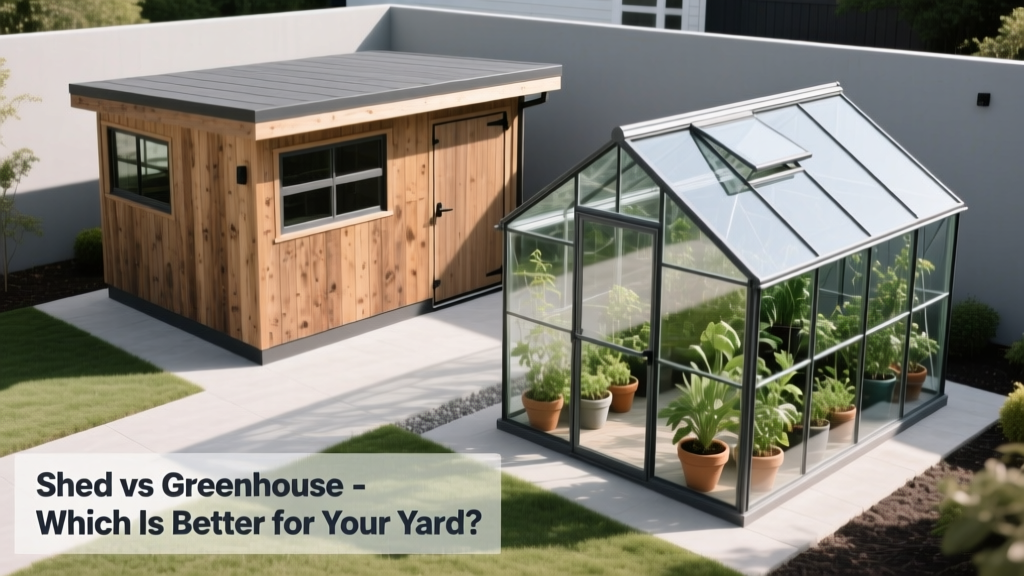
You’re staring at that empty patch of yard, torn between building a shed to store tools or a greenhouse to grow tomatoes year-round. Both look practical. Both need permits, space, and cash. But they solve entirely different problems—and mixing them up can cost hundreds in wasted materials or missed harvests.
Quick Verdict
A shed is better if you need secure, dry storage for lawn equipment, seasonal decor, or workshop gear. A greenhouse is better if you want to extend growing seasons, start seedlings early, or cultivate heat-sensitive plants like orchids or citrus. They’re not interchangeable: one locks things out; the other lets light—and life—in.
Side-by-Side Comparison
| Feature | Shed | Greenhouse |
|---|---|---|
| Primary purpose | Storage & workspace | Plant propagation & growing |
| Average cost (DIY kit) | $800–$2,400 | $1,200–$4,500 |
| Wall material | Wood, metal, or vinyl siding | Polycarbonate, glass, or polyethylene film |
| Insulation | Optional (R-11 common) | Rarely insulated; passive heat retention only |
| Ventilation | Small windows or vents (for airflow) | Manual or automated roof/wall vents + fans (critical for humidity control) |
| Foundation requirement | Gravel pad or concrete slab | Level, well-drained gravel or concrete—often with anchoring for wind |
| Lifespan (with maintenance) | 15–30 years | 10–20 years (film lasts 2–5 years; polycarbonate 10–15) |
Deep Dive on Sheds
Sheds prioritize utility over environment. Most are built with structural integrity first—think 2×4 framing, pressure-treated floors, and lockable doors. You’ll find models with lofts, electrical rough-ins, and even HVAC-ready walls.
Pros
- Stronger security: Solid doors, optional deadbolts, and non-transparent walls deter theft
- Lower long-term upkeep: No condensation management, no UV degradation of glazing
- Easier permitting: Often classified as accessory structures—not agricultural infrastructure
- Better resale value: Buyers consistently rate functional storage as a yard asset (National Association of Realtors, 2022)
Cons
- No natural light transmission—useless for plant growth without supplemental lighting
- Poor temperature stability for sensitive items: Uninsulated sheds swing from 20°F to 110°F seasonally
- Not designed for humidity: Can’t safely house tropical plants or mushroom cultivation
Deep Dive on Greenhouses
Greenhouses are engineered ecosystems. Even basic models balance solar gain, ventilation, and moisture retention. High-end versions include thermostats, misting systems, and shade cloth rails—all aimed at replicating ideal microclimates.
Pros
- Extends growing season by 6–10 weeks in most USDA Zones 4–7 (University of Vermont Extension, 2021)
- Enables crop diversity: Grow peppers in March, basil in November, or microgreens year-round
- Higher light transmission: Polycarbonate panels transmit 80–90% of available PAR light
Cons
- Vulnerable to weather extremes: Hail cracks glass; high winds lift unanchored poly tunnels
- Condensation buildup invites mold and fungal disease without proper airflow
- Requires active management: Daily venting, weekly cleaning of glazing, seasonal shading adjustments
When to Choose a Shed vs Greenhouse
If your yard floods in spring, skip the greenhouse—it needs stable, elevated, well-drained ground. If you live in Zone 3 with -30°F winters, a standard greenhouse won’t keep tomatoes alive without serious heating investment (and likely won’t be cost-effective). Conversely, if you’ve got 20 bags of potting soil, six trays of seedlings, and a compost tumbler spilling onto your patio, a greenhouse solves real workflow friction.
"A greenhouse isn’t just a box with glass—it’s a living system. I see more crop failure from poor ventilation than from cold snaps." — Dr. Lena Cho, Horticulture Extension Specialist, Cornell CALS (2023)
Choose a shed when:
- You store mowers, bikes, holiday decorations, or power tools
- Your HOA restricts non-residential structures taller than 8 feet
- You need a dry, lockable space for woodworking or pottery
Choose a greenhouse when:
- You’re committed to starting seeds 8+ weeks before last frost
- You grow herbs, lettuces, or cut flowers for market or personal use
- You want to experiment with grafting, hydroponics, or pollination control
Alternatives to Consider
Neither option fits every need. Here are three middle-ground solutions:
- Cold frames: Low-cost, passive-season extenders—ideal for hardening off seedlings or overwintering kale
- Hybrid shed-greenhouses: Insulated sheds with south-facing glazing walls and exhaust fans—best for Zone 5–7 hobbyists
- Pop-up fabric greenhouses: <$300, easy to assemble—but limited to short-term use and light frosts
Can I convert a shed into a greenhouse?
Yes—but it’s rarely cost-effective. You’d need to replace at least two walls and the roof with glazing, add vents, reinforce framing for snow load, and install a vapor barrier. Budget $2,000+ in labor and materials beyond the original shed cost.
Do greenhouses need a foundation?
Yes—especially permanent ones. The U.S. EPA recommends anchoring all freestanding greenhouses to concrete piers or a poured perimeter to withstand 60+ mph winds (2022 Wind Load Standards for Accessory Structures).
Are plastic sheds suitable for gardening storage?
Only for dry goods. Most resin sheds trap heat and lack floor ventilation—so bags of fertilizer clump, and dormant bulbs shrivel. Opt for wood or metal with a raised floor and gable vents instead.
How much space do I need for a functional greenhouse?
Minimum viable size is 6'×8': enough room for two 4'×8' benches, aisle access, and overhead clearance for trellised tomatoes. Anything smaller limits airflow and makes temperature control unreliable.
Will a greenhouse increase my property taxes?
It depends on your county. In 27 states, permanent greenhouses over 120 sq ft are assessed as taxable improvements (Lincoln Institute of Land Policy, 2023). Detached sheds under 200 sq ft are often exempt—check your local assessor’s office before ordering.
There’s no universal “better” choice—only the right tool for your soil, schedule, and season. Start small: try a $99 cold frame before committing to a $3,500 greenhouse. Or test shed usability with a rented storage unit first. Either way, measure twice, permit once, and leave room for both compost and curiosity.