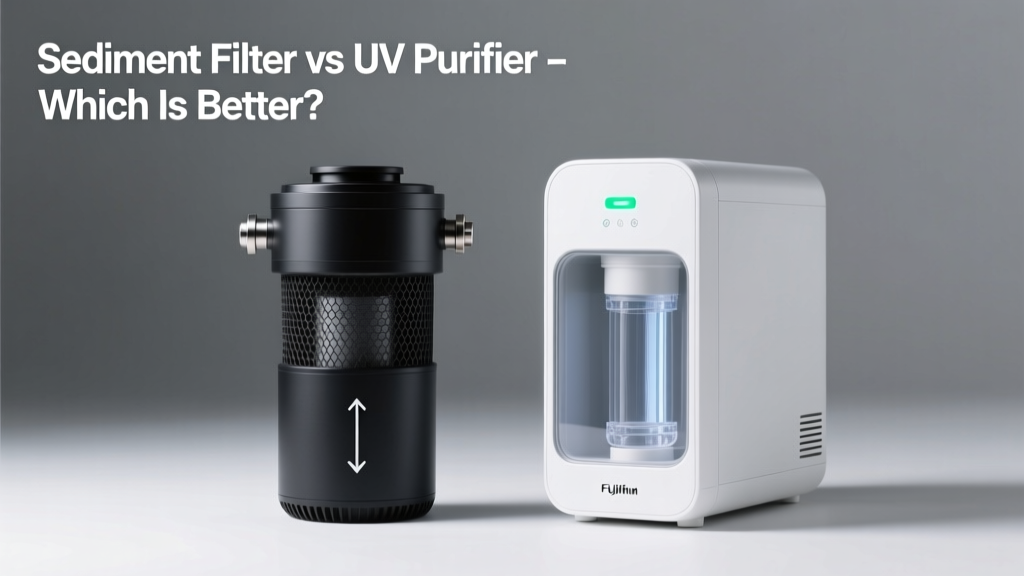
You’re staring at two very different water treatment devices—one traps particles like rust and sand, the other zaps microbes with light—and wondering which actually belongs in your home. It’s not a simple ‘better or worse’ question. It’s about matching technology to your water’s real problems.
Quick Verdict
A sediment filter is essential pre-treatment for nearly all whole-house systems—it removes visible debris but does nothing against bacteria, viruses, or dissolved contaminants. A UV purifier kills 99.99% of microorganisms but fails completely if water is cloudy or contains iron, manganese, or tannins. They’re complementary, not competitors: most experts recommend using them together when microbiological risk is high and turbidity exceeds 1 NTU (per NSF/ANSI Standard 55).
Side-by-Side Comparison
| Feature | Sediment Filter | UV Purifier |
|---|---|---|
| Primary function | Mechanically traps suspended solids (dirt, rust, silt) | Inactivates bacteria, viruses, and protozoa via ultraviolet light |
| Removes E. coli? | No | Yes—up to 99.99% at proper dose (40 mJ/cm²) |
| Lifespan (typical) | 3–6 months (depends on turbidity) | Lamp: 9–12 months; quartz sleeve: clean every 3–6 months |
| Requires electricity? | No | Yes (12–24V or 120V models) |
| Installation location | First stage in filtration train (pre-softener, pre-RO, pre-UV) | Last stage before point-of-use (must follow sediment & carbon filters) |
| NSF certification standard | NSF/ANSI 42 (aesthetic effects) | NSF/ANSI 55 (microbiological safety) |
Deep Dive on Sediment Filters
Sediment filters are passive, mechanical barriers—usually pleated polypropylene, spun poly, or string-wound cartridges rated from 0.5 to 100 microns. They’re inexpensive ($15–$45 per cartridge) and require no power, making them ideal as first-line defense in wells, municipal supplies with aging pipes, or homes near construction zones.
Pros
- Low upfront cost and zero operating expense
- Reduces wear on downstream equipment (water softeners, RO membranes, UV lamps)
- Effective on visible particulates—even heavy sand loads in shallow well water
- No disinfection byproducts or chemical residues
Cons
- Does not improve taste, odor, or chemical content
- Cannot remove dissolved metals (iron, lead), chlorine, or microbes
- Clogging increases pressure drop—requires regular monitoring and replacement
- Useless against cysts like Giardia if pore size >1 micron
According to the U.S. EPA, sediment-laden water reduces UV transmittance (UVT) by up to 70%—making pretreatment non-negotiable for UV reliability. That’s why whole-house water filtration systems almost always start with sediment removal.
Deep Dive on UV Purifiers
UV purifiers use germicidal UV-C light (254 nm wavelength) to disrupt microbial DNA. They don’t add chemicals or alter water chemistry—but only work when water is optically clear. Units range from compact under-sink models ($250–$400) to whole-house systems ($600–$1,200), and all require annual lamp replacement and periodic quartz sleeve cleaning.
Pros
- Proven efficacy against bacteria (E. coli, Legionella), viruses (norovirus, hepatitis A), and protozoa (Cryptosporidium)
- No taste or odor alteration—unlike chlorine or chloramine
- Immediate treatment—no contact time or holding tanks required
- NSF/ANSI 55 Class A units deliver ≥40 mJ/cm², validated for unsafe water sources
Cons
- Fails silently—if lamp burns out, quartz sleeve clouds, or flow exceeds rated GPM
- No residual protection: recontamination can occur downstream
- Zero effect on chemicals, heavy metals, hardness, or turbidity
- Not effective on spores or algae without extended exposure
"UV is the gold standard for microbial control—but it’s a precision tool, not a magic wand. We see 80% of UV failures trace back to poor pretreatment or missed lamp replacements." — Dr. Lena Cho, Water Quality Engineer, NSF International, 2022
When to Choose Sediment Filter vs UV Purifier
Choose a sediment filter if your water looks cloudy, leaves orange stains, or clogs aerators frequently—even if your lab test shows low coliform counts. Choose UV only if you’ve confirmed microbiological contamination (e.g., positive well test for total coliform) AND your water has UVT ≥75%, iron <0.3 ppm, and turbidity <1 NTU. For rural well owners, that often means installing both: sediment → carbon → UV.
If your municipal supply tested positive for Legionella in the building’s plumbing (per ASHRAE 188-2021), UV makes sense at point-of-entry—but only after verifying sediment levels won’t coat the quartz sleeve. Meanwhile, apartments with consistent city water rarely need UV unless immunocompromised occupants live there.
Alternatives to Consider
Neither device solves everything—and sometimes another solution fits better:
- Reverse osmosis: Removes dissolved solids, heavy metals, and some microbes—but wastes 3–4 gallons per gallon purified
- Chlorination + contact tank: Effective for persistent bacterial issues, but creates THMs and affects taste
- Ozonation: Stronger oxidizer than UV, handles iron/manganese, but requires complex injection and off-gassing
- Ceramic filters (e.g., Doulton): Remove cysts and bacteria down to 0.2 microns, no power needed—but slow flow and frequent scrubbing
Can I install UV without a sediment filter?
No—not safely or effectively. Even 5 NTU turbidity cuts UV dose delivery by over 50%. The NSF/ANSI 55 standard mandates ≤1 NTU input for Class A systems. Without sediment removal, quartz sleeves foul within weeks, and lamp output degrades faster than rated.
Do sediment filters remove microplastics?
Yes—but only those ≥0.5 microns. Most common filters (5–10 micron) catch larger fibers; sub-micron polypropylene (0.5–1 micron) captures ~90% of microplastics >1 µm (per 2023 study in Environmental Science & Technology). For full coverage, pair with activated carbon and ultrafiltration.
Is UV safe for drinking water?
Yes—when properly installed and maintained. UV light doesn’t make water radioactive or leave residues. However, it offers zero protection against chemical contaminants, so never rely on UV alone in areas with agricultural runoff or industrial plumes.
How often should I test my well after installing UV?
Test for total coliform and E. coli quarterly for the first year, then annually—plus anytime you notice odor, cloudiness, or lamp alerts. Also test iron, manganese, and hardness yearly; elevated levels shorten UV sleeve life and reduce UVT.
Why does my UV unit have an alarm light?
Most modern UV systems include sensors for lamp intensity, flow rate, and sleeve fouling. An alarm usually means one of three things: lamp output dropped below threshold (lamp aging), flow exceeded design capacity (reducing dwell time), or UVT fell due to sediment or organic buildup. Check your manual—but don’t ignore it.
Can UV damage plastic plumbing?
UV-C light itself doesn’t reach plumbing—it’s contained inside the stainless steel chamber. However, ozone generated as a byproduct in some older UV units (<1% of models) can degrade certain PVC or CPVC fittings over years. Modern NSF-certified units minimize ozone production; verify compliance with NSF/ANSI 55 before purchase.
Ultimately, sediment filters and UV purifiers answer different questions: ‘What’s physically in my water?’ versus ‘What’s biologically dangerous?’ Neither replaces the other—and choosing one without understanding your water quality report is like treating symptoms without diagnosing the cause. Start with a certified lab test, map your plumbing layout, and consider stacking technologies—not picking sides. For more on pairing solutions, see our guide to well water treatment systems and filters for city water.