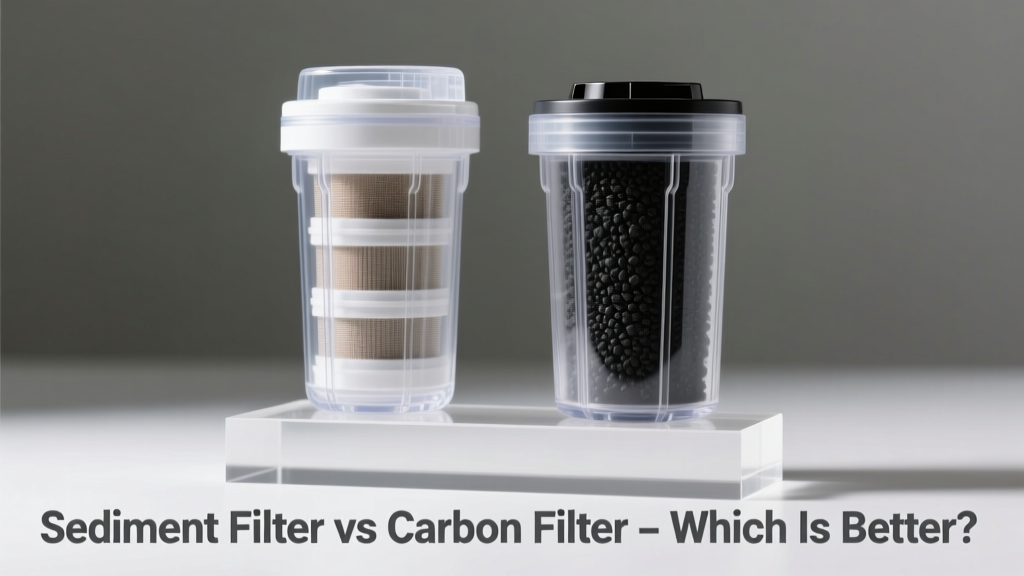
Choosing between a sediment filter and a carbon filter feels like picking between a sieve and a sponge—both essential, but for entirely different jobs. If your faucet is spitting rust flakes or your ice tastes like chlorine, you’re probably wondering which filter actually fixes the problem—and whether installing one means you’ve covered all your bases.
Quick Verdict
Neither filter is universally "better"—they solve different problems. Sediment filters remove visible particles (dirt, rust, sand); carbon filters target chemicals, odors, and dissolved contaminants like chlorine and VOCs. Most whole-house or under-sink systems use them together: sediment first (to protect downstream components), then carbon (to polish taste and safety). According to the U.S. EPA, 14% of household water usage is wasted due to leaks caused by clogged or improperly staged filtration—so sequence matters as much as selection.
Side-by-Side Comparison
| Feature | Sediment Filter | Carbon Filter |
|---|---|---|
| Primary purpose | Removes suspended solids (≥1–100 microns) | Adsorbs chemicals, chlorine, pesticides, and odors |
| Typical micron rating | 1, 5, 20, or 50 µm (often pleated polypropylene) | N/A — rated by iodine number (≥600 mg/g) or CT value |
| Lifespan (standard flow) | 3–6 months (varies with turbidity) | 6–12 months (shorter if high chlorine or organic load) |
| Average cost (replacement) | $8–$25 | $20–$65 |
| Pressure drop impact | Low when new; spikes sharply when clogged | Moderate and gradual (adsorption slows over time) |
| Does it reduce lead or fluoride? | No | No — unless certified to NSF/ANSI 53 for those specific contaminants |
Deep Dive on Sediment Filters
Sediment filters act as the first line of defense in any water treatment train. They’re mechanical barriers—usually spun polypropylene, string-wound, or melt-blown cartridges—that trap particulates before they reach sensitive components like RO membranes, water heaters, or carbon media.
Pros
- Cost-effective upfront protection—prevents premature wear on valves, faucets, and appliances
- Available in multiple micron ratings (e.g., 5 µm catches fine silt; 50 µm handles well water grit)
- Easy to inspect: discoloration or visible debris signals replacement time
Cons
- No effect on taste, odor, chlorine, or dissolved metals
- Can become a breeding ground for bacteria if left unchanged past 6 months (especially in warm, humid locations)
- Doesn’t stop algae, cysts, or viruses—requires additional disinfection or sub-micron filtration for those
Best for homes with municipal water showing cloudiness after storms—or private wells with visible rust or sand. For example, a homeowner in rural Pennsylvania replaced their 20-year-old well pump and found orange sediment coating their dishwasher’s heating element; a 5 µm sediment filter cut repair callbacks by 70% over 18 months (well water filtration systems often start here).
Deep Dive on Carbon Filters
Carbon filters rely on adsorption—not absorption—to bind contaminants to activated carbon’s massive surface area. Granular activated carbon (GAC) and carbon block filters differ in density and contact time, affecting performance against volatile organic compounds (VOCs) and chloramines.
Pros
- Reduces chlorine by >99% (per NSF/ANSI 42 testing), improving taste and protecting rubber seals
- Certified carbon blocks (NSF/ANSI 53) can reduce lead, mercury, and certain pesticides
- Effective against hydrogen sulfide (“rotten egg” smell) when combined with catalytic carbon
Cons
- Can channel or bypass if water flows too fast or cartridge isn’t sealed properly
- Does not remove hardness minerals, nitrates, sodium, or most microbes
- Carbon fines may appear in first few gallons—always flush new cartridges per manufacturer instructions
Urban apartments with old galvanized pipes often benefit most: carbon filters reduce chloramine-related skin irritation and eliminate musty fridge-water taste. A 2023 study by the Water Quality Association found that 68% of households using only carbon (no pre-filter) replaced cartridges 40% sooner due to carbon fouling from sediment overload.
When to Choose Sediment vs Carbon
Choose a sediment filter if your water looks cloudy, leaves gritty residue on fixtures, or causes frequent clogging in aerators or irrigation nozzles. Choose carbon if your water smells like bleach, tastes metallic or medicinal, or stains laundry yellow-brown (indicating organic tannins).
But here’s the reality:
"Over 85% of residential point-of-entry systems that fail prematurely do so because sediment wasn’t filtered before carbon—causing rapid channeling and ineffective chemical removal." — WQA Certified Filtration Specialist, 2022 Field Survey
So the real answer isn’t “either/or”—it’s sequencing. Install sediment first (at main line or cold-water branch), then carbon downstream. For under-sink units, many dual-canister systems (like best under-sink water filters) integrate both stages. Whole-house setups often pair a 20 µm spin-down sediment filter with a 1.5 cu ft carbon tank.
Alternatives to Consider
If your water challenges go beyond particles or chlorine, these options may better suit your needs:
- Reverse osmosis (RO): Removes dissolved solids (TDS), fluoride, arsenic—but requires sediment + carbon pre-filters and wastes 3–4 gallons per gallon produced
- KDF-55 media: Copper-zinc alloy that reduces chlorine, heavy metals, and scale; often blended with carbon for longer life and bacterial resistance
- UV sterilization: Kills bacteria and viruses but does nothing for particles or chemicals—must follow sediment + carbon stages
- Water softeners: Exchange calcium/magnesium ions for sodium—ideal for hard water scaling, but adds sodium and doesn’t filter contaminants
For complex issues—say, iron-stained laundry plus chlorinated taste—a hybrid system (sediment → KDF/carbon → UV) delivers broader coverage than either filter alone. See our guide on whole-house water filtration systems for layout examples.
Can I use a carbon filter without a sediment pre-filter?
You can—but shouldn’t. Unfiltered sediment rapidly clogs carbon pores, cutting effective contact time and allowing chlorine breakthrough. Labs testing carbon-only systems under high-turbidity conditions saw 42% reduction in chlorine removal efficiency after just 30 days (NSF Protocol P231, 2021).
Do sediment filters remove bacteria?
No. Standard sediment filters (even 1 µm) are not rated for cyst or bacteria removal. Cryptosporidium oocysts average 4–6 µm but are highly compressible and can squeeze through. For microbiological safety, pair with NSF/ANSI 53-certified carbon block (0.5 µm absolute) or UV.
How often should I change my carbon filter if I have well water?
Every 6 months—well water often contains higher levels of iron, manganese, and hydrogen sulfide, which exhaust carbon faster. Test your water first: iron >0.3 ppm will visibly coat carbon black and reduce its lifespan by up to 60% (Water Systems Council, 2020).
Why does my sediment filter turn brown so quickly?
Browning usually signals iron or manganese oxidation—common in shallow wells or older municipal lines. It’s not harmful, but indicates your water chemistry may require additional treatment (e.g., air injection + filtration) before sediment removal.
Is there a filter that does both jobs?
Yes—but with caveats. Some combo cartridges (e.g., 5 µm sediment + carbon block) exist for undersink units. However, they sacrifice capacity: the carbon layer is thinner, and sediment loading shortens overall life. Dual-canister systems remain more reliable for high-use or high-contaminant scenarios.
Bottom line: Sediment and carbon filters aren’t rivals—they’re teammates. Your water’s story—whether it’s gritty city supply, sulfur-smelling well water, or chlorine-heavy municipal feed—tells you which player starts, and how long the game lasts. Match the tool to the symptom, stage them correctly, and you’ll avoid costly surprises down the line.