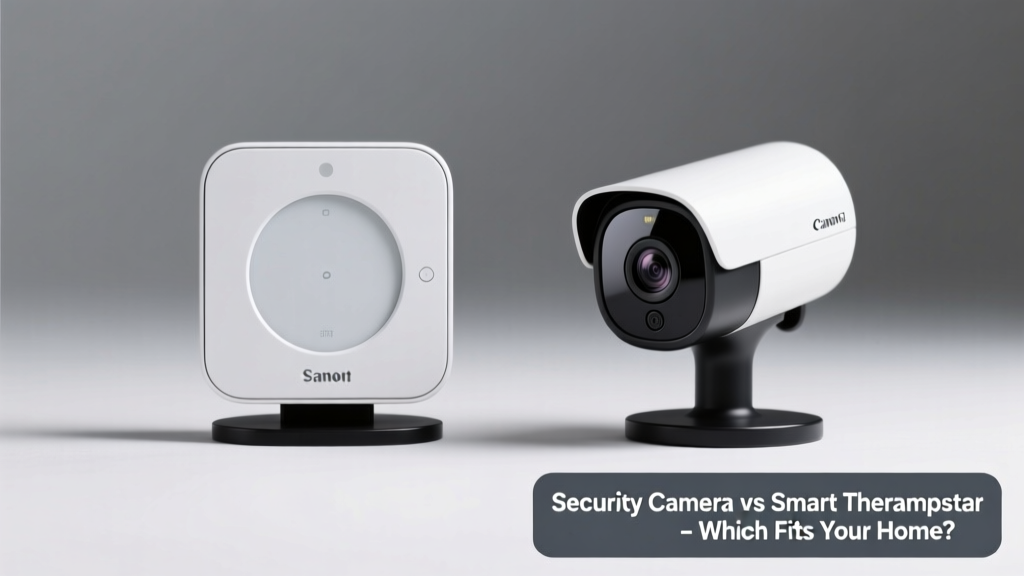
You’re upgrading your home’s smart tech—and suddenly you’re stuck between a security camera and a smart thermostat. Both promise peace of mind, but they solve entirely different problems. One watches your front door; the other adjusts your HVAC while you’re at work. Confusing them is like comparing a smoke detector to a coffee maker: same house, totally different jobs.
Quick Verdict
Neither is "better" overall—it depends on your top priority right now: safety or efficiency. If break-ins, package theft, or remote monitoring keep you up at night, a security camera delivers immediate, tangible protection. If your energy bills spike every winter or you forget to adjust the heat before vacation, a smart thermostat pays for itself in under 18 months (per U.S. Department of Energy’s 2022 analysis). You don’t need to choose one over the other long-term—but picking the wrong one first wastes time, money, and setup effort.
Side-by-Side Comparison
| Feature | Security Camera | Smart Thermostat |
|---|---|---|
| Primary function | Real-time visual monitoring & motion-triggered alerts | Automated HVAC control based on schedule, occupancy, and weather |
| Installation complexity | Moderate (wiring or Wi-Fi + mounting + app setup) | Moderate to high (requires compatible HVAC wiring, often needs C-wire) |
| Monthly cost (if any) | $0–$30 (cloud storage subscriptions optional) | $0 (no recurring fees; some offer premium support tiers) |
| Average ROI timeline | Intangible (deterrence, evidence, peace of mind) | 12–18 months (10–12% HVAC energy savings, per ENERGY STAR 2023 data) |
| Privacy impact | High (records video/audio; requires clear placement boundaries) | Low (collects temp/occupancy data only; no audio/video) |
Deep Dive on Security Cameras
Modern security cameras go far beyond basic surveillance. Indoor models like the Arlo Essential or Wyze Cam v3 offer color night vision, person/package detection, and local microSD recording—no subscription needed. Outdoor units (e.g., Reolink Argus 4 Pro) add weatherproofing, two-way audio, and solar charging options.
Pros
- Immediate crime deterrence: A visible camera reduces burglary attempts by up to 60%, according to the University of North Carolina’s 2021 residential security study
- Remote verification: See who’s at your door before opening—or confirm if that ‘motion alert’ was your cat
- Insurance discounts: Some providers offer 5–15% premium reductions for verified video systems
Cons
- Privacy headaches: Neighbors may object to wide-angle outdoor coverage; indoor mics can capture private conversations
- False alerts: Tree branches, headlights, or insects trigger recordings—especially with cheaper models
- No direct utility savings: Unlike thermostats, cameras don’t reduce bills or carbon footprint
Deep Dive on Smart Thermostats
Devices like the Nest Learning Thermostat or Ecobee SmartThermostat with voice control learn your habits, integrate with window/door sensors, and auto-adjust based on weather forecasts. The latest models even detect room occupancy via infrared and adjust zones independently.
Pros
- Energy savings: U.S. EPA estimates smart thermostats cut heating/cooling costs by 8–12% annually
- Seamless automation: Away mode kicks in automatically when your phone leaves geofence radius
- Health benefits: Consistent temps reduce mold risk and respiratory strain—especially critical for households with asthma or elderly residents
Cons
- Compatibility limits: Older HVAC systems (pre-2005) may lack a C-wire, requiring an adapter or pro install
- Learning curve: First-week behavior can feel erratic until the unit adapts to your rhythm
- No security function: It won’t tell you if someone’s tampering with your back door
When to Choose a Security Camera vs Smart Thermostat
Choose a security camera if:
- You rent and can’t modify HVAC wiring—but can mount a battery-powered camera in minutes
- You’ve had recent porch piracy, suspicious activity, or live in a high-theft ZIP code (check local FBI UCR data)
- Your home has multiple entry points, pets that roam freely, or aging parents living alone
Choose a smart thermostat if:
- Your electric bill regularly exceeds $180/month in summer or $220 in winter (a strong ROI signal)
- You travel frequently and forget to adjust temps—or your family argues over the thermostat daily
- You’re planning HVAC replacement soon and want future-proof compatibility
Alternatives to Consider
Before committing to either device, weigh these hybrid or lower-friction options:
- Video doorbells: Offer camera-like visibility at entry points without full-property coverage
- Smart plugs with energy monitoring (e.g., Kasa KP115): Track and schedule non-HVAC loads like space heaters or AC units
- Basic motion sensors + smart lights: Create presence simulation for security—no video required
- Programmable thermostats (non-smart): Cut costs by 5–7% with manual scheduling—no app needed
Can I install both—and does it make sense?
Absolutely—and many homeowners do within 6–12 months. Start with whichever solves your most urgent pain point. Just prioritize privacy settings: disable microphone access on indoor cameras in bedrooms, and review thermostat data-sharing permissions in its app.
Do security cameras work without Wi-Fi?
Yes—but functionality drops sharply. Local SD card recording works offline, but you’ll lose remote viewing, cloud alerts, and AI detection (like facial recognition or pet vs person differentiation). Battery-powered models without cellular backup become inert during extended outages.
Will a smart thermostat work with my oil furnace?
Most modern smart thermostats support oil, gas, and heat pump systems—but verify compatibility using the manufacturer’s online tool (e.g., Nest’s Heating System Checker). Oil systems often require a relay kit for safe low-voltage control.
Are there security cameras that also measure temperature?
A few niche models (like the Bosch NBN-732V) include ambient temp/humidity sensors—but accuracy lags behind dedicated thermostats by ±2°F or more. They’re designed for environmental context, not HVAC control.
How long do smart thermostats last?
Typically 10–15 years—matching HVAC equipment lifespan. Firmware updates usually continue for 5–7 years post-release. After that, core functions remain, but new integrations (e.g., Matter support) may stop.
What’s the biggest mistake people make when choosing either device?
"Most buyers focus on specs—not use cases. A 4K outdoor camera means nothing if it’s pointed at a blank wall. And a thermostat with geofencing is useless if your phone’s location services are disabled." — Sarah Lin, home automation consultant and author of Practical Smart Homes (2023)
Start small. Pick the device that answers a question you ask weekly: “Who’s at my door?” or “Why is my AC running nonstop?” That clarity beats chasing features—and builds confidence for your next upgrade.