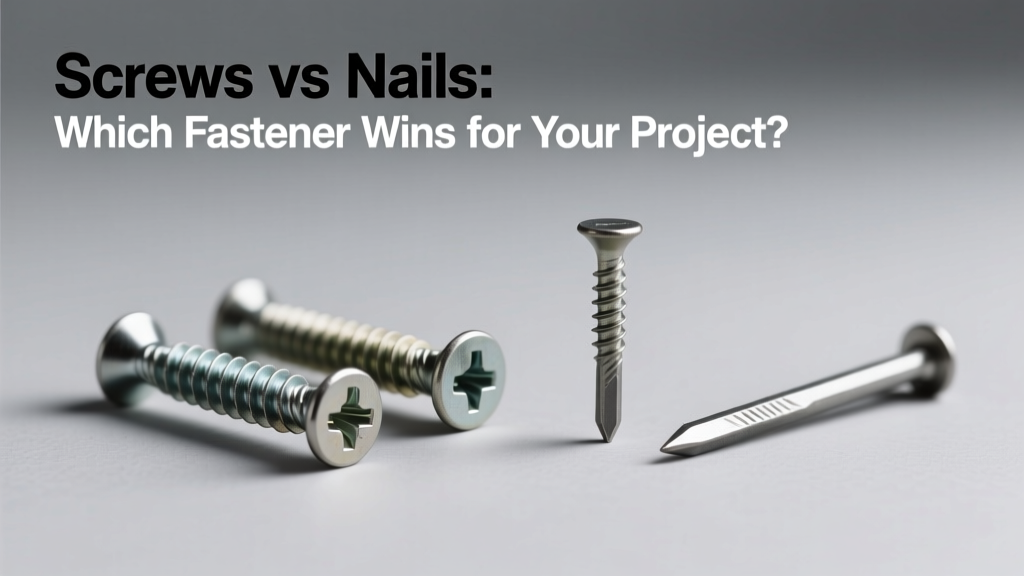
Every carpenter, DIYer, or weekend renovator has stood in the hardware aisle, staring at bins of screws and boxes of nails, wondering: which one actually belongs in this project? It’s not just about grabbing what’s handy — the wrong fastener can mean stripped wood, popped joints, or a shelf that sags before the books arrive.
Quick Verdict
Screws win for structural integrity, adjustability, and long-term hold — especially in load-bearing or high-vibration applications. Nails excel in speed, shear resistance, and forgiving joinery like framing or subflooring where slight movement is expected. Neither is universally 'better'; the right choice depends on material, load direction, and whether you might need to disassemble later.
Side-by-Side Comparison
| Feature | Screws | Nails |
|---|---|---|
| Holding power (tensile) | Strong — up to 3× greater pull-out resistance than nails of same diameter/length (Wood Handbook, USDA Forest Service, 2019) | Weaker — relies more on friction and lateral grip |
| Shear strength | Moderate — threads can shear under sideways force if undersized | High — smooth shank bends slightly, absorbing energy without snapping |
| Installation speed | Slower — requires drilling pilot holes for hardwoods or large diameters | Faster — hammer-driven; no prep needed for most softwood framing |
| Removability | Easy and clean — designed for repeated insertion/removal | Destructive — prying often splits wood or bends nail heads |
| Cost per fastener | Higher — $0.03–$0.15 each (deck screws, drywall screws) | Lower — $0.005–$0.02 each (16d common nails) |
Deep Dive on Screws
Screws anchor with threaded engagement — essentially turning into the material. That gives them superior withdrawal resistance, especially critical in deck ledger boards, cabinet mounting, or attaching trim to masonry with anchors.
- Pros: Reusable, precise depth control, minimal splitting risk with pilot holes, excellent for dissimilar materials (e.g., metal brackets to wood)
- Cons: Slower to install without a driver, prone to stripping if over-torqued, poor performance in end-grain without special thread design
- Ideal for: Cabinetry, furniture assembly, drywall-to-stud attachment, outdoor decking, and any application where disassembly or adjustment may be needed later
According to the National Association of Home Builders’ 2022 Builder Practices Survey, 78% of custom home builders specify screws over nails for interior trim and built-ins — citing cleaner finishes and reduced callbacks from popped fasteners.
Deep Dive on Nails
Nails rely on friction and bending resistance. Their smooth, tapered shanks allow slight flex under stress — a feature that prevents brittle failure in dynamic loads like wind or foot traffic.
- Pros: Faster installation, better shear capacity, forgiving in green or uneven lumber, lower material cost at scale
- Cons: Poor pull-out resistance, difficult to remove without damage, higher risk of splitting in thin or dry wood without pre-drilling
- Ideal for: Structural framing (walls, roofs), subflooring, roofing, pallet building, and temporary or sacrificial assemblies
When to Choose Screws vs Nails
Match the fastener to the force it will face — and the life cycle of the assembly.
- Use screws when: You’re attaching something heavy to vertical surfaces (e.g., floating shelves to studs), working with hardwood or MDF, or building something meant to last decades without maintenance.
- Use nails when: You’re toe-nailing studs, securing plywood sheathing, or nailing down hardwood flooring — where lateral movement must be absorbed, not resisted.
- Avoid both when: Joining pressure-treated lumber above ground — use hot-dipped galvanized or stainless steel versions to prevent corrosion-induced failure (per ICC-ES AC257 guidelines, 2021).
- Hybrid approach works best for: Deck construction — nails for joist hangers (shear load), screws for decking boards (pull-out resistance and ease of replacement).
Alternatives to Consider
Neither screws nor nails solve every problem. For specialized needs, consider:
- Rivets — permanent, vibration-resistant fastening for metal-to-metal joints
- Wood glue + clamps — stronger than mechanical fasteners alone in long-grain bonding
- Concrete anchors — sleeve, wedge, or tapcon types for masonry substrates where screws or nails won’t bite
Can I use screws instead of nails for framing?
No — not without engineering review. The International Residential Code (IRC R602.3) permits only specific structural screws (e.g., SDWS or Strong-Drive screws) for certain framing connections, and they must meet load-rated specifications. Standard drywall or deck screws lack the ductility and shear capacity required for wall or roof framing.
Why do nails hold better in shear than screws?
It’s physics: a nail’s smooth shank deforms microscopically under lateral load, distributing stress across more wood fibers. A screw’s rigid threads concentrate stress at discrete points — making it more likely to snap or strip under sudden side force. This is why shear values in the Wood Handbook list common nails at 120 lbs shear capacity versus an equivalent #10 x 3" screw at just 85 lbs.
Do screws split wood more than nails?
Only if improperly installed. Screws are actually less likely to split wood than nails — if you drill a pilot hole. Nails driven near board ends or in dry, dense species (like maple or oak) frequently cause splits without pre-drilling. A properly sized pilot hole reduces radial expansion pressure dramatically.
Are there screws that work like nails?
Yes — structural screws like Simpson Strong-Tie’s SDWS series have notched shanks and modified threads that mimic nail-like ductility while retaining screw advantages. They’re code-listed for framing, shear walls, and hurricane ties — bridging the gap between traditional fasteners.
What’s the best fastener for attaching drywall?
Use drywall screws — not nails. While nails were common in older homes, modern drywall screws provide consistent depth control, resist popping (especially in temperature-humidty cycles), and reduce the risk of dimpling. The Gypsum Association’s GA-216 (2023) explicitly recommends coarse-thread drywall screws for wood studs and fine-thread for metal studs.
How do I choose the right screw length for my project?
Rule of thumb: the screw should penetrate at least 1 inch into the receiving material — never less. For example, attaching ¾" plywood to a 2×4 (1.5" actual thickness): use 2¼" screws so 1.5" engages the stud. Too short = weak hold; too long = blowout or hitting wiring. Always verify stud location with a detector first.
At the end of the day, screws and nails aren’t rivals — they’re teammates with different specialties. The most skilled builders keep both within arm’s reach, choosing not by habit but by physics, code, and consequence. If your project involves weight, precision, or future access, lean toward screws. If it’s about speed, flexibility, or structural framing, nails still earn their place in the toolbox — and in the codebook.