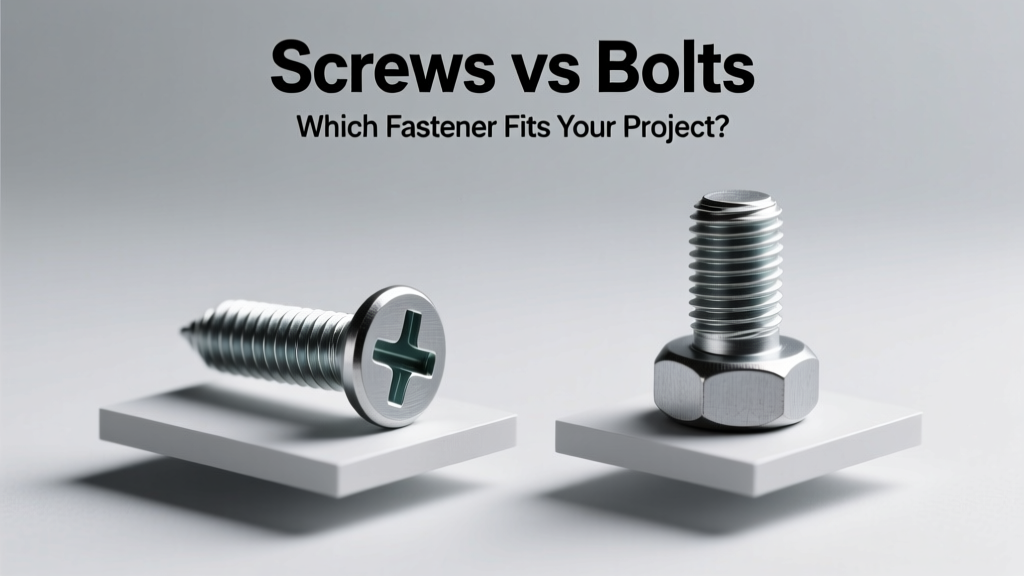
Choosing between a screw and a bolt feels trivial—until your deck railing wobbles, your cabinet hinge pulls out, or a machine assembly vibrates loose. Both look similar, both join materials, but their mechanics, load paths, and failure modes are fundamentally different.
Quick Verdict
Bolts win for high-strength, removable, or dynamic-load applications—think engine blocks, structural steel, or outdoor furniture frames. Screws excel in wood-to-wood fastening, sheet metal, drywall, and situations where threading into material (not a nut) is necessary. Neither is universally 'better'; the right choice depends on load type, material, accessibility, and whether disassembly is expected.
Side-by-Side Comparison
| Feature | Screws | Bolts |
|---|---|---|
| Thread engagement | Self-tapping or cut threads directly into substrate (e.g., wood, plastic) | Require pre-tapped hole or paired nut; threads don’t cut into base material |
| Tensile strength (typical Grade 5/8.8) | 30–60% lower than equivalent-diameter bolt | Higher clamping force and shear resistance; ASTM F568M Grade 8.8 bolts handle ~800 MPa tensile stress |
| Installation tool | Phillips, Torx, or flathead driver; often hand-tightened | Wrench or socket; requires torque control for proper preload |
| Removability | Can strip or cam out; repeated removal degrades thread integrity | Designed for repeated assembly/disassembly without degradation |
| Average cost (per unit, #10 × 1.5") | $0.07–$0.12 (wood screws) | $0.18–$0.35 (hex bolts + nuts) |
Deep Dive on Screws
Screws rely on thread-to-material friction and torsional resistance to hold. Their helix angle and pitch are optimized for biting into softer substrates—not resisting pure pull-out or shear.
Pros
- No nut required—ideal for blind assemblies (e.g., attaching a shelf bracket to wall studs)
- Faster installation in wood, drywall, or plastic with power drivers
- Wide variety: deck screws, drywall screws, self-drilling metal screws, lag screws
Cons
- Lag screws may split hardwoods without pilot holes; drywall screws snap easily under lateral load
- Repeated tightening loosens threads—especially in particleboard or MDF
- Poor fatigue resistance in vibrating environments (e.g., HVAC ductwork or farm equipment)
According to the American Wood Council’s Design Values for Wood Construction (2021), withdrawal resistance of a #10 wood screw drops 40% after three cycles of removal and reinsertion in southern yellow pine.
Deep Dive on Bolts
Bolts function as tension members: they stretch slightly under torque, creating clamp load that holds parts together via friction—not thread grip. That’s why washers and precise torque matter.
Pros
- Consistent, repeatable clamping force—critical in automotive, aerospace, and structural connections
- Superior fatigue life: properly torqued Grade 8 bolts withstand 20,000+ vibration cycles (SAE J429, 2022)
- Easily inspected, replaced, or upgraded without damaging base material
Cons
- Requires access to both sides (or use of a rivet nut or T-nut in blind applications)
- More expensive and time-intensive to install—drill, tap or insert nut, align, torque
- Over-torquing risks yielding or thread stripping; under-torquing causes joint slippage
"A bolted joint isn’t held together by the bolt—it’s held together by the clamping force the bolt creates. If you skip torque specs, you’re relying on luck, not engineering." — Dr. Linda S. Kahl, Mechanical Engineering Faculty, Purdue University (2020)
When to Choose Screws vs Bolts
Use screws when:
- You’re fastening 3/4" plywood to 2×4 framing in a closet build
- Mounting a TV bracket to hollow drywall with toggle bolts (yes—even toggle bolts are technically screws with expansion anchors)
- Assembling flat-pack furniture where disassembly isn’t planned
Use bolts when:
- Securing a trailer hitch to a vehicle frame (dynamic loads, corrosion exposure)
- Joining two steel plates in a workshop bench base
- Installing a ceiling-mounted garage door opener motor (vibration + overhead safety-critical)
Alternatives to Consider
Not every job demands a screw or bolt. For light-duty, non-structural uses, consider pop rivets (permanent, no backside access needed) or threaded inserts (for repairing stripped threads in aluminum or plastic). For temporary or adjustable setups, machine screws with T-nuts offer bolt-like reliability in wood or composite panels.
Can I use a screw in place of a bolt?
Only if the load is compressive and static—like holding a picture frame to drywall. Never substitute a wood screw for a Grade 5 bolt in a swing set bracket. The failure mode differs: screws pull out; bolts shear or loosen. The U.S. Consumer Product Safety Commission recorded 12,400 injuries from failed fasteners in outdoor play equipment between 2019–2023—over 60% involved improper screw substitution.
Do all bolts need washers?
Yes—for most structural or cyclic-load applications. Washers distribute clamp load, prevent embedment in soft materials, and reduce friction during torqueing. ASTM A563 specifies hardened washers for Grade 8 bolts. Skipping them risks uneven stress and premature joint failure.
Why do some screws have a smooth shank near the head?
That unthreaded section ensures the screw pulls the top material tightly against the bottom before the threads engage—critical for flush joints in cabinetry. It also increases shear strength by providing a solid, non-threaded bearing surface.
Are stainless steel screws as strong as stainless bolts?
No. Most stainless screws (e.g., ANSI B18.6.4 Type 18-8) are rated for ~70 ksi tensile strength. Stainless bolts (ASTM A193 B8M Class 2) reach 125 ksi. Strength isn’t just about material—it’s about geometry, thread form, and how the fastener transfers load.
What’s the biggest mistake people make installing either?
Using the wrong driver bit—or forcing a screw/bolt instead of drilling the correct pilot or clearance hole. A 2022 study by the National Association of Home Builders found 31% of reported framing failures traced to undersized pilot holes causing wood splitting or stripped threads.
Fasteners aren’t interchangeable parts—they’re engineered systems. Match the tool to the task, not the appearance. When in doubt, consult load tables, follow manufacturer specs, and remember: if it vibrates, carries weight, or keeps someone safe, default to a properly torqued bolt.