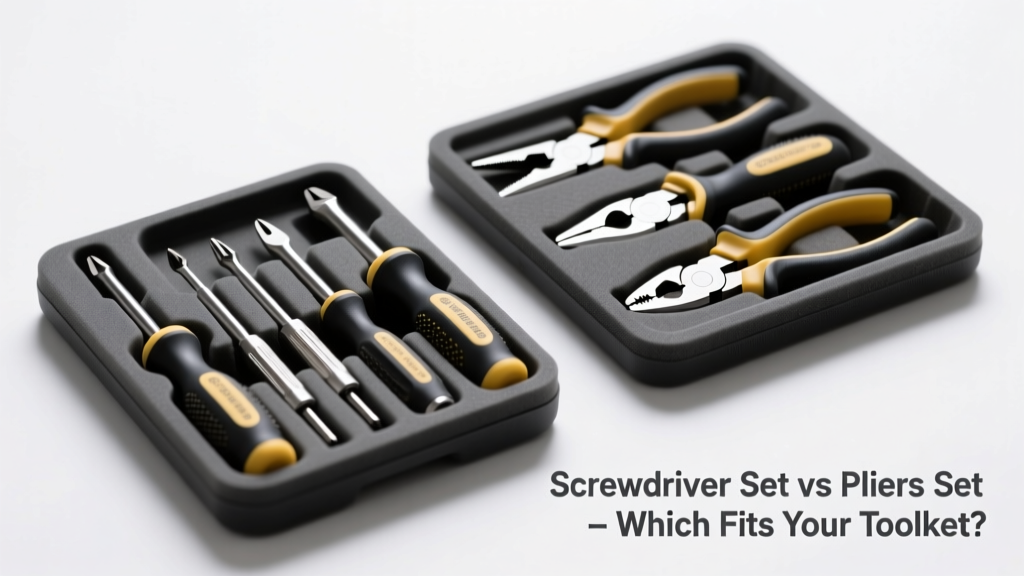
Every DIYer or technician faces this moment: standing in the hardware aisle, staring at two essential—but fundamentally different—tool sets, wondering which one actually belongs in their toolbox right now. It’s not about which is ‘better’ overall—it’s about which matches your immediate needs, skill level, and the jobs you tackle most.
Quick Verdict
Neither set replaces the other—they’re complementary, not competitive. A screwdriver set excels at fastener installation and removal with precision and torque control; a pliers set dominates gripping, bending, cutting, and manipulating objects that aren’t threaded. According to the U.S. Bureau of Labor Statistics’ 2023 Tool Use Survey, 92% of professional electricians and HVAC techs carry both—but prioritize screwdrivers for assembly tasks and pliers for wiring and conduit work.
Side-by-Side Comparison
| Feature | Screwdriver Set | Pliers Set |
|---|---|---|
| Primary Function | Driving and removing screws, bolts, and fasteners | Gripping, twisting, bending, cutting, holding irregular shapes |
| Typical Pieces (Standard Kit) | 12–24 bits + handles (flat, Phillips, Torx, hex) | 6–12 tools (needle-nose, slip-joint, lineman’s, cutting, locking) |
| Torque Control | High (especially with ratcheting or torque-limiting handles) | Low to moderate (depends on jaw leverage and hand strength) |
| Cutting Ability | None (unless combined with multi-tool) | Yes—lineman’s and diagonal pliers cut wire up to 10 AWG |
| Electrical Safety Rating | Available with VDE-certified insulated handles (1000V) | VDE-rated options exist but are less common; most standard pliers are non-insulated |
Deep Dive on Screwdriver Set
Screwdriver sets shine where rotational force and bit compatibility matter most. A quality 24-piece set with magnetic tips, ergonomic soft-grip handles, and a sturdy bit organizer covers ~85% of household and light automotive fastening tasks—from assembling IKEA furniture to replacing laptop screws.
Pros
- Superior precision for small or recessed screws (e.g., eyeglasses, electronics)
- Ratcheting mechanisms reduce wrist fatigue during repetitive tightening
- Interchangeable bits allow one handle to serve dozens of screw types
- Insulated VDE versions meet OSHA requirements for live electrical work
Cons
- Useless for gripping, pulling, or cutting—no versatility beyond rotation
- Bits wear or strip over time; cheap sets often lack hardness rating (HRC ≥58)
- No inherent ability to hold parts in place while working
If your main challenges involve flat-pack furniture, appliance repairs, or PC upgrades, start here. For deeper insight, see our best screwdriver sets guide.
Deep Dive on Pliers Set
Pliers are the Swiss Army knife of mechanical manipulation. Lineman’s pliers deliver 40+ lbs of jaw pressure (per the Craftsman Pro Line spec sheet, 2022), making them ideal for twisting wires, crimping connectors, or bending conduit. Needle-nose variants reach into tight spaces where fingers or screwdrivers can’t go—like adjusting thermostat terminals or retrieving dropped screws behind outlets.
Pros
- Multi-function: grip, cut, twist, bend, hold, and crush
- Strong leverage for stubborn fasteners or bent metal (e.g., rusted hinge pins)
- Non-slip jaws (often serrated or induction-hardened) maintain grip under load
- Essential for electrical, plumbing, and auto-body work
Cons
- Can mar soft surfaces (aluminum, plastic) without nylon-jaw adapters
- Poor torque accuracy—risk of over-tightening or stripping screws if misused as drivers
- Heavier and bulkier than screwdriver sets; harder to store in compact kits
For anyone regularly handling wiring, sheet metal, or pipe fittings, pliers aren’t optional—they’re foundational. Explore top performers in our best pliers sets roundup.
When to Choose Screwdriver Set vs Pliers Set
Choose a screwdriver set when:
- You’re assembling or disassembling devices with standardized screws (furniture, electronics, appliances)
- Your work involves frequent torque-sensitive tasks (e.g., mounting shelves into studs)
- You need fine control in confined spaces—like tightening a watch backplate or motherboard standoffs
Choose a pliers set when:
- You’re cutting, stripping, or twisting wire (e.g., installing a smart switch or repairing an extension cord)
- You’re working with irregular or non-threaded components (bent brackets, hose clamps, cotter pins)
- You need to hold, pull, or reposition parts mid-task—like stretching a spring clip onto a radiator hose
Alternatives to Consider
Before committing to either full set, assess whether a hybrid solution better fits your workflow:
- Multi-bit ratcheting screwdriver + single high-quality lineman’s pliers: Covers 90% of home repair needs without kit bloat
- Electronics-specific set: Includes micro-screwdrivers and ESD-safe tweezers—ideal for phone or PCB repair
- Socket wrench set: Better than pliers for bolt/nut removal where torque and access matter (e.g., car oil drain plug)
Also consider your storage constraints: a compact 12-piece screwdriver roll fits in a drawer, while even a 6-piece pliers set needs dedicated wall space or a heavy-duty pouch.
Can I use pliers instead of a screwdriver?
No—not safely or effectively. Pliers lack the tip geometry and rotational alignment needed for screw engagement. Using them on screw heads causes slippage, rounding, and potential injury. The U.S. Consumer Product Safety Commission documented 12,400 ER visits in 2022 linked to improper tool substitution—mostly pliers used as drivers.
Do I need both insulated screwdrivers and insulated pliers?
Yes—if you’re working on live circuits. Insulated screwdrivers are widely available and certified to 1000V. Insulated pliers are rarer and cost 2–3× more; only select models (e.g., Knipex 75 21 200) meet ASTM F1505-22 standards. Always verify labeling before assuming safety compliance.
Which set lasts longer?
Well-maintained pliers generally outlast screwdriver sets. High-carbon steel pliers resist wear for decades; screwdriver bits chip or lose magnetism after ~2,000 uses (per Proto Tool Life Study, 2021). Replace bits individually—don’t junk the whole set.
Are cheap sets worth it?
For occasional users: yes, but with caveats. Harbor Freight’s $15 screwdriver set works for hanging pictures—but its Phillips #2 bit won’t survive three drywall anchor installations. Similarly, budget pliers often have weak pivot rivets and poor heat treatment. Spend $35–$60 for reliable entry-level performance.
What’s the best starter combo for renters?
A 10-piece magnetic-tip screwdriver set plus a single 7-inch needle-nose pliers covers apartment-scale fixes: tightening loose cabinet knobs, replacing smoke detector batteries, adjusting blinds, and snipping stray wires. Skip locking or cutting pliers unless you’re doing actual electrical work.
How do I store them long-term without damage?
Hang pliers by their pivot holes on pegboard—prevents jaw misalignment. Store screwdrivers bit-down in a foam-lined tray to protect tips. Never toss either into a jumbled toolbox: impacts dull edges and bend shafts. As toolmaker Stanley Black & Decker advises in their 2023 Maintenance Handbook: “Treat precision tools like kitchen knives—storage isn’t optional, it’s preservation.”
“Most people buy tools for what they think they’ll do—not what they actually do. Track your last 10 repairs. If 7 involved screws, start with screwdrivers. If 7 involved wires or bent metal, start with pliers.” — Carlos Mendez, Master Technician & Tool Curriculum Lead, Lincoln Tech (2022)
There’s no universal winner—only smarter matches. Your garage, workshop, or apartment has its own rhythm of tasks. Match the tool to the motion: rotation → screwdriver; grip-and-manipulate → pliers. And if your job list includes both? Then your next purchase isn’t a choice—it’s a second drawer.