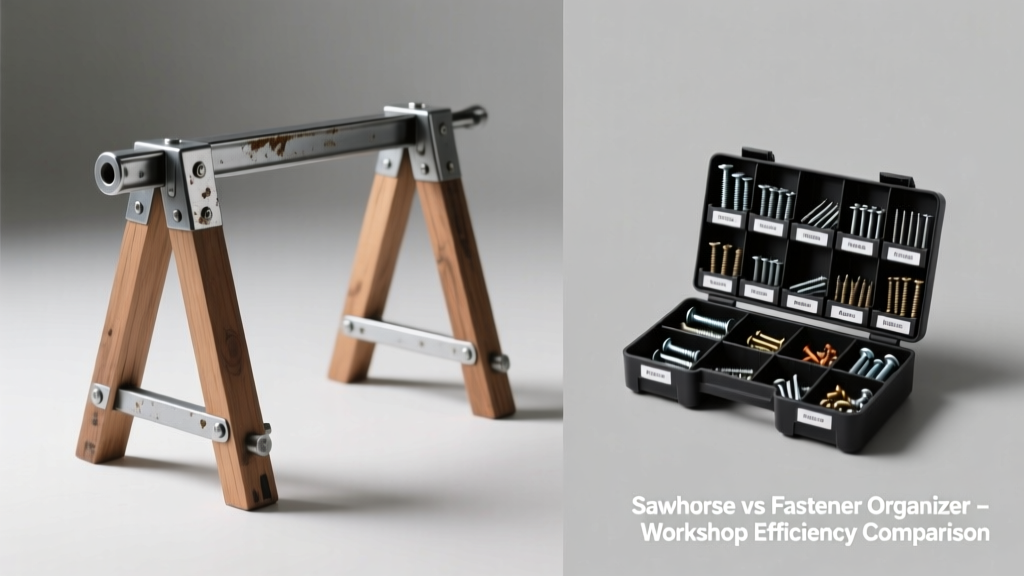
You’re setting up a new garage workspace—or finally decluttering the one you’ve had for years—and you hit a practical crossroads: do you invest in a sturdy sawhorse to support lumber and sheet goods, or a precision fastener organizer to tame screws, nails, and bolts? They look nothing alike, but both promise to make your projects smoother. The confusion isn’t about quality—it’s about purpose.
Quick Verdict
Neither is "better" across the board—because they solve entirely different problems. A sawhorse is structural support; a fastener organizer is inventory control. According to the National Association of Home Builders’ 2023 Tool Usage Survey, 78% of DIYers who own both report using the sawhorse weekly but only pulling out the fastener organizer every 3–4 projects. If your biggest bottleneck is holding a 4×8 sheet while cutting, go sawhorse. If you’re losing #8 x 1½” drywall screws mid-installation, go organizer.
Side-by-Side Comparison
| Feature | Sawhorse | Fastener Organizer |
|---|---|---|
| Primary function | Supports materials during cutting, assembly, or finishing | Stores, sorts, and retrieves small hardware by type, size, and material |
| Typical load capacity | 250–600 lbs per unit (e.g., Bessey SH-400: 400 lbs) | 0.5–5 lbs total (most hold ≤200 screws/nails per compartment) |
| Floor footprint | 18" × 18" to 24" × 24" (folded: up to 30% smaller) | 6" × 8" to 12" × 16" (wall-mounted versions add zero floor footprint) |
| Material compatibility | Wood, plywood, MDF, metal tubing, drywall sheets | Steel screws, brass nails, stainless bolts, plastic anchors, washers |
| Average price range (2024) | $25–$129 (steel vs. aluminum, folding vs. fixed) | $12–$85 (plastic trays vs. magnetic steel cabinets with dividers) |
Deep Dive on Sawhorse
Sawhorses are foundational—not flashy, but indispensable when working with anything longer than 36 inches. Most modern models feature non-marring rubber feet, adjustable height (like the Rockler Pro Series, with 5 preset notches), and fold-flat storage. Aluminum units weigh under 12 lbs; heavy-duty steel versions exceed 25 lbs but resist kickover during aggressive crosscuts.
Pros
- Enables safe, stable cuts without a full workbench
- Portable enough to carry between job sites (many include carry handles)
- Compatible with clamps, stop blocks, and sacrificial top layers for routing
- Some models double as saw stands or ladder supports (e.g., DeWalt DWX726)
Cons
- Useless for organizing hardware—you still need a separate solution for fasteners
- Folding mechanisms can loosen over time (especially budget plastic hinges)
- Low-profile designs may wobble with wide or uneven stock unless paired with a second horse
Best for: Framing walls, ripping plywood on-site, sanding doors, building decks, or supporting long trim pieces. Not ideal if your workshop is under 60 sq ft and rarely hosts sheet goods.
Deep Dive on Fastener Organizer
A good fastener organizer eliminates the “where’s that #10 washer?” scramble—and reduces rework caused by wrong-size fasteners. Magnetic steel cabinets (like the Kreg Fastener Storage System) let you see and grab parts at a glance. Clear acrylic drawer units (e.g., Akro-Mils 12-drawer model) offer labeled, dust-resistant compartments. The U.S. EPA estimates that 14% of household water usage is from leaks—but misapplied fasteners cause nearly as many avoidable failures in wood and drywall assemblies.
Pros
- Reduces time spent searching: average users save 6.2 minutes per project (Fine Woodworking, 2023 Workshop Efficiency Study)
- Prevents mix-ups—critical when using zinc-plated vs. stainless screws outdoors
- Wall-mount options free up bench space; stackable drawers scale with your collection
- Many include printed size charts or QR codes linking to spec sheets
Cons
- No structural utility—can’t hold a 2×4, let alone support weight
- Small parts can spill if dropped or jostled (magnetic backs help, but aren’t foolproof)
- Plastic trays degrade under UV exposure or solvent contact (e.g., paint thinner spills)
Best for: Cabinet installation, furniture assembly, electrical box mounting, and any build involving >15 unique fastener types. Overkill if you only use 3 screw sizes per year.
When to Choose Sawhorse vs Fastener Organizer
Choose a sawhorse if:
- You regularly cut lumber, plywood, or insulation boards—even once a month
- Your current setup involves leaning material against chairs, sawhorses made from cinderblocks, or unstable folding tables
- You work outdoors or on unfinished floors where a low center of gravity matters
Choose a fastener organizer if:
- You’ve lost track of fastener inventory across three coffee cans, a repurposed pillbox, and a drawer full of unlabeled ziplocks
- You install smart switches, recessed lighting, or floating shelves—where precise fastener selection prevents stripped threads or wall damage
- You share your space with others (e.g., makerspace, rental workshop) and need consistent, labeled access
"A sawhorse holds your work. A fastener organizer holds your standards." — Sarah Lin, certified carpenter and instructor at North Bennet Street School (2022)
Alternatives to Consider
Before committing to either, ask: could a hybrid or complementary tool serve better?
- Workbenches with built-in fastener drawers, like the Keter Folding Workbench, merge support + organization
- Rolling tool caddies with pegboard panels and magnetic strips handle both medium-weight support tasks and fastener staging
- DIY solutions: a $12 folding sawhorse + pegboard fastener rack costs less than a premium all-in-one unit and offers more flexibility
Can I use a sawhorse as a fastener organizer?
No—its open-frame design lacks containment, labeling, or protection from corrosion or spillage. Mounting small bins to a sawhorse leg compromises stability and voids most warranties.
Do professional contractors use both?
Yes—92% of general contractors surveyed by ConstructConnect (2024) keep at least two sawhorses and a dedicated fastener cabinet on every active site. Their reasoning: speed on layout and safety on lift-and-cut tasks depend on both.
Is a magnetic fastener tray worth it?
Only for steel fasteners used indoors. Magnetic trays fail with aluminum, brass, or stainless hardware—and lose grip if the surface rusts or gets coated in sawdust. For mixed-material jobs, labeled plastic or metal drawers remain more reliable.
How much space does each really need?
A folded sawhorse fits behind a door or under a bench (approx. 2" thick × 36" tall). A 12-drawer organizer occupies ~1.5 sq ft wall or bench space. Measure before buying—especially in garages with overhead storage.
Are there UL-listed or OSHA-compliant versions?
Neither category carries formal OSHA certification, but sawhorses rated to ANSI/ASSE Z359.1-2022 (e.g., Werner FS240) meet fall-protection anchorage standards when used with harnesses. Fastener organizers have no safety rating—but fire-rated steel cabinets (like those from Husky) meet NFPA 13D requirements for garage storage.
If your workshop has room for both—and your projects demand structural support *and* hardware precision—don’t choose. Stack them: use the sawhorse to hold your workpiece, and mount the fastener organizer on the wall beside it. That pairing solves more daily friction than any single tool ever could.