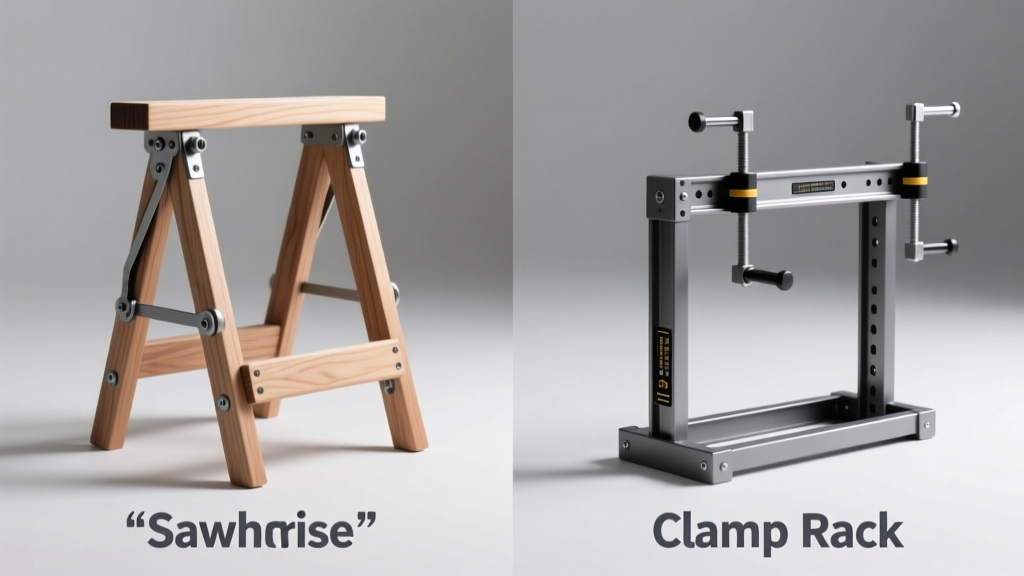
You’re standing in your garage, project lumber stacked nearby, and you need to hold something steady—but should you reach for the sawhorses or the clamp rack? It’s not just about convenience; it’s about workflow, safety, and whether your next cut stays square or slips mid-saw.
Quick Verdict
Sawhorses win for portability, quick setup, and rough-cut support—especially outdoors or on job sites. Clamp racks excel indoors for precision work, repeatable setups, and hands-free clamping of sheet goods or joinery. Neither is universally better; your typical project type, workspace size, and material thickness dictate the smarter pick.
Side-by-Side Comparison
| Feature | Sawhorse | Clamp Rack |
|---|---|---|
| Weight & Portability | 12–25 lbs per unit; folds flat or nests for transport | 35–80 lbs; bolted or weighted base limits mobility |
| Max Load Capacity | 300–600 lbs (per pair, depending on model) | 200–450 lbs (distributed across rails/clamps) |
| Setup Time | Under 10 seconds per unit | 2–5 minutes for rail alignment and clamp positioning |
| Floor Space Used | ~2 ft × 1.5 ft per unit (when deployed) | 4–8 ft length × 1.2 ft depth (fixed footprint) |
| Material Compatibility | Boards, beams, pipes, odd-shaped stock | Sheet goods (plywood, MDF), panels, doors, cabinet parts |
| Clamping Force Control | None—relies on gravity/friction or added bar clamps | Precise, adjustable pressure (up to 1,200 psi with toggle or screw clamps) |
Deep Dive on Sawhorses
Sawhorses are the original workshop Swiss Army knife—simple, rugged, and forgiving. Most modern versions feature steel-reinforced legs, non-marring rubber feet, and fold-flat designs like the DeWalt DWX726. They shine when you’re breaking down 16-ft studs on gravel, supporting a 4×8 sheet while cutting with a circular saw, or bracing a door slab for hinge mortising.
Pros
- Cost-effective: $35–$95 for reliable pairs (vs. $220–$650 for full clamp racks)
- No assembly required—open, lock, go
- Handles irregular shapes: ladder rails, bowed boards, metal conduit
- Stacks or hangs vertically when not in use
Cons
- No built-in clamping—requires separate clamps for hands-free work
- Can tip if loaded asymmetrically or on uneven ground
- Less stable for thin sheet goods (<1/2" plywood) without additional supports
According to the Woodworking Institute’s 2022 Workshop Safety Survey, 68% of DIYers reported at least one near-miss with unclamped stock on sawhorses—underscoring why pairing them with quick-release bar clamps is non-negotiable for precision cuts.
Deep Dive on Clamp Racks
A clamp rack—like the Kreg KMA2685 or Rockler Panel Clamping System—is essentially a modular workbench extension. Its rails accept interchangeable clamps, stops, and fences, turning any flat surface into a repeatable, zero-slip station. It’s engineered for consistency: align once, cut ten identical cabinet sides.
Pros
- Repeatable positioning via indexed rail holes or T-track systems
- Eliminates marking and measuring for batch work
- Integrated stop blocks and angle guides reduce setup errors
- Works seamlessly with track saws and router tables
Cons
- Requires dedicated floor or bench space—can’t be tossed in a truck bed
- Learning curve for optimal clamp placement and load distribution
- Limited utility for long, narrow stock (e.g., 2×4s over 8 ft)
"A clamp rack doesn’t save time on one-off cuts—but it cuts setup time by 70% on production runs of 5+ identical parts." — Sarah Lin, lead fabricator at Timberline Millworks (2023 shop efficiency audit)
When to Choose Sawhorse vs Clamp Rack
Choose sawhorses if you regularly:
- Cut dimensional lumber on-site (framing, deck builds, fence repairs)
- Work in tight garages where floor space is premium
- Need to support >10-ft stock that won’t fit on a fixed rack
- Prefer low-cost, high-durability tools with no moving parts
Choose a clamp rack if you regularly:
- Build cabinets, shelves, or furniture from sheet goods
- Use a track saw or panel cutter daily
- Need consistent 90° edge joints or repeatable dados
- Have a dedicated indoor workspace with 6+ ft of wall-adjacent floor space
Alternatives to Consider
Not sold on either? These fill specific gaps:
- Bench-mounted clamp systems: Ideal for small shops—mounts to your existing workbench, offers clamp rack precision without floor footprint
- Portable panel supports (e.g., Festool MFT/3): Hybrid solution—lighter than clamp racks, more stable than sawhorses for sheet goods
- Adjustable pipe clamps + folding stands: A budget hack for occasional panel work, but lacks repeatability and fine control
Can I use both together?
Absolutely—and many pros do. Use sawhorses as end supports for long sheet goods, then add a clamp rack section mid-span for registration and clamping. This combo gives you stability, adjustability, and precision in one setup.
Do clamp racks work with hand tools?
Yes—especially for chisel work, dovetail layout, or glue-ups. The rigid frame prevents shifting during tapping or planing. Just avoid placing heavy mallet strikes directly on unsupported rails.
Are folding sawhorses strong enough for power tools?
Most aluminum or reinforced steel models handle circular saws, jigsaws, and even light routers—but avoid aggressive plunge cuts or side-load stress on single-leg hinges. Always check manufacturer specs: the Bessey SH-24 lists 500-lb static capacity but warns against lateral torque exceeding 12 ft-lbs.
How much space does a clamp rack really need?
Minimum: 4 ft length × 18" depth for basic operation. Add 12" clearance behind for clamp handles and 24" in front for tool swing radius. For dual-rail setups (top + bottom clamping), allow 30" depth.
Is there a hybrid product that bridges both functions?
The Makita XGT Clamp & Support Station combines foldable legs with integrated T-track rails and quick-clamp mounts. It weighs 42 lbs, supports up to 350 lbs, and converts from sawhorse mode to clamp-rack mode in under 90 seconds—but costs nearly twice as much as entry-level options in either category.
If your projects swing between framing a shed and building a bookcase, don’t force a single-tool solution. Keep a sturdy pair of sawhorses for mobility and rough work—and invest in a clamp rack only when your shop starts running repeatable, measurement-critical jobs. Your time, accuracy, and back will thank you.