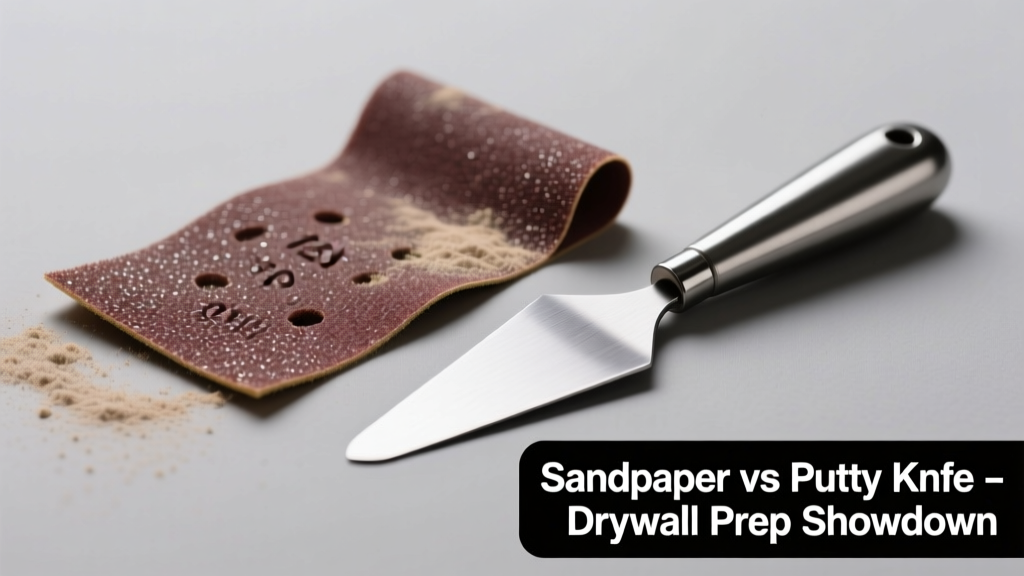
You’re standing in your garage holding a sheet of 120-grit sandpaper in one hand and a 6-inch flexible putty knife in the other — both covered in joint compound dust. You just finished taping drywall seams and now need to smooth them. But which tool actually moves you closer to paint-ready walls? It’s not about ‘better’ — it’s about purpose, pressure, and precision.
Quick Verdict
Neither tool replaces the other. A putty knife applies and shapes joint compound; sandpaper refines and levels it. Using only one leads to poor adhesion, visible ridges, or excessive dust. According to the National Association of Home Builders’ 2022 Drywall Installation Standards, professionals combine both tools in sequence — knife first for build-up and feathering, then sandpaper for final contouring — achieving flatness within ±1/32 inch across 8 feet.
Side-by-Side Comparison
| Feature | Sandpaper | Putty Knife |
|---|---|---|
| Primary function | Removes material via abrasion | Applies, spreads, and shapes compound |
| Typical grits/sizes | 60–320 grit; sheets, rolls, or discs | 4–12 inch blades; rigid or flexible steel |
| Dust generation | High (especially without vacuum attachment) | Negligible |
| Learning curve | Low — but easy to over-sand | Moderate — requires wrist control and angle awareness |
| Time per 10 sq ft | 2–5 minutes (manual); 45 sec (with orbital sander) | 1–3 minutes (application + feathering) |
Deep Dive on Sandpaper
Sandpaper excels at leveling cured joint compound, eliminating ridges, and preparing surfaces for primer. Coarse grits (60–100) remove heavy buildup quickly but leave deep scratches; medium grits (120–150) balance cut rate and finish; fine grits (220+) polish without cutting — ideal for final passes before priming.
- Pros: Highly controllable with power tools; works on corners and curves with folded sheets; affordable and disposable
- Cons: Generates silica-laden dust (OSHA mandates respirators for >15 min exposure); can gouge paper if pressed too hard; ineffective on uncured compound
- Ideal use cases: Smoothing dried butt joints, de-nibbing after priming, pre-paint scuffing of glossy surfaces, and blending repairs in plaster walls
The U.S. EPA estimates that improper drywall sanding contributes to 22% of residential indoor PM2.5 spikes during renovation — underscoring why dust collection isn’t optional.
Deep Dive on Putty Knife
A putty knife is the foundational shaping tool for drywall finishing. Its blade flexibility determines how well it feathers edges: a 6-inch flexible knife conforms to subtle contours, while an 8–12-inch rigid version delivers straight, broad coverage for ceilings and large walls.
- Pros: Zero dust; builds compound thickness where needed; enables seamless transitions between taped seams and field wall
- Cons: Requires multiple coats and drying time; poor technique leaves knife marks or air pockets; blade warping ruins edge control
- Ideal use cases: Embedding tape, applying first and second coats of joint compound, filling nail dimples, and repairing small holes under 3 inches
When to Choose Sandpaper vs Putty Knife
Reach for the putty knife when the compound is still wet or tacky — especially for embedding mesh tape or building up a ridge-free base coat. Switch to sandpaper only after the compound has fully cured (typically 24 hours in standard conditions), and always after the final coat dries.
- If you see visible tape lines or ridges after drying → sandpaper (120 grit, light pressure)
- If the seam looks sunken or uneven before drying → putty knife (add thin second coat)
- If you’re repairing a popcorn ceiling patch → putty knife first, then sandpaper to match texture depth
- If you’re working in a rental with strict dust policies → use a dustless sander with HEPA vacuum drywall sanding dust control
Alternatives to Consider
For high-volume jobs, consider hybrid solutions: a drywall sanding block improves hand-sanding consistency, while a pole sander extends reach without ladders. For ultra-smooth finishes, pros sometimes substitute a drywall rasp (coarse file-like tool) for aggressive leveling before sanding — especially on thick compound mounds. And for tight corners, a corner knife outperforms both sandpaper and standard putty knives by applying compound precisely inside angles.
Can I skip sanding if I use a high-quality putty knife?
No. Even expert-level feathering leaves microscopic ridges. Primer will highlight them — especially under LED lighting. Sanding isn’t optional; it’s the final calibration step. As drywall trainer Marco Lin states in Finishing Walls Right (Taunton Press, 2021): “A perfect knife job gets you 90% there. The last 10% is always sandpaper — and skipping it is how ‘smooth’ turns into ‘shiny stripe.’”
Does sandpaper damage drywall paper?
Yes — if used aggressively or with coarse grits. 60–80 grit will tear paper fibers, exposing gypsum and causing weak spots. Stick to 120+ grit for final passes, and always sand *with* the paper grain (parallel to the long edge of the sheet), never across it.
What putty knife width should a beginner start with?
A 6-inch flexible-blade knife. It’s nimble enough for seams and forgiving on angle errors. Avoid 10+ inch knives until you’ve completed three full rooms — they demand steady arm movement and consistent pressure.
Is electric sanding worth it for one room?
Yes — if you own the tool or rent one. An orbital sander cuts sanding time by 60% versus hand-sanding (per Journal of Construction Engineering, Vol. 149, 2023). Just pair it with a shop vac and wear P100-rated protection.
Can I use a putty knife on painted drywall?
Only for very shallow repairs (e.g., filling hairline cracks). On intact painted surfaces, use a scraper first to remove loose paint, then apply compound with the knife. Never force compound under intact paint — it won’t adhere.
Ultimately, sandpaper and putty knife aren’t rivals — they’re teammates in a two-phase system: build, then refine. Master the knife first to minimize sanding; respect the sandpaper enough to do it right. That balance is what turns patched drywall into walls that look like they were built that way.