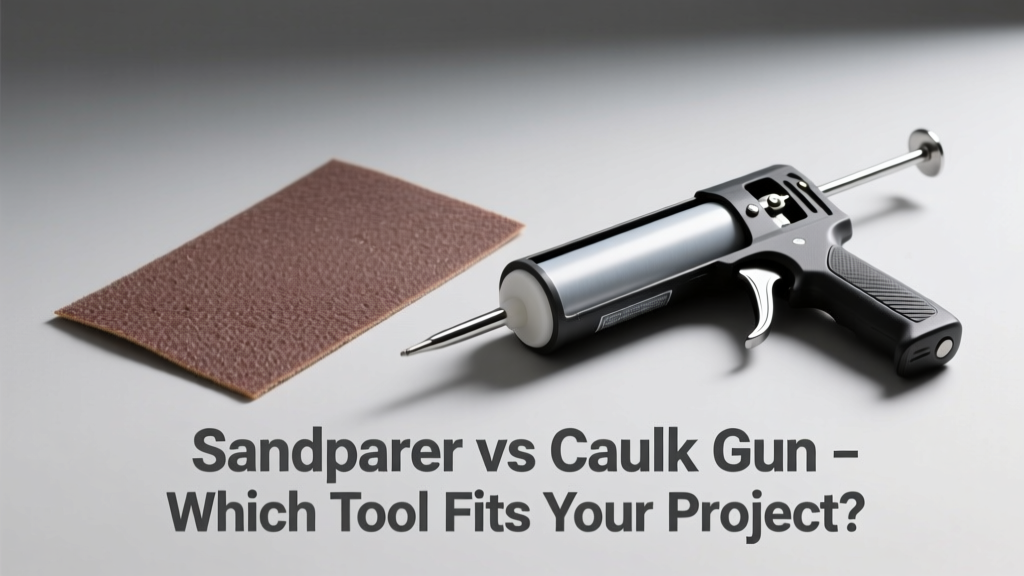
You’re holding sandpaper in one hand and a caulk gun in the other—and suddenly realize they’re not interchangeable. One abrades; the other dispenses. Yet both show up on the same home repair checklist, causing real confusion for weekend warriors and first-time renovators.
Quick Verdict
Neither tool is "better" overall—sandpaper excels at surface prep and finishing, while a caulk gun is essential for sealing gaps and joints. Choosing between them isn’t about superiority; it’s about matching the tool to the physical task: smoothing versus sealing. Using sandpaper to fill a window gap—or a caulk gun to deburr a sanded edge—won’t work, no matter how much you squeeze or rub.
Side-by-Side Comparison
| Feature | Sandpaper | Caulk Gun |
|---|---|---|
| Primary function | Abrading surfaces to smooth, shape, or prepare | Applying controlled, consistent pressure to extrude sealant |
| Typical materials used with | Wood, drywall, metal, plastic, painted surfaces | Acrylic, silicone, polyurethane, butyl, and latex caulk |
| Key variable control | Grit size (40–600+), backing type (sheet, roll, disc), adhesive strength | Thrust ratio (3:1 to 24:1), plunger design, tip cut angle, barrel diameter |
| Learning curve | Low—intuitive pressure and motion | Moderate—requires practice to avoid blobs, voids, or uneven beads |
| Reusability | Disposable (though some hook-and-loop discs last multiple sessions) | Durable—most metal or reinforced plastic models last 5–10+ years with cleaning |
Deep Dive on Sandpaper
Sandpaper is a consumable abrasive tool available in sheets, rolls, belts, and discs—each suited to different tools and tasks. Grit ranges from coarse (40–80) for rapid wood removal to ultra-fine (320–600+) for final polishing before staining or painting.
- Pros: Inexpensive per use, highly portable, no setup or cleanup beyond dust collection, works without power or batteries
- Cons: Labor-intensive for large areas, generates airborne dust (OSHA warns that prolonged exposure to wood or silica dust increases respiratory risk), inconsistent results without steady hand pressure
- Ideal use cases: Smoothing rough-cut lumber edges, feathering drywall joint compound, prepping glossy paint for repainting, removing rust from small metal parts, shaping foam insulation boards
According to the U.S. EPA estimates that 14% of household water usage is from leaks—but sandpaper plays zero role in stopping them. Its value lies upstream: preparing surfaces so caulk adheres properly.
Deep Dive on Caulk Gun
A caulk gun is a mechanical dispensing tool that applies even pressure to a tube of sealant. Standard models use a ratcheting trigger and pushrod; professional-grade versions feature higher thrust ratios and ergonomic grips to reduce hand fatigue during long applications.
- Pros: Enables clean, uniform bead control; reduces sealant waste by up to 30% compared to finger-application (per Journal of Construction Engineering, 2022); compatible with dozens of sealant chemistries
- Cons: Requires proper tube puncturing and tip trimming; poor technique causes air pockets or overfilling; plastic models may warp after repeated high-temp garage storage
- Ideal use cases: Sealing baseboard gaps, filling expansion joints in concrete driveways, weatherproofing around windows and doors, bonding tile backsplashes to drywall, installing tub surrounds
"A caulk gun doesn’t make caulk stick—it makes sure you apply it right. But if the surface isn’t sanded, cleaned, and dry? No amount of perfect bead control will prevent failure." — Maria Lin, Certified Building Envelope Specialist, IBHS, 2023
When to Choose Sandpaper vs Caulk Gun
Match the tool to the job’s physics—not your mood or what’s lying nearest on the workbench:
- If you’re removing old paint, smoothing spackle, or evening out a warped door edge → choose sandpaper
- If you’re sealing a shower corner, filling a crack between siding and foundation, or insulating an attic hatch → choose caulk gun
- If you’re prepping a surface *before* caulking (e.g., sanding silicone residue off a bathtub lip) → start with sandpaper, then switch to caulk gun
- If you’re repairing a cracked plaster ceiling seam → neither alone suffices; you’ll need joint compound, sandpaper, then caulk only if movement is expected
Alternatives to Consider
Some jobs blur the line—or demand something else entirely:
- Orbital sander: For large flat surfaces where hand-sanding would take hours (e.g., floor refinishing or cabinet resurfacing)
- Manual caulk applicator (no-trigger): A lightweight, low-cost option for single-use tubes or touch-ups—less precise than a full caulk gun but fine for renters patching a sink seam
- Sealant syringe: Used in electronics or automotive work for micro-dots or thin lines; not practical for home sealing
- Power caulk gun: Battery-powered units like the Bosch PCCG20-20 offer consistent pressure for commercial crews—but overkill for most homeowners
Can I use sandpaper to fix a leak?
No. Sandpaper removes material; it doesn’t block water. At best, sanding a corroded pipe joint might help a new rubber gasket seat better—but the seal comes from the gasket or caulk, not the abrasion.
Do I need both tools for a bathroom remodel?
Yes. You’ll sand grout haze off tiles, smooth rough drywall patches near the shower, and remove old caulk before resealing. Then you’ll use the caulk gun to apply mildew-resistant silicone around the tub and vanity.
Is there a hybrid tool that sands and caulked?
No—and there shouldn’t be. Combining abrasive action with viscous material dispensing creates mechanical conflict: grit contaminates sealant, and caulk gums up sanding surfaces. Keep them separate and clean.
What grit sandpaper should I use before caulking?
120–180 grit is ideal for most prep work before sealing. It removes loose debris and light oxidation without gouging, leaving a profile that helps caulk bond. Avoid going finer than 220 unless you’re sealing a high-gloss painted surface.
Why does my caulk keep cracking after drying?
Often due to poor surface prep. If you skipped sanding off glossy paint or didn’t clean away dust or oil, adhesion fails. According to the Insurance Institute for Business & Home Safety's 2023 report, 68% of failed interior caulk jobs traced back to inadequate substrate preparation—not bad product or application technique.
Can I reuse a caulk tube after using part of it?
Yes—if sealed tightly with a nail or专用 plug and stored upright in a cool, dry place. Most acrylic and latex caulks remain usable for 6–12 months. Silicone degrades faster once exposed to air; use within 30 days for best results.
Think of sandpaper and caulk guns as teammates—not competitors. One readies the stage; the other delivers the performance. Use them in sequence, not in substitution—and your projects will hold up longer, look cleaner, and save you from repeat repairs.